
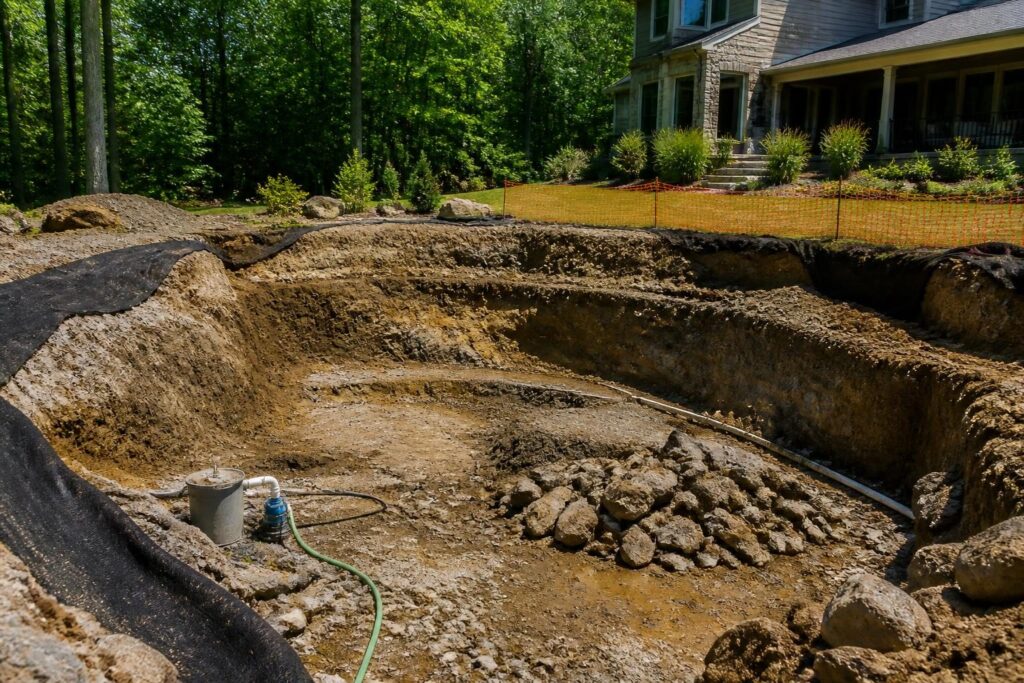
Before excavation begins, pool excavation rock groundwater allowance questions can help you understand what a proposal includes and what may become an extra charge. Rock, groundwater, unsuitable soil, pumping, hauling, and disposal can affect both the work and the written scope.

A proposal may describe the pool shell and equipment clearly while using broad language for difficult ground conditions. That language deserves careful review. Ask how the contractor will identify a changed condition, price it, obtain approval, and document the work.
North Carolina conditions vary by property and jurisdiction. Soil, slopes, drainage, groundwater, access, septic features, adopted requirements, and nearby structures can all affect excavation. General information cannot replace a site-specific review by the pool contractor or another qualified professional.
Why rock and groundwater allowances need attention
An allowance is a stated amount, quantity, or limited assumption for work that cannot be fully defined at the proposal stage. It is not always a fixed price. Its meaning depends on the written terms.
One proposal might include ordinary excavation but say little about hard rock, buried debris, wet soil, or water entering the excavation. Another might include limited pumping or hauling. Those offers may look similar until site conditions differ from the assumptions.
Rock can affect equipment, excavation methods, production, noise, access, and disposal. Groundwater may require temporary pumping or another water-management approach. Unsuitable soil may involve removal, replacement, stabilization, or additional review. Each item needs a defined path in the contract.
Read the allowance beside the exclusions, payment terms, schedule language, and change-order section. A favorable sentence in one part of the proposal may be limited by another section.
Pool excavation rock groundwater allowance questions for the proposal
Ask the contractor to explain each assumption in plain language. Request answers in the proposal, scope attachment, or another signed document. Verbal explanations can fade from memory or invite different interpretations later. These pool excavation rock groundwater allowance questions work best when the answers identify limits, measurements, and approval steps.
- What type of excavation does the base price include?
- Does “normal soil” have a stated meaning for this project?
- How does the proposal treat rock, boulders, concrete, buried foundations, roots, or other obstructions?
- Is rock removal priced by time, equipment, volume, disposal load, or another method?
- Does the scope include groundwater control, pumping, discharge, monitoring, and temporary equipment?
- What happens if the excavation becomes wet after rain or if water enters from below?
- How will the project team identify unsuitable or unstable soil?
- Does the base price include removing and replacing unsuitable material?
- Who decides that a condition falls outside the original scope?
- What records support an added charge?
These are discussion points, not engineering or code advice. If the site has unusual soil, a steep slope, nearby structures, or persistent groundwater, ask whether a surveyor, engineer, geotechnical professional, or other specialist should review the condition.
Define the work included in the base scope
A useful written scope should identify the excavation footprint and its assumptions. The documents may refer to pool dimensions, depth, steps, benches, over-excavation, working room, access, and material handling. Confirm that the description matches the current design.
Clarify whether the price includes loading, temporary stockpiling, hauling, disposal, and restoration. “Remove soil” may not explain where material goes or whether disposal fees are included. If you want suitable soil kept on site, record that decision before digging.
Ask how the contractor will handle material that cannot remain near the excavation. The answer may depend on access, local conditions, property layout, and material characteristics. Do not assume that all excavated material can go in a particular area.
Check quantities and measurement methods
Allowances become easier to compare when the measurement method is clear. The contract should explain whether a quantity means truckloads, hours, cubic yards, linear feet, or another unit. It should also state who measures the work and what documentation you receive.
Ask whether equipment mobilization is separate from excavation time. A rock hammer, specialty machine, pump, hauling vehicle, or treatment material may create different charges. The scope should say whether those costs are included, limited, or excluded.
Do not treat an allowance as a prediction of actual conditions. Treat it as a financial and procedural boundary that needs a clear definition.
Groundwater and pumping: identify the full process
Groundwater control involves more than placing a pump in a hole. Depending on site conditions, work may involve pumps, hoses, temporary power, discharge routing, monitoring, maintenance, and excavation protection. The qualified project team should select the site-specific approach.
Ask what the proposal means by “dewatering.” Does the term include only pumping during excavation? Will it include keeping the area workable during concrete or shell installation? Is a response after rain included? A short term can hide several tasks.
- When does pumping begin and end?
- Who supplies and operates the pump?
- Who provides power, fuel, hoses, and temporary protection?
- How will discharge avoid erosion or directing water toward the home?
- What happens if pumping continues overnight or between stages?
- What event triggers a change request?
- Are approvals or professional recommendations needed for discharge?
North Carolina land-disturbing work can involve erosion and sediment concerns. Review site controls and ask how the contractor will manage water and sediment. The NC DEQ Erosion and Sediment Control Manual is an authoritative resource, but local requirements still need confirmation.
For background, see questions about pool groundwater and hydrostatic pressure. That topic is separate from contract pricing, but it can help frame questions for the project team.
Unsuitable soil, instability, and material replacement
“Unsuitable soil” is not a universal homeowner term. It may refer to material that the project team considers too soft, wet, loose, organic, unstable, or otherwise unsuitable for a planned use. The contractor’s scope and, when needed, a qualified professional should define it.
Ask what happens if the excavation bottom differs from expectations. The written procedure might include notice, photographs, measurements, professional review, a proposed remedy, and approval before extra work starts. It should also explain whether urgent safety work can occur before a signature.
Potential responses may include removing material, placing approved replacement material, changing drainage measures, revising the design, or following a professional recommendation. Do not choose a remedy from a short conversation beside an open excavation.
Where a specialist recommends input, request the report, field note, drawing, or written direction that supports the proposed work. Keep it with the contract records.
Build a practical written change procedure
A change procedure should explain how unexpected conditions become approved work. It should not require a homeowner to decide quickly beside an open excavation without enough information.
- Notice: The contractor identifies the condition and describes its location.
- Evidence: The record includes photographs, measurements, delivery tickets, equipment records, or other support.
- Options: The contractor explains the proposed method and reasonable alternatives.
- Price: The document states the added or credited amount and pricing basis.
- Schedule: The parties record the expected effect on upcoming work without promising a completion date.
- Approval: Authorized parties approve the change under the contract.
- Closeout: The final record identifies the work completed and the documents produced.
Ask whether work may proceed before approval when delay could create a safety or property risk. If so, identify who can authorize urgent action and how the cost will be documented. Address rejected options and credits for work no longer required.
For a broader recordkeeping approach, review how homeowners can document excavation changes. Keep the excavation log, daily photographs, notices, approvals, invoices, and updated drawings together.
Compare proposals without guessing at risk
Use a comparison table rather than focusing only on the total price. List base excavation, rock treatment, groundwater control, unsuitable soil, disposal, restoration, access, and the change procedure separately. These pool excavation rock groundwater allowance questions help reveal differences in risk allocation.
| Scope item | Proposal language to find | Question to resolve |
|---|---|---|
| Rock | Included method, limit, or exclusion | How is extra work measured and approved? |
| Groundwater | Pumping or dewatering allowance | What equipment, discharge, and duration are included? |
| Unsuitable soil | Removal, replacement, or professional review | Who identifies the condition and selects the response? |
| Disposal | Hauling, stockpiling, fees, and restoration | What material leaves the property, and at whose cost? |
| Changes | Written notice, price, schedule, and approval | Can added work begin without written authorization? |
Also compare exclusions. One contractor may include ordinary pumping while another excludes all groundwater work. One may include a limited disposal allowance while another leaves disposal open. The difference is risk allocation, not necessarily a quality ranking.
For more detail, see the proposal allowances and exclusions checklist and the residential pool contract scope checklist.
Records to request before excavation continues
- Dated photographs showing the condition and location.
- A written description of the rock, water, soil, obstruction, or disposal issue.
- Measurements or quantities used for pricing.
- The equipment, labor, hauling, pumping, or material basis for the charge.
- Any professional recommendation or revised drawing.
- The effect on drainage, access, safety controls, and upcoming work.
- A signed change document or contract-approved authorization.
- Receipts, tickets, logs, and final quantities for completed extra work.
Photographs help, but they do not independently establish a soil condition, structural need, code requirement, or fair price. Keep them with the written explanation and professional documents.
Questions to settle before signing
Before approving the proposal, confirm who may authorize changes, where notices must go, and how quickly the contractor must respond. Ask whether email approval is valid and whether a field conversation counts as authorization.
Confirm the plan for utilities and site protection. North Carolina homeowners can review North Carolina 811 for official excavation-notification information. Utility marking does not resolve every private or site-specific line.
Finally, check whether the contractor’s qualifications and contract documents fit the work. Verify current licensing and records through the appropriate official source.
Good documentation does not eliminate unexpected excavation conditions. It gives you a clearer way to understand them, compare choices, and approve work described well enough to evaluate.
Because excavation, groundwater, drainage, disposal, structural support, electrical work, permits, and septic or well conditions can require specialized decisions, consult the local inspections department, licensed pool contractor, engineer, surveyor, septic professional, electrician, or another qualified specialist as appropriate. Confirm current North Carolina and local requirements before work begins.