
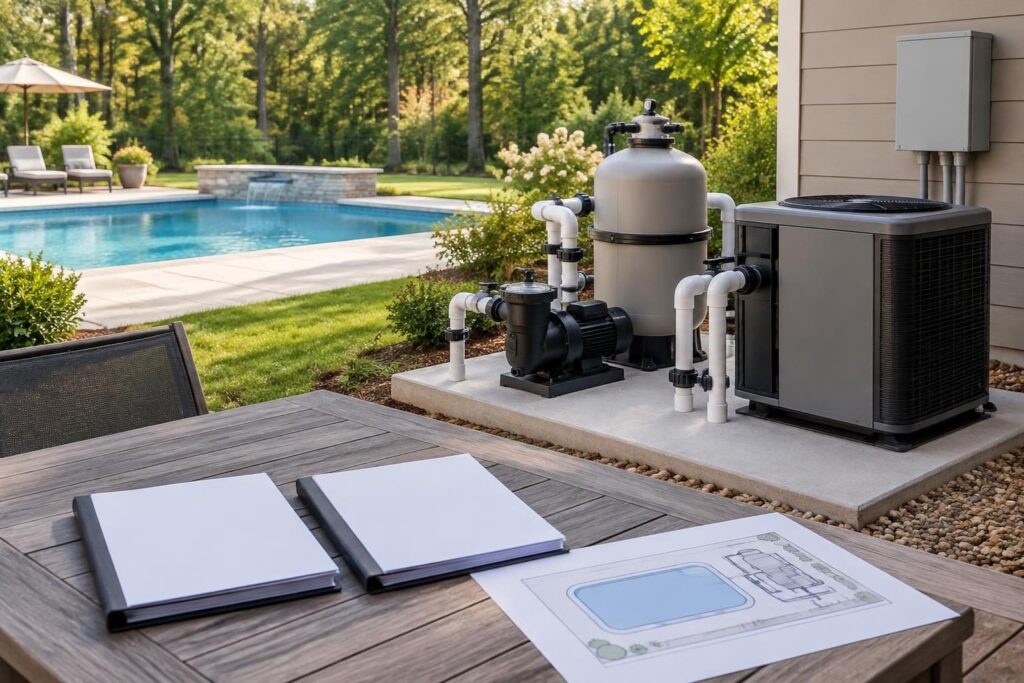
A pool equipment substitution approval checklist helps you evaluate a replacement before it changes your North Carolina pool project. A proposed pump, filter, heater, or controller may sound similar to the specified product. That does not establish equal performance, compatibility, service access, or warranty coverage.

Start with the original written commitment and the exact proposed replacement. Then request a comparison that identifies benefits, limitations, costs, and installation changes. Treat an undefined claim of equivalence as a question to resolve, not a basis for approval.
Establish what the original equipment scope includes
Find the signed contract, equipment schedule, approved drawings, and later revisions. An equipment schedule is the project’s list of products and specifications. Determine whether these records identify exact models or only broad descriptions.
If the scope says only “variable-speed pump” or “automation system,” clarify the intended features before comparing alternatives. Otherwise, both parties may judge equivalence against different expectations.
- Record the original manufacturer, full model number, and included accessories.
- Identify promised functions, such as spa control or remote scheduling.
- Separate included equipment from optional upgrades and budget allowances.
- Locate the contract’s substitution and approval procedure.
Ask the contractor to resolve conflicts between drawings and written specifications. Keep that clarification with your equipment product information and approval records.
Build a pool equipment substitution approval checklist around exact models
Request a dated substitution proposal before authorizing the affected purchase or installation. It should name both products and explain why the contractor recommends changing them.
Availability, installation preferences, and revised design needs deserve different follow-up questions. Ask what happens if you retain the original selection, including any documented cost or schedule effects.
| Comparison item | Evidence to request |
|---|---|
| Product identity | Full model numbers, accessories, and current product sheets |
| Performance | Ratings under comparable conditions and project-specific selection reasons |
| Compatibility | Installation manuals and written confirmation of supported connections |
| Installation effects | Revised pad layout, utility needs, and included labor |
| Ownership effects | Warranty terms, maintenance needs, and service availability |
Save the supporting documents, not just a sales-page screenshot. Model suffixes can distinguish product versions, so ask about any mismatch between the proposal and manufacturer documentation.
Compare performance under the same conditions
Similar headline ratings do not answer every performance question. Ask the pool designer or qualified contractor to explain how each product serves your actual system.
For pumps, compare expected flow at the system’s resistance. Resistance is the opposition to water movement through pipes, fittings, and equipment. A pump curve shows how flow changes with that resistance. Request the selection basis rather than comparing horsepower alone.
- Filters: Compare allowed flow, filtration area, cleaning method, and replacement media needs.
- Heaters: Compare heating output and efficiency under matching test conditions.
- Salt chlorine generators: Compare chlorine production, operating limits, and expected demand.
- Feature pumps: Confirm the intended operation of waterfalls, jets, or other features.
For pump energy claims, review ENERGY STAR’s pool pump information and verify the exact proposed model. Ask what operating schedule and utility rate support any savings estimate. An efficiency label does not establish whole-system suitability.
Verify plumbing compatibility and safety functions
A replacement may require different connections, flow limits, or equipment placement. Ask whether the substitution changes pipe routing, valves, sensors, or the order of components.
Have the responsible professional review interactions across the system. For example, a heater and chemical feeder each have installation instructions that the layout must address.
- Does the proposed equipment support each planned operating mode?
- Will plumbing changes affect flow through other components?
- Are adapters, valves, supports, and installation labor included?
- Who will review any effects on suction-system safety?
- Which drawings and testing records need updates?
Do not approve bypassed safety devices or improvised connections based on convenience. Request manufacturer instructions and qualified review when compatibility remains unclear. Homeowners should not calculate safe suction-system performance or modify safety controls themselves.
Check controls beyond basic on-and-off operation
Equipment can switch on successfully without delivering every promised control feature. Ask for a function-by-function comparison with your selected controller and other connected devices.
Distinguish basic switching from digital communication, which lets devices exchange commands and operating information. Brand names alone do not establish which functions work together.
- Can the controller change pump speeds and heater settings?
- Will schedules, alerts, and equipment status appear as planned?
- Are extra communication modules or software updates needed?
- Does remote access require a subscription or separate account?
- What remains available when internet service fails?
Add a demonstration plan to your pool equipment substitution approval checklist. List the functions the installer will show during startup. Obtain written compatibility confirmation from manufacturer documentation or technical support when the proposed combination is unclear.
Have electrical and utility changes reviewed before approval
A different model may have different electrical supply and protective-device requirements. Give the licensed electrician both models’ installation instructions before equipment is ordered or wiring is concealed.
Ask whether the change affects the circuit, disconnect, grounding, or bonding. Grounding and bonding are distinct electrical safety measures; leave their design and verification to qualified professionals. Gas-fired equipment also warrants review by the appropriate licensed trade.
North Carolina requirements can vary by jurisdiction, adopted code, property conditions, utilities, septic systems, flood zones, and project scope. Ask the local inspections department whether revised documents or additional inspections are needed. Do not assume the existing permit automatically covers every substitution.
Keep the reviewer’s findings with your electrical inspection preparation documents. Clarify who pays for revisions, utility coordination, inspections, and any required corrections.
Recheck equipment access and the pad layout
A product that fits on the pad may still be difficult to maintain. Compare the replacement’s installation dimensions and required service space against the actual layout.
Ask the contractor to mark access needs on a revised drawing. Review filter opening space, removable panels, heater airflow, valve access, and the route for future removal.
- Can a technician reach service connections without moving other equipment?
- Will fences, landscaping, or covers obstruct required clearances?
- Does changed equipment placement affect drainage or nearby walkways?
- Are mounting changes or pad modifications included?
Use the manufacturer’s instructions rather than assumed clearances. Review your future equipment replacement route before approving a larger or differently arranged model. Photograph the pad and connections before later work conceals them.
Compare warranty coverage and long-term ownership costs
The replacement’s purchase price is only one part of the decision. Request the written warranty for the exact model and intended purchase and installation arrangement.
Check whether coverage depends on registration, installer qualifications, purchase channel, or an equipment package. Do not assume a substitution preserves any package warranty discussed earlier.
- Which parts and labor does each warranty cover?
- Who handles diagnosis, travel charges, and warranty claims?
- When does coverage begin, and who completes registration?
- Are local providers willing and authorized to service the model?
- What do routine consumables and replacement components involve?
Independently contact the manufacturer or a prospective service provider about important claims. Verbal assurances may omit conditions that appear in written terms. Record who confirmed the information, when, and for which model.
Document the decision, price, and remaining conditions
Complete your pool equipment substitution approval checklist before signing the change order—a written revision to the project agreement. It should identify the accepted model, supporting documents, and every agreed scope effect.
Record any credit or added cost, installation work, schedule effect, and responsibility for unresolved questions. If the price remains unchanged, state that explicitly. Follow the contract’s approval procedure and retain a copy acknowledged by both parties.
Reluctance to identify models, inconsistent explanations, or pressure to pay before review warrants clarification. These signs do not prove wrongdoing. Ask for the missing evidence and a written explanation before authorizing the affected change.
The North Carolina Licensing Board’s home-improvement contract guidance provides additional consumer context. If approval or payment obligations are disputed, obtain legal advice rather than assuming you can change contract terms unilaterally.
Verify delivery, startup, and closeout
Approval is not the final verification step. Compare delivered model labels with the signed revision before installation. Photograph accessible labels and serial numbers without opening electrical enclosures or entering unsafe work areas.
At startup, request the agreed function demonstrations and qualified installation checks. Retain inspection results, correction records, manuals, warranty registration evidence, and updated drawings. Track incomplete work on a punch list with responsible parties and completion arrangements.
Keep the completed pool equipment substitution approval checklist in your handover file. Review payment milestones against the contract and documented completion, including outstanding records and corrections.
Consult the local inspections department about permit questions and a qualified pool contractor about equipment selection. Involve a licensed electrician, engineer, or other specialist when the substitution changes utilities, safety, or site design.