
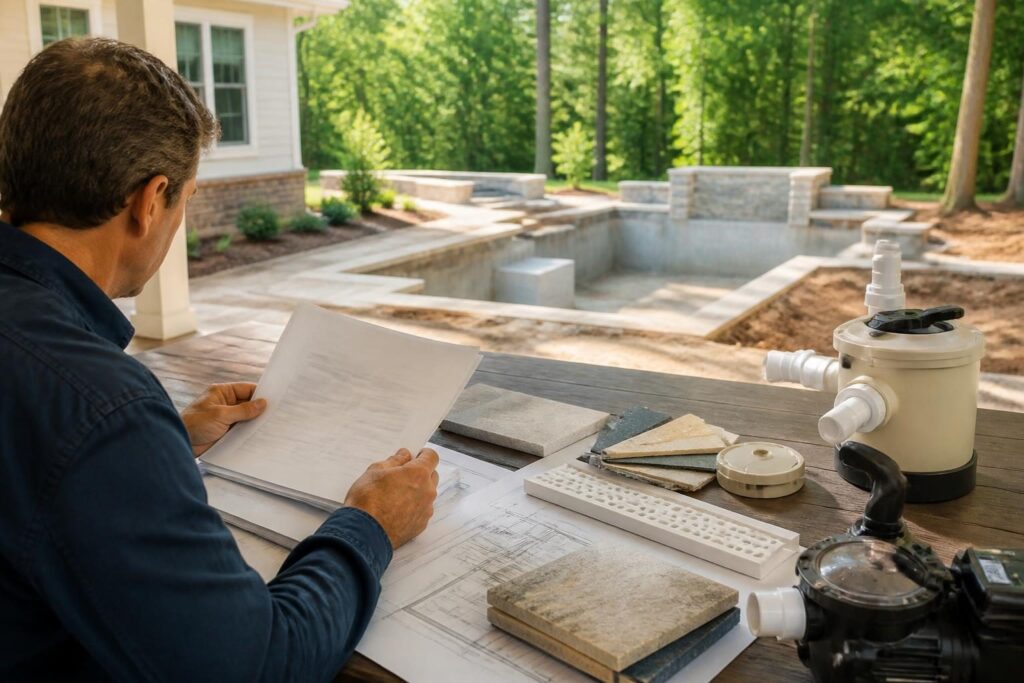
A residential pool construction contract scope checklist helps you turn a promising proposal into a specific written agreement. It should show what the contractor will provide, what the property owner must arrange, and how changes receive approval.

A clear scope does not remove every construction risk. Site conditions, weather, inspections, material availability, and design decisions can still affect the work. However, detailed writing gives everyone a better reference when questions arise.
Use this residential pool construction contract scope checklist alongside the proposal, drawings, selections, allowances, and exclusions. North Carolina requirements can vary by local jurisdiction, adopted code, property conditions, utilities, septic systems, flood zones, and project scope. Treat the contract as a project-control document, not a substitute for advice from the appropriate qualified professionals.
Start with a complete description of the pool
The contract should identify the pool being built, not merely describe it as an “in-ground pool.” Include the proposed location and reference the drawing set, specifications, and approved revisions. Each document should use consistent dimensions and labels.
Ask the contractor to describe the pool type, interior finish or liner, shape, dimensions, depths, stairs, benches, ledges, swim-outs, and water features. Elevations matter, too. The documents should explain how the pool relates to the existing yard, home, deck, and surrounding grade.
- Pool structure and construction method
- Interior finish, liner, tile, coping, and color selections
- Pool dimensions, depth transitions, steps, and built-in features
- Decking type, limits, layout, and finish
- Lighting, water features, cover provisions, and accessibility features
- Referenced drawings, specifications, and approved selections
Do not rely on a showroom image or a verbal description for a feature that affects cost or construction. If a drawing controls the scope, attach it or identify it by date, revision, and page number.
Use the contract to define materials and equipment
“Standard equipment” is too vague for many projects. The scope should identify equipment types, quantities, locations, major characteristics, and approved substitutions. It should also state whether installation, startup, programming, and owner instruction form part of the work.
For example, list the pump, filter, sanitizer system, heater, automation controls, lighting transformers, valves, plumbing components, and safety-related equipment. Brand names may help, but a model number or meaningful performance description can provide more clarity. Ask how substitutions will be presented and approved.
Energy use deserves a written discussion. Equipment selection affects operating routines, service access, and electrical needs. You can consult ENERGY STAR information about pool pumps when comparing certified equipment and efficiency considerations. That information does not replace a design review by the pool professional or electrician.
Confirm finish and selection responsibilities
List who selects colors, tile patterns, coping, decking, fixtures, and accessories. Include selection deadlines and the effect of late decisions. A finish allowance should state the included amount, product assumptions, and the process for choosing an item outside that allowance.
Keep signed selections with the contract. A product photograph alone may not identify size, texture, color variation, quantity, or installation method.
Separate included site work from exclusions
Site work often creates the largest gap between a broad proposal and a homeowner’s expectations. The written scope should describe access, layout, clearing, excavation, hauling, grading, drainage, utility coordination, and restoration.
Define the assumed access route and any protection for driveways, fences, trees, irrigation, buildings, and existing hardscape. State whether temporary fencing, material staging, erosion controls, dust control, and daily cleanup form part of the work. A related planning guide on pool construction site access protection can help you organize these questions.
Excavation language should address ordinary soil removal, rock, groundwater, buried debris, unsuitable soil, dewatering, spoils, and off-site disposal. Do not assume every condition is included. Ask how a changed condition will be documented before extra work starts.
Restoration should be equally specific. Identify the areas to restore and the expected standard for soil, grass, planting beds, irrigation, fencing, gates, walkways, driveways, and drainage features. “Leave property clean” does not explain what the finished yard should contain.
Make exclusions easy to find
Request a separate exclusions list. It may address permits, surveys, engineering, utility relocation, septic work, well-related work, electrical service upgrades, gas work, landscape design, tree removal, retaining structures, fencing, alarms, covers, water delivery, and unusual soil conditions.
An exclusion is not necessarily a problem. An unclear exclusion is the problem. The contract should identify who coordinates the item, who pays for it, and when it must be complete.
Address permits, inspections, and approvals
The contract should explain who prepares and submits permit materials, who pays application fees, who schedules inspections, and who responds to corrections. It should also state whether the contractor will provide documents needed by the local inspections department.
Requirements differ across North Carolina jurisdictions. Verify current requirements with the local inspections department before relying on a contract statement. The North Carolina Office of State Fire Marshal document library provides code documents and interpretations, but local officials remain the right source for project-specific confirmation.
Review the relationship between the contract and the approved plans. The scope should identify which document controls if a proposal, drawing, selection sheet, or later message conflicts with another document. You can also compare the contract against the site plan and construction plan before signing.
- Permit responsibility and fee responsibility
- Inspection scheduling and correction procedures
- Required barrier, electrical, drainage, and site documents
- Approval authority for drawings, selections, and substitutions
- Record of approved revisions and their effective dates
If an HOA, utility, lender, or other reviewing body is involved, state whether its approval is a homeowner responsibility or part of the contractor’s work.
Define approval procedures before construction begins
A good contract explains how decisions move from discussion to authorization. Set out the method for approving selections, design changes, substitutions, allowances, added work, and schedule adjustments.
Written approval may use a signed change order, an agreed electronic form, or another clearly defined process. The record should show the requested change, reason, revised drawing or specification, price effect, schedule effect, payment timing, and signatures or other accepted approvals.
Do not assume that a text message, field conversation, or invoice fully describes a change. Before work proceeds, ask who has authority to approve it and whether approval is required before ordering materials or altering the site.
For a focused recordkeeping format, review this pool construction change order checklist. It covers the information that helps connect a requested change to the final project file.
Connect payments to defined work and records
Payment milestones should match identifiable work, not vague calendar dates alone. The contract should state the amount or calculation, what work supports the payment, and which documents or approvals you should receive at that stage.
For example, a milestone might relate to an approved material order, a completed construction phase, an inspection point, or a documented installation. Avoid inventing a payment schedule from another project. Ask the contractor to explain the proposed schedule for this property and scope.
Also clarify deposits, allowances, taxes, permit fees, financing charges, retainage if applicable, and the treatment of credits. The North Carolina Licensing Board’s home-improvement contract guidance offers consumer information about contracts, references, payments, and changes. Confirm current applicability for your project and circumstances.
Require a useful handover and project record
The final scope should say what the homeowner receives at completion. These records help with operation, maintenance, future service, insurance discussions, and later property questions.
- Final approved plans and recorded design revisions
- Equipment schedules, model information, and installation records
- Operating instructions, manuals, labels, and programming details
- Inspection records and permit closeout information, when applicable
- Warranty documents, exclusions, registration steps, and contact procedures
- Maintenance instructions, startup information, and recommended service intervals
- Photos or diagrams showing concealed plumbing, wiring, valves, and equipment locations
- Records of restoration work, unresolved items, and completion approvals
Ask when each record will arrive. “At completion” can mean different things unless the contract defines the handover point. This residential pool construction contract scope checklist should identify the records before construction begins.
Questions to ask before signing
Read the scope with the drawings, selections, allowances, exclusions, and payment schedule open at the same time. Use the residential pool construction contract scope checklist to look for conflicts rather than reading each page in isolation.
- Which exact documents form the complete agreement?
- What work is assumed but not included?
- Which site conditions trigger a written price or schedule change?
- Who obtains each permit, approval, inspection, and utility coordination item?
- What must the homeowner select, supply, protect, or remove?
- How will substitutions and design changes receive approval?
- Which restoration standard applies to the yard and access route?
- Which records will you receive, and when?
- How will the parties resolve a conflict among the proposal, drawing, selection, and contract?
Save the signed contract and every attachment in one dated project folder. Keep approval messages, receipts, selections, inspection records, photographs, and change documents together.
Final review before you approve the scope
A strong contract scope gives you a shared map of the project. It describes the finished pool, the work around it, the limits of the price, and the records that support handover. It also creates a clear path for decisions when conditions or preferences change.
Build a Pool in North Carolina can help homeowners organize questions before a contract review. For permit, barrier, electrical, septic, drainage, excavation, survey, or structural concerns, consult the local inspections department and the appropriate licensed pool contractor, electrician, engineer, surveyor, septic professional, or other qualified specialist.