
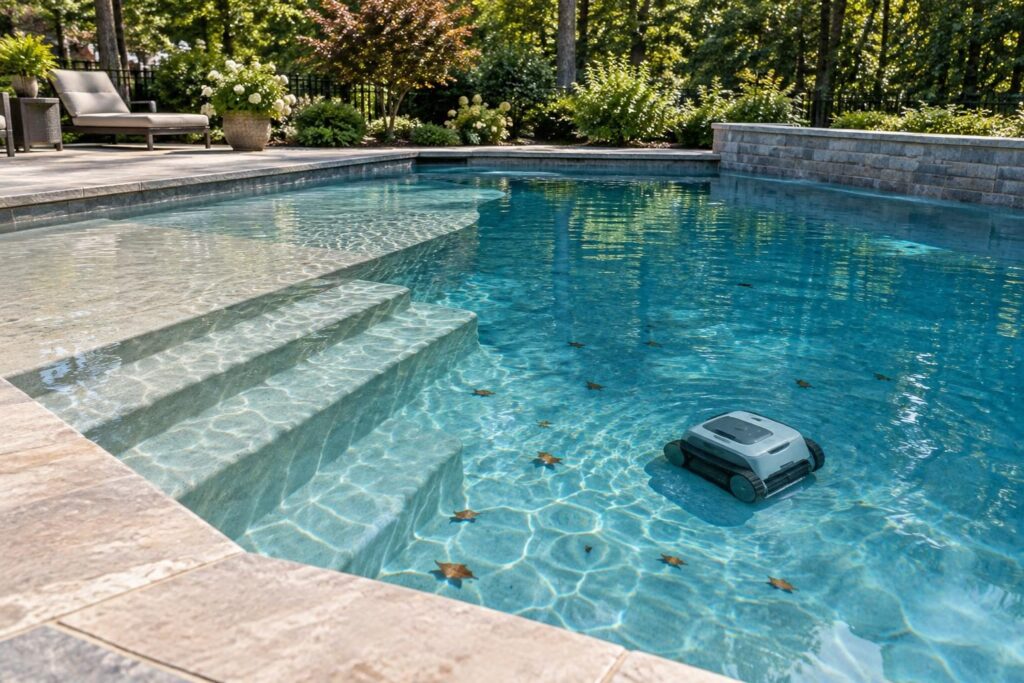
Checking robotic pool cleaner compatibility with steps means looking beyond a wall-climbing claim. A cleaner may travel up a wall yet miss stair treads, shallow shelves, or tight corners. For North Carolina homeowners, the useful question is specific: will this exact model clean your pool’s hardest areas?
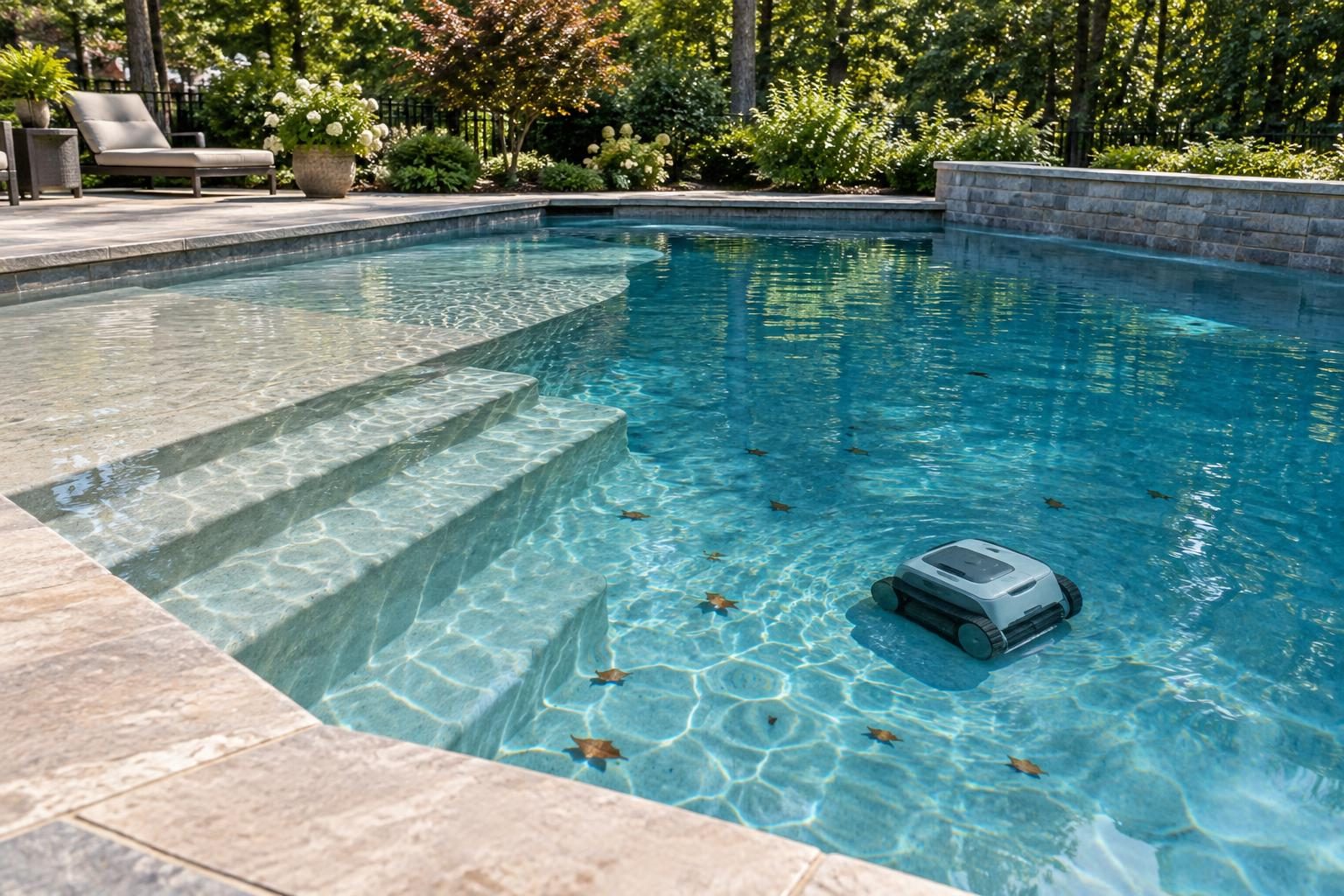
Start with the operating manual, your pool’s dimensions, and a realistic demonstration when available. Compare the work left behind, not just the features advertised. A robot can still be a good purchase when you understand which areas require manual cleaning.
Separate wall climbing from step and ledge coverage
Floor cleaning, wall climbing, and waterline scrubbing describe different tasks. None automatically establishes stair or tanning-ledge coverage. A tanning ledge is a broad, shallow shelf intended for lounging.
Stairs create several challenges: narrow standing surfaces, vertical faces, and abrupt transitions. A cleaner must reach each surface, remain supported, and collect debris there. Brief contact with a step does not demonstrate effective cleaning.
Ask the seller to distinguish between these claims:
- The cleaner can reach an area.
- Its brushes contact that area.
- It removes debris from that area.
- It repeats that coverage during ordinary cleaning cycles.
Have the seller identify the manual section supporting each important claim. If the manual says nothing about stairs, request written clarification from the manufacturer. Silence is not a coverage guarantee.
Map your pool’s shape before comparing models
Create a simple sketch showing steps, benches, shelves, slopes, and the deepest floor area. Record actual water depths over shallow features at your normal operating water level. Add step widths and any narrow passages.
Use existing drawings where reliable, but check whether construction changes affected the finished pool. Photographs from the deck can help a dealer understand unusual transitions. Do not enter an unsafe area to collect measurements.
- Where does the floor change slope?
- Do curved corners or raised features interrupt travel?
- Are handrails, ladders, or ledge furniture potential obstacles?
- Can the cleaner reach separate floor areas without assistance?
- Does the manual specify minimum operating depth or shape restrictions?
Pool length alone cannot answer these questions. Send the sketch to the seller and retain their model-specific response. For broader comparisons, review these pool cleaning system options before narrowing your shortlist.
Verify shallow ledges, slopes, and surface compatibility
A shallow ledge may not provide the operating depth a particular robot requires. Its edge may also prevent access from the main pool. Ask whether the model can enter, clean, and leave the shelf without intervention.
Do not place a cleaner onto a shallow shelf unless the manufacturer permits that use. Confirm whether any claimed shelf performance depends on a particular water depth or operating mode.
Surface approval matters separately from geometry. Identify your actual finish: vinyl liner, fiberglass, plaster, exposed aggregate, tile, or a combination. Then verify approved brushes, tracks, and settings for that finish.
Ask whether slopes, slippery surfaces, or textured finishes affect the manufacturer’s coverage claims. For newly installed or resurfaced pools, obtain startup restrictions from the finish provider and cleaner manufacturer. A general “all pools” description is not enough to resolve conflicting care instructions.
Match the filter and intake to your debris
List what you routinely remove: leaves, pine needles, insects, fine sediment, or settled pollen. North Carolina yards differ, so compare models against your own debris rather than a generic demonstration.
The intake is the opening through which debris enters. The cleaner’s internal filter holds collected material. Ask how the model handles bulky debris and whether finer filter inserts are included or sold separately.
- Can needles or leaves obstruct the intake?
- Which filter is recommended for fine settled debris?
- How does filter loading affect a cleaning cycle?
- Can you inspect and rinse every filter surface easily?
- What replacement filters are available, and through whom?
A floor-cleaning robot does not replace surface skimming, water testing, or sanitizer management. Compare recurring debris with your tree canopy and leaf-load plan. Preventing avoidable debris can matter as much as cleaner selection.
Use a demonstration to test coverage, not motion
The strongest practical check of robotic pool cleaner compatibility with steps is a permitted trial in your own pool. A demonstration elsewhere is useful only when its geometry and finish resemble yours.
Agree on the demonstration conditions beforehand. Record the exact model, filter, cleaning mode, water level, and starting debris. Follow all operating instructions, including restrictions on swimmers during use.
- Photograph the stairs, ledge, slope transitions, and floor before the cycle.
- Observe from a safe deck position without redirecting the cleaner.
- Note stalls, missed areas, and any assistance provided.
- Photograph the same locations afterward.
- Inspect collected debris and discuss what remains.
Watch for a cleaner that crosses a shelf but leaves its debris untouched. One successful pass also does not establish consistent coverage. Ask whether further trial cycles are allowed under the purchase terms. If no demonstration is available, weigh that uncertainty against the written return policy.
Try retrieval, filter access, and cable handling
Daily handling can determine whether an otherwise capable cleaner suits your household. Ask to see the approved retrieval process. Confirm the designated lifting handle and whether a retrieval hook or other accessory is required.
Do not assume the cable serves as a lifting line. Follow the model’s retrieval instructions, including shutdown and draining before lifting. Evaluate the reach from your deck without leaning over the water.
Check these practical details before buying:
- Can you manage the cleaner during approved retrieval?
- Does filter access require awkward lifting or turning?
- Can you release the latches comfortably?
- Where will the cleaner drain, dry, and remain stored?
- How must a corded model’s cable be deployed and stored?
- How is a cordless model recovered when its battery runs low?
Ask whether cable routing reaches the whole pool without crossing essential walkways. Keep equipment and storage carts from interfering with gates or creating climbing access near barriers.
Confirm the manufacturer-specified power arrangement
Corded and battery-powered models have different power and charging instructions. Neither label alone establishes a safe arrangement for your property. Obtain the manual for the exact model before choosing its operating or charging location.
Ask about the supplied power unit, approved receptacle, placement, weather exposure, and cable routing. Verify instructions addressing extension cords, adapters, and ground-fault circuit-interrupter protection, commonly called GFCI. GFCI protection helps reduce electric-shock risk; it does not make an unsuitable setup acceptable.
For battery models, confirm charging-location restrictions, drying instructions, temperature limits, and battery service procedures. Never improvise a charger or bypass a protective device.
Have a licensed electrician assess an uncertain arrangement or proposed electrical work. North Carolina requirements can vary with jurisdiction, adopted code, property conditions, and project scope. Verify permit and inspection needs locally.
Cleaning equipment does not replace supervision or barriers. Review Pool Safely’s safety tips when organizing cleaning and storage routines.
Put model promises and purchase terms in writing
Document robotic pool cleaner compatibility with steps alongside the limitations you accept. Keep the model number, manual version, included accessories, filter options, and written manufacturer responses.
If a builder includes the cleaner, require the exact model in the equipment schedule. Avoid a vague allowance that leaves capabilities undecided. Review any proposed replacement using an equipment substitution approval checklist before authorizing it.
Clarify these terms before payment:
- Whether an in-water trial affects return eligibility.
- Any return shipping or restocking obligations.
- Warranty coverage, exclusions, and authorized service arrangements.
- Who handles an initial performance complaint.
- Whether promised demonstrations or accessories remain outstanding.
Conflicting explanations or reluctance to document coverage warrant follow-up, not an automatic accusation. Request the supporting manual passage or manufacturer confirmation. Keep emails, demonstration photos, invoices, and service records together.
Choose based on the cleaning work that remains
Decide how much manual brushing and vacuuming you are willing to keep doing. A model that cleans the main floor reliably may suit you despite missing narrow steps. Another household may reasonably reject that tradeoff.
Judge robotic pool cleaner compatibility with steps by supported capabilities, observed results, and manageable limitations. Do not pay extra for a feature name without understanding what it delivers in your pool.
Consult the manufacturer or a qualified pool service professional about unresolved coverage and finish questions. Use a licensed electrician for power concerns. Contact your local inspections department before electrical or equipment changes that may require approval.