
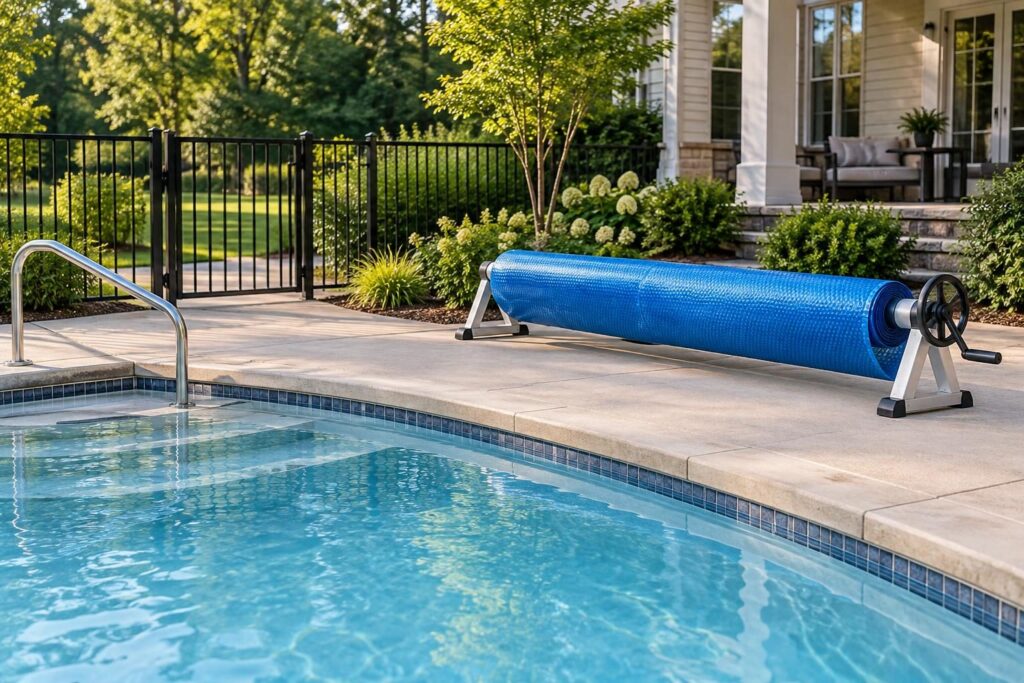
Good solar pool blanket reel placement planning starts with where the equipment will sit—not which reel looks easiest to crank. A reel winds a floating solar blanket onto a horizontal tube. The right setup must fit your pool, your handling abilities, and the routes people use around the water.
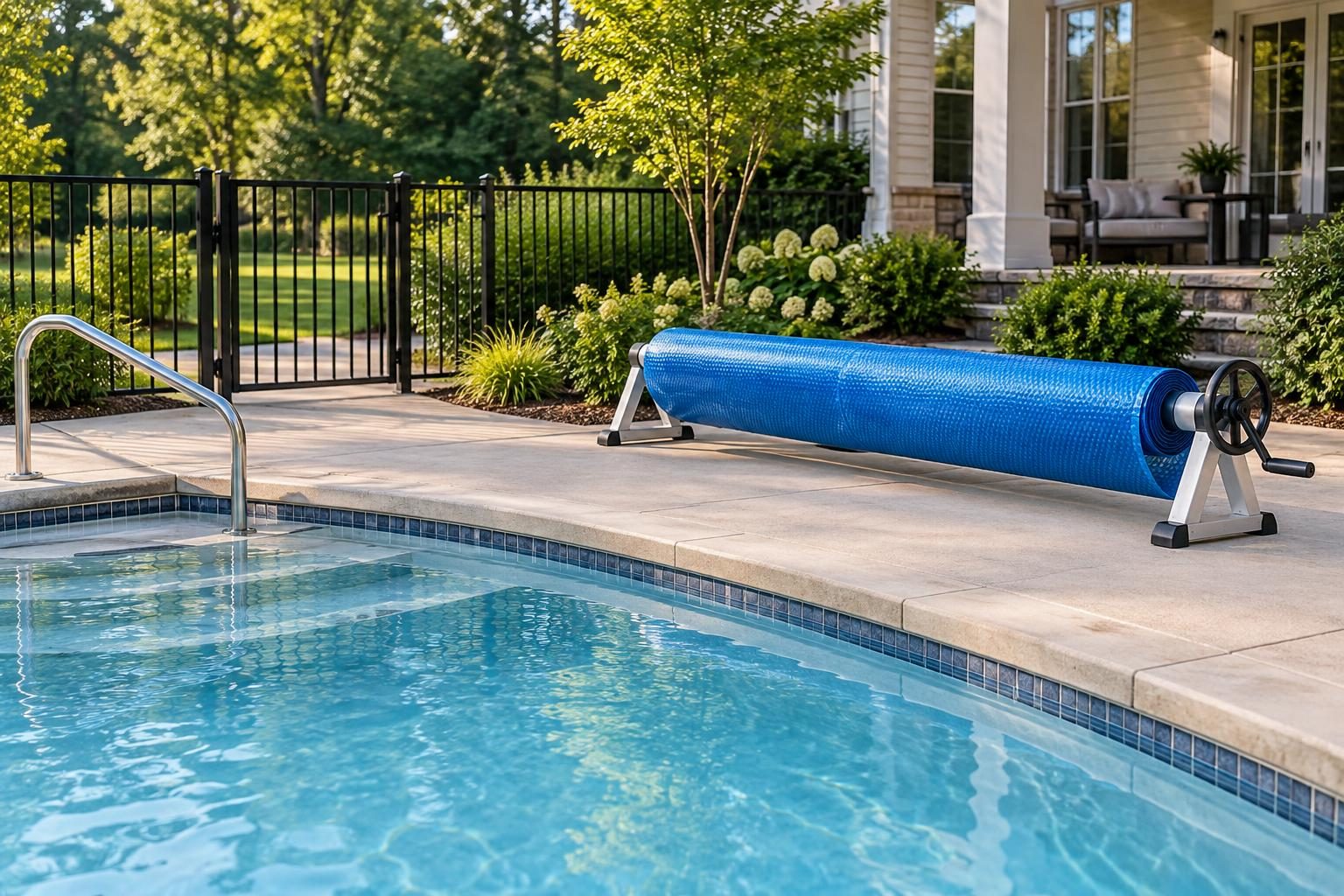
Before buying, compare the reel in three conditions: deployed, loaded with the rolled blanket, and parked during swimming. Include off-season storage in your solar pool blanket reel placement planning. A convenient operating location may become an awkward obstacle once the pool opens for use.
Start with safety, not storage convenience
A solar blanket is not a safety cover. It does not provide a dependable barrier against entry and can create an entrapment hazard. Never allow anyone to walk, sit, or play on it. Remove the entire blanket before anyone enters the pool; do not leave part floating beside swimmers.
The reel also needs a safety review. Neither its frame nor the rolled blanket should block gates, pedestrian circulation routes, rescue equipment, or views needed for supervision. Keep it from becoming a climbing aid near a barrier.
The CPSC residential pool barrier guidelines explain why solar covers cannot substitute for safety barriers. For a separate protective cover, review pool safety cover selection considerations.
North Carolina requirements can vary with jurisdiction, adopted code, property conditions, utilities, septic systems, flood zones, and project scope. Verify barrier clearances and any installation requirements with your local inspections department. A retailer’s placement suggestion does not establish local compliance.
Map the reel’s operating and parked locations
Draw a simple overhead plan showing the water’s edge, gates, steps, handrails, furniture, drains, and storage doors. Mark the proposed reel tube, supports, handle, and movement route. Use the manufacturer’s full assembled dimensions rather than the advertised blanket width.
For solar pool blanket reel placement planning, the loaded reel matters as much as the empty frame. Ask for the rolled blanket’s expected size with your selected material. Include room for hands, cranking, turning, and any required helpers.
- Can every gate open and close normally in each reel position?
- Can someone reach the pool steps without stepping over supports or straps?
- Does the loaded reel hide water from the usual supervision position?
- Can rescue equipment and service workers pass without moving it first?
- Will moving the reel require backing toward the water?
Mark candidate footprints temporarily when the pool is not in use, then walk the routes. Remove the markers afterward. Use this emergency access route planning guide to review more than everyday foot traffic.
Compare practical reel placement options
No location works for every pool. Compare the operational benefit against what that location takes away.
- Across a straight pool end: This may offer a direct winding path for a rectangular blanket. Check whether supports or the loaded roll interfere with steps, ladders, or seating.
- At a wider section of a shaped pool: This may suit some manufacturer-approved arrangements. Ask how curved edges and projecting sections will feed without bunching.
- Mobile reel with separate parking: This can free the pool end during swimming. It requires a usable travel route, suitable wheels, and a stable parking location.
- Fixed or swing-away installation: This may reduce routine repositioning. It introduces mounting, support, and clearance questions that need professional review.
Side parking is not the same as side operation. Do not assume a reel stored along a long edge can wind the blanket from there.
If every option obstructs access, reconsider the product or layout. Do not treat moving furniture before every swim as proof of a workable plan.
Check pool-shape and blanket compatibility
Pool width alone does not establish compatibility. The reel must suit the blanket’s dimensions, material, attachment method, and intended winding arrangement. Ask the seller to identify the exact tube assembly and its approved operating range.
Freeform pools, tanning ledges, projecting steps, and raised features deserve a layout-specific review. An irregular blanket may need guidance while winding. A proposed multi-piece blanket adds handling and storage tasks that should be explained before purchase.
- Which edge attaches to the reel, and where do the straps connect?
- How will ledge extensions or curved sections pass through the winding path?
- Must any handrail or ladder be accommodated without removing safety equipment?
- Does trimming affect return eligibility or warranty coverage?
- Who verifies the final fit before irreversible cutting?
Send a dimensioned sketch and photographs to the supplier. Request written compatibility confirmation for the actual model. A general claim that a reel suits freeform pools is not a review of your pool.
Evaluate handling effort before choosing features
A reel reduces folding, but it does not eliminate every handling task. Someone still needs to attach, guide, deploy, secure, and sometimes move the blanket. Wet material and collected debris can make those tasks harder.
Ask for a demonstration using a comparable blanket, not only an empty reel. Check handle reach and whether the operator can remain stable without leaning over the water. Keep hands away from winding and pinch points.
Compare manual and powered models by the whole routine. Powered winding may reduce cranking, but it does not automatically solve deployment, alignment, or parking. Have a licensed electrician review any model’s electrical installation needs before purchase.
- Does the manufacturer call for one operator or additional help?
- Can the intended user move the loaded reel over the actual deck surface?
- Are wheel locks or other approved restraints included?
- Can the blanket be deployed without dragging it across abrasive surfaces?
If the routine needs more strength or help than your household can reliably provide, choose another arrangement.
Account for wind and off-season storage
Observe the proposed operating and parking areas during ordinary breezy conditions. Wind can complicate blanket handling and affect loose material. Do not test a setup during dangerous weather or chase a loose blanket into the pool.
Ask the manufacturer how to secure the loaded reel and when to stop using it. Do not improvise with loose weights, straps across walkways, or attachments to gates. For broader site choices, consider windbreak placement around a pool without compromising barriers or visibility.
Plan the seasonal storage route before delivery. Check door openings, turns, floor space, and whether approved disassembly requires tools or another person.
- Follow the blanket maker’s cleaning, drying, and storage instructions.
- Verify whether the rolled blanket needs its specified protective cover during outdoor storage.
- Keep equipment separate from pool chemicals and protected from pests and sharp objects.
- Label removable hardware and retain the assembly instructions.
Do not assume a storage cover makes a reel storm-ready or suitable for permanent outdoor exposure.
Put the selected setup in writing
Turn solar pool blanket reel placement planning into a clear purchase specification. List the reel model, tube assembly, blanket material, attachment kit, wheels, protective cover, and any mounting hardware.
Request a written total that identifies delivery, assembly, trimming, installation, and demonstration charges. Record exclusions and any allowance—an estimated amount reserved for an item not yet fully selected. Compare warranty responsibilities for the blanket, reel, and installation separately.
For contractor-installed equipment, approve location drawings and changes in writing. Before drilling or anchoring, have the installer verify the deck’s suitability and concealed utilities or pool systems. Photograph installation work before anything becomes concealed.
Vague compatibility claims, undocumented substitutions, and requests for payment before agreed milestones deserve follow-up. They do not prove wrongdoing. Ask for supporting documents and reconcile the invoice with the contract before authorizing the next step.
Verify the full routine at handover
Have the installer demonstrate removal, parking, redeployment, and storage preparation with the supplied blanket. Confirm that gates work and supervision views remain clear in every position. Keep swimmers out during the demonstration.
Retain the receipt, model information, manuals, warranty terms, approved layout, photographs, and written communications. List missing parts or unresolved handling problems on a punch list—a written record of unfinished items. Obtain correction records and any required inspection documentation before accepting closeout as complete.
Consult your local inspections department about barrier or permit questions. Use a qualified, appropriately licensed pool contractor for installation review, an electrician for electrical needs, and an engineer for uncertain structural supports. Resolve those questions before drilling, paying for changes, or putting the reel into service.