
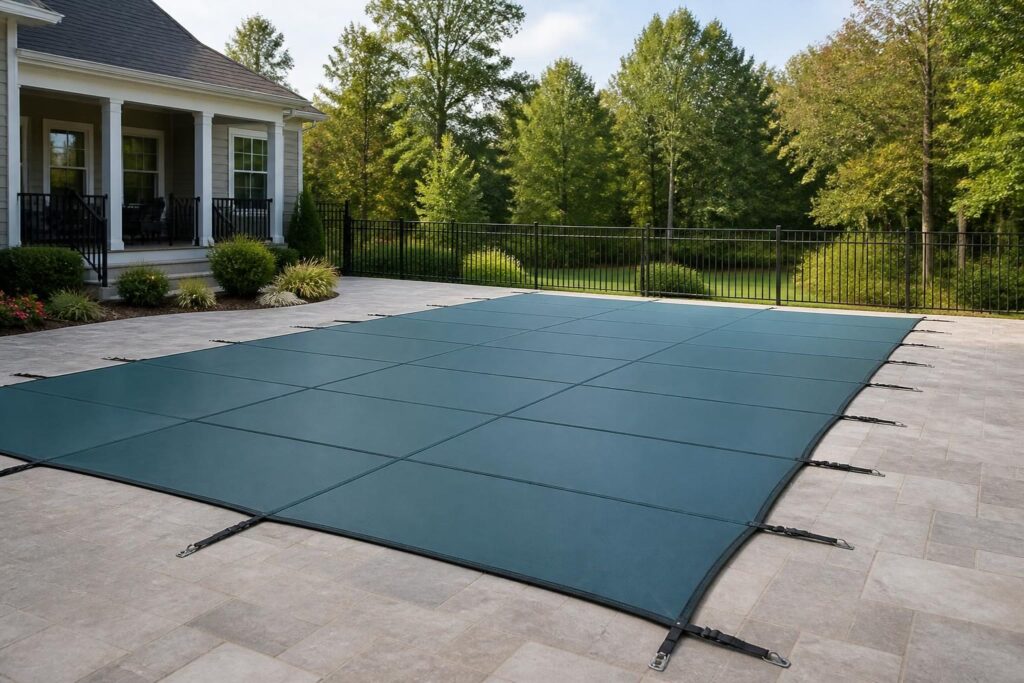
Pool safety cover planning North Carolina homeowners undertake should compare more than fabric, color, or catalog price. A cover must fit the pool, work with the deck and surrounding barriers, and remain practical for daily use. It also needs a clear inspection and storage routine.

A safety cover is one layer of protection. It does not replace active supervision, a suitable barrier, a secure gate, or other precautions that fit your household. The U.S. Consumer Product Safety Commission’s Pool Safely guidance describes layers of protection around pools and spas.
North Carolina requirements can vary by jurisdiction, property conditions, adopted codes, and project scope. Before selecting a product, ask the local inspections department and a qualified pool professional how the proposed cover fits the approved pool plan and local requirements.
Start with the cover’s role in your safety plan
First, define what you expect the cover to do. Some homeowners want a barrier when the pool is closed. Others also want help reducing leaves, evaporation, or heat loss. Those goals can point toward different products and operating habits.
Do not treat a cover as a substitute for a fence or other required protection. A cover may sit open while people swim, remain partly installed during maintenance, or become unavailable during repair. Your plan should still protect the pool during those periods.
Questions to answer before comparing products
- Who will open and close the cover?
- How often will the pool be used?
- Will children, guests, or pets have access to the yard?
- Can the cover be secured every time the pool is unattended?
- Where will equipment, keys, remotes, and removable parts be stored?
- What happens if wind, rain, debris, or a power interruption affects operation?
These answers matter because a sophisticated cover still depends on consistent use. A product that is difficult to operate may not support the routine your household can maintain.
Compare manual and automatic safety covers
Manual covers usually require a person to position, tension, and remove the cover. They may use straps, springs, anchors, or a roller. Their operation can be straightforward, but the homeowner must handle the cover correctly each time.
Automatic covers use a motorized mechanism. Depending on the design, the mechanism may sit at the pool end, hide below the deck, or fit into a cover housing. The proposal should explain service access, control location, power requirements, and the response to a power failure.
Neither category automatically offers the better choice. Compare the full routine, including cleaning, adjustment, storage, repairs, and seasonal use. Ask the installer to demonstrate the system with the pool in its actual finished condition.
Comparison points for a written proposal
- Cover material, construction, and intended use.
- Pool shape, steps, benches, raised walls, and attached features.
- Required deck area and the location of anchors or housing.
- Method for opening, closing, tensioning, and securing the cover.
- Controls, electrical connections, and emergency or manual operation.
- Routine cleaning and inspection responsibilities.
- Manufacturer documents, service contacts, and warranty limitations.
Ask which parts come as standard and which parts count as allowances or exclusions. A proposal that states “cover included” may not describe deck preparation, anchor installation, electrical work, drainage changes, or finish repairs. The scope should identify those items in writing.
For broader proposal comparisons, review the checklist in Pool Construction Allowances and Exclusions. The same habit helps expose missing cover-related work.
Review fit, shape, and poolside obstacles
Fit is central to pool safety cover planning North Carolina homeowners should complete before ordering. The cover must match the measured pool and account for features that affect its travel, tension, or contact with the deck.
Ask who will measure the pool and when the measurement will occur. A design drawing may not show every field condition. Coping edges, skimmers, ladders, handrails, water features, raised bond beams, and unusual corners can affect the final fit.
Features that deserve a detailed review
- Freeform curves, angled corners, and changing pool widths.
- Integrated or attached steps and shallow ledges.
- Raised spas, spillways, walls, and deck transitions.
- Removable ladders, rails, diving equipment, or slides.
- Drainage paths that could carry water toward the cover or pool.
- Deck surfaces that may interfere with anchors or operating equipment.
Request a scaled cover drawing or measurement record. Keep photographs of the finished deck, anchor locations, controls, and removable components. These records can help with future service and replacement decisions.
If the cover forms part of new construction, coordinate it before deck work ends. The residential pool construction phases checklist can help homeowners track when safety-related decisions need confirmation.
Understand anchors, deck conditions, and water loads
Many covers rely on anchors installed in the deck around the pool. Anchor type, spacing, embedment, and placement depend on the cover system and deck construction. A homeowner should not select or modify these details without the installer’s instructions and, when needed, qualified design input.
Ask whether the existing or planned deck can accept the proposed anchors. Cracked, deteriorated, unusually thin, or uneven surfaces may require evaluation. The installer should explain how the crew will install anchors without damaging concealed utilities, reinforcement, plumbing, or electrical components.
Water can collect on a closed cover. That creates weight and may affect operation, drainage, and safe removal. Ask how the design handles rainwater and what the homeowner should do after heavy weather. Do not walk on a cover unless the manufacturer specifically allows it and designs the product for that purpose.
Records to request and keep
- Final cover measurements and a product identification record.
- Anchor layout, installation instructions, and deck preparation notes.
- Operating instructions for normal and emergency conditions.
- Electrical information for an automatic system.
- Cleaning, tension, drainage, and storage instructions.
- Warranty terms, exclusions, and service procedures.
- Photographs taken after installation and deck completion.
If a cover changes the approved barrier arrangement, ask the local authority whether revised drawings or an inspection are needed. The pool permit inspection records guide explains why homeowners should retain approved plans and final records.
Compare operation, controls, and everyday access
A cover only helps when people use it correctly. During the demonstration, operate it from the normal control point. Watch how the cover moves, where people stand, and whether the system stops when an obstruction appears.
Ask how to handle the cover if it stops, folds, binds, or loses tension. Do not bypass safety controls or attempt electrical repairs. Record the service contact and the steps for securing the pool while the system remains unavailable.
For automatic covers, clarify whether the system needs a dedicated power connection, a protected control location, or other electrical coordination. A licensed electrician should review electrical work. Local officials should confirm applicable permit and inspection requirements.
Household operating checklist
- Close and secure the cover whenever the pool is unattended.
- Keep controls, remotes, and access keys away from unsupervised children.
- Confirm the cover sits fully in position before treating the pool as closed.
- Keep people and objects clear while the cover moves.
- Never use a damaged cover until the responsible professional evaluates it.
- Maintain separate fence, gate, door, and alarm routines.
A cover can add protection, but supervision remains essential when anyone is in or near the water. The CDC also recommends multiple safety measures for residential pools.
Plan storage, weather response, and inspections
Manual covers need a clean, dry, protected storage plan. Wet or dirty material can become difficult to handle and may suffer avoidable wear. Ask whether the cover should be rolled, folded, suspended, or stored in a particular container.
Automatic systems still need housekeeping. Keep the cover track, housing, and nearby deck free of leaves, soil, toys, and standing water. North Carolina rain, pollen, freeze events, and storms can change the inspection routine through the year.
Build pool safety cover planning North Carolina into a simple recurring check. Look for torn material, loose stitching, damaged straps, exposed hardware, anchor movement, unusual noise, uneven travel, and water that does not drain as expected.
When to pause use and request help
- The cover cannot fully close or secure.
- Anchors pull out, spin, crack the deck, or no longer hold tension.
- The material has a tear, failed seam, or severe stretching.
- The motor, controls, or power connection behaves unusually.
- Water, debris, or ice prevents normal movement.
- The pool shape, deck, or surrounding barrier has changed.
Keep a dated inspection log. Note the condition, photographs, action taken, and professional service. Also check the separate gates and barriers. This pool barrier gate inspection checklist covers latches, swing, gaps, and hardware condition.
Use a broader safety plan at handover
Before accepting the finished system, ask for a complete demonstration. Every adult who may operate the cover should practice opening, closing, securing, and responding to a fault. Confirm that children cannot access controls or removable parts.
Review the cover alongside the fence, gates, doors, alarms, lighting, rescue equipment, and supervision rules. The safety plan should identify who checks the pool after storms, who reports damage, and how access stays restricted during repairs.
Save the final measurements, drawings, manuals, invoices, photographs, service contacts, and warranty documents in one file. Note the product model and replacement material specifications. These records can prevent guesswork later.
The best pool safety cover planning North Carolina approach is practical: choose a system that fits the pool, suits the household routine, and has a documented maintenance plan. Verify current local requirements with the inspections department before relying on any cover or barrier arrangement.
Consult the local inspections department, a licensed pool contractor, a licensed electrician, an engineer, or another qualified specialist when the project involves permits, structural deck conditions, electrical work, unusual pool geometry, or barrier questions. Build a Pool in North Carolina provides homeowner education, not a substitute for property-specific professional advice.