
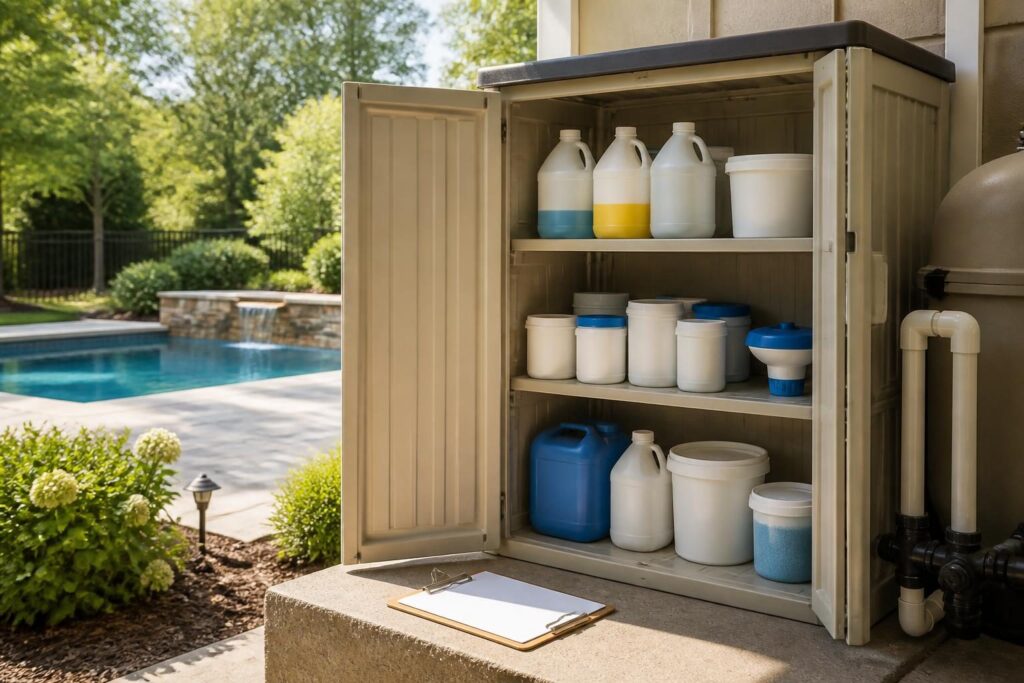
A pool chemical inventory expiration log gives your household one clear place to track products, dates, storage locations, labels, and disposal questions. It can reduce guesswork when several containers look similar or when seasonal maintenance changes your supply needs.

This record does not replace the product label, safety data sheet, local disposal guidance, or advice from a qualified professional. Chemical products differ. Their storage, use, mixing, and disposal instructions must come from the current label and manufacturer information.
Why keep a pool chemical inventory expiration log?
Pool chemicals may include sanitizers, oxidizers, acids, alkalinity products, stabilizers, water clarifiers, algaecides, and cleaning products. Each product has its own handling instructions. Some materials must remain separated because contact can create dangerous reactions.
A written log helps you answer basic questions before opening a container:
- What is this product called, and what is its active ingredient?
- When did we buy it or open it?
- Does the label show an expiration date, lot number, or storage warning?
- Where is it stored?
- Is the container damaged, leaking, swollen, damp, or hard to identify?
- Does the label explain disposal, or do we need local guidance?
North Carolina conditions can add practical concerns. Heat, humidity, rain, coastal air, and changing garage temperatures may affect containers and labels. Local solid-waste programs may also have specific instructions for unwanted household chemicals. Verify current guidance with the appropriate local authority.
Set up the log with the right fields
A spreadsheet, binder page, or printed table can work. Choose a format that stays available without placing the record inside the chemical storage area. The goal is a quick inventory, not a complicated laboratory record.
Product and date fields
Record the product name exactly as printed. Add the product type, active ingredient if shown, container size, and manufacturer. Do not rely on memory or a shortened nickname.
Include these date fields:
- Purchase date, if known
- Date opened
- Expiration date, if printed
- Date checked
- Date removed from active storage
If no expiration date appears, write “not shown” rather than inventing one. Add the lot or batch number when available. Photograph the front, back, and top of the label to preserve information that may fade later.
Storage and condition fields
Give each container a simple storage location, such as “locked outdoor cabinet, upper shelf” or “garage cabinet, left side.” Avoid storing chemicals in a way that requires moving one container across another.
Add a condition note. Useful descriptions include “label clear,” “cap secure,” “outer container dry,” or “needs professional review.” Do not open, sniff, test, transfer, or combine an unknown or damaged product to learn more about it.
Map storage locations without creating new risks
The log should support safe storage, not encourage reorganizing chemicals casually. Keep products in their original containers with readable labels. Never place pool chemicals in food, drink, or unmarked containers.
Review the storage area for the conditions described on each label. Depending on the product, instructions may address moisture, heat, sunlight, ventilation, ignition sources, children, pets, or contact with other materials. The label controls when it gives a specific instruction.
Keep the inventory outside the reach of children and visitors. A locked, dry, well-maintained location may suit some products, but the correct arrangement depends on the label and storage space. Do not assume that an outdoor shed, pool house, or garage suits every chemical.
Use a location review checklist:
- Are containers protected from rain, standing water, and sprinklers?
- Can labels be read without moving containers unnecessarily?
- Are products kept away from incompatible materials identified on the labels?
- Could a leak reach a drain, soil, fuel, fertilizer, or electrical equipment?
- Are shelves stable and strong enough for the containers?
- Can the area remain inaccessible to children and pets?
Water, fertilizer, gasoline, solvents, and other household products may create storage concerns. Do not decide that two products are compatible because both support pool care. Check the labels and manufacturer information.
Record incompatible materials clearly
“Incompatible” means materials that should not contact each other or remain together under stated conditions. The exact concern depends on the product. Some labels provide separation instructions, while others direct users to additional safety information.
Add an “incompatibilities and warnings” column to the pool chemical inventory expiration log. Copy short label-based notes, such as “keep dry,” “do not mix with acids,” or “keep away from organic materials,” when those warnings appear. Do not rewrite technical directions in a way that changes their meaning.
Consider separate, clearly identified storage zones only when the product labels and storage arrangement support that choice. Physical separation is not a substitute for reading labels. A shelf divider does not make incompatible chemicals safe to combine.
Never mix leftover products, pour one product into another container, or combine old and new material. If a container has no readable label, appears damaged, or has an unusual odor or appearance, leave it undisturbed and seek appropriate guidance.
Track use and water-care decisions
An inventory becomes more useful when paired with a simple use record. For each addition, record the date, product, approximate amount used as directed, reason for use, and available water-test information.
This record does not tell you how much chemical to add. Follow the product label and your pool professional’s instructions. It can show whether someone used a product for routine maintenance, a water-quality adjustment, or a seasonal task.
For general residential testing information, review the CDC guidance on home pool water treatment and testing. Water testing results can provide context, but they do not change storage or handling instructions.
Keep these records together:
- Current product labels and label photographs
- Safety data sheets, when provided
- Water-test results
- Equipment service notes
- Instructions for chemical feeders or dosing systems
- Disposal and collection information
If an automated feeder is part of your system, connect its product information to the inventory. The pool chemical feeder inspection checklist can help organize visual observations about labels, tubing, storage, and operating instructions.
Handle expiration and disposal questions carefully
An expiration date is a reason to review a product, not a reason to pour it down a drain or throw it away without checking. Product condition, container type, quantity, and local collection rules may all matter.
Mark products approaching their stated date. Compare the container with the current label. If the label is missing or unreadable, do not use the product simply because the contents look normal.
For unwanted or expired chemicals, write a disposal question in the pool chemical inventory expiration log:
- What is the exact product name and active ingredient?
- What quantity remains?
- Is the container intact and labeled?
- Does the label provide disposal instructions?
- Which North Carolina or local household hazardous-waste program should be contacted?
- Does the receiving program require advance notice or special transport instructions?
Keep questionable products in their existing containers while seeking guidance. Do not transport a leaking container without instructions. If a spill, exposure, fire, or strong reaction occurs, move people away and contact emergency services or the appropriate poison and hazardous-material resource.
Use a monthly review routine
A short monthly check can prevent small record problems from becoming storage problems. Choose a consistent date, such as the first weekend of each month or before opening the pool for the season.
During the review, compare every container with the log. Check labels, caps, dates, condition, and location. Look for moisture, corrosion, residue, damaged shelving, or changes in access control. Update the pool chemical inventory expiration log after buying a product, opening a container, moving storage, or removing an item.
If someone else maintains the pool, agree on who updates the log and who confirms disposal instructions.
For related water-care records, see the guide to connecting pool test trends with equipment checks. If landscape sprinklers reach the storage or pool area, review irrigation overspray and backflow questions as part of the wider maintenance plan.
A simple printable record
Start with one row per product. Add more detail only when it helps someone make a safer decision.
| Field | Example entry |
|---|---|
| Product name | Exact label name |
| Product type | Sanitizer, acid, oxidizer, or other |
| Active ingredient | As printed on label |
| Purchase or open date | Date or “unknown” |
| Expiration or lot number | As printed, or “not shown” |
| Storage location | Specific cabinet or shelf |
| Warnings | Short label-based notes |
| Condition | Container and label observations |
| Disposal question | Local guidance needed, if applicable |
| Last review | Date and initials |
A consistent record makes routine pool care easier to hand off and review. It also helps you notice when a product no longer has a clear identity, safe container, or documented storage location.
When a question involves a spill, damaged container, chemical reaction, electrical equipment, local disposal rule, or unusual water condition, stop and seek qualified guidance. Contact the local inspections or waste authority when appropriate, and consult a licensed pool contractor, water-care professional, or other qualified specialist for product-specific advice.