
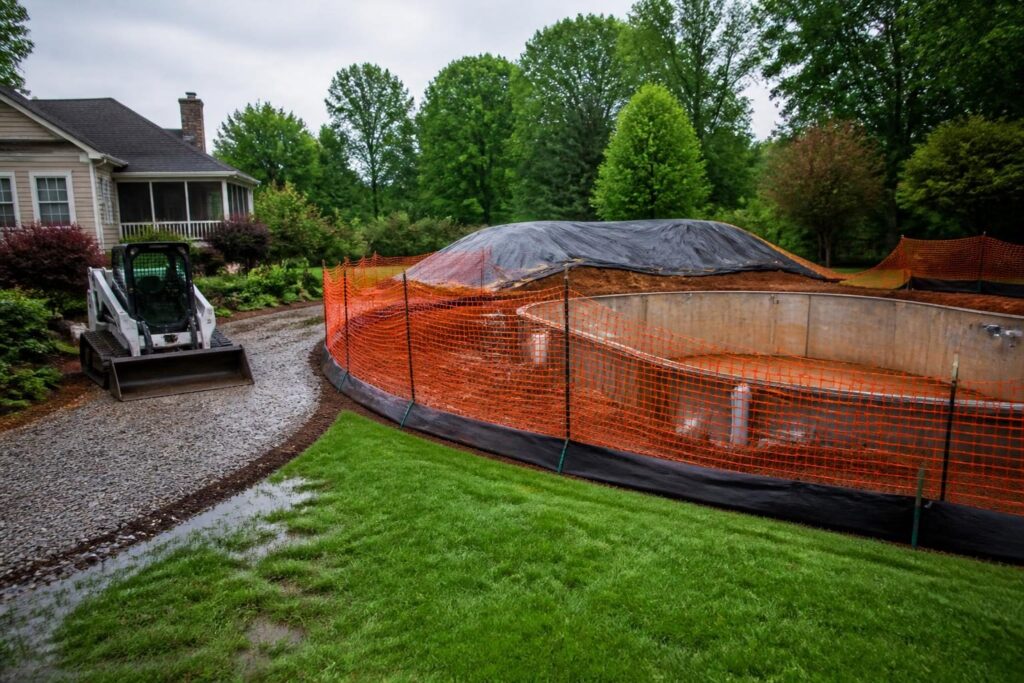
Rain can change a pool construction site within hours. Temporary pool construction drainage runoff controls help reduce flowing water, muddy access routes, soil movement, and exposure of unfinished work. Discuss temporary pool construction drainage runoff controls before excavation, not after the first major storm.

This article explains planning questions homeowners can raise with the pool contractor and other qualified professionals. It does not replace a site-specific erosion-control plan, engineering review, permit decision, or local inspection. North Carolina requirements can vary by jurisdiction, property conditions, adopted rules, utilities, flood zones, and the amount of land disturbance.
Why rain matters during an unfinished pool project
An active pool site rarely has its final grades, paving, planting, drainage features, or stable surfaces. Excavation leaves exposed soil. Stockpiled material may sit near the work area. Heavy equipment can compact some areas while loosening others. Water then follows temporary paths that may differ from the finished design.
Runoff is water that moves across the ground after rain. Erosion occurs when moving water carries soil away. Sediment is the soil that settles elsewhere, such as on a driveway, sidewalk, neighboring lot, storm inlet, or low part of the yard.
Ask the project team how the site will stay protected during each phase. Controls may include temporary channels, berms, stabilized entrances, inlet protection, covers, check structures, or staged soil placement. The appropriate measures depend on the site and should come from the responsible qualified professional.
For statewide background, review the NC DEQ Erosion and Sediment Control Manual. It provides planning and design guidance, but homeowners should confirm which requirements apply to their project.
Questions about the excavation and open work areas
An open pool excavation can collect rainwater and receive runoff from higher ground. Water may soften exposed soil, fill low areas, or make access unsafe. It can also complicate unfinished work, such as wall preparation, plumbing installation, steel placement, or shell construction.
Discuss these questions before digging:
- Which existing slopes send water toward the excavation?
- Where will rainwater collect after a heavy storm?
- What temporary measures will keep clean water away from the open excavation?
- Who decides when pumping or other water-management work becomes necessary?
- Where may collected water be released, and how will that discharge avoid erosion?
- What conditions require workers to stop, secure the site, or request professional review?
Pumping water from an excavation does not automatically solve every drainage issue. Discharge can create a new erosion problem if it reaches a slope, neighboring property, public area, or stormwater system without suitable control. If groundwater appears, the planning issues may differ from ordinary rainwater. See our guide to pool construction groundwater dewatering questions for a separate discussion.
Do not enter an excavation to inspect it. Keep children, pets, and visitors away from open work areas. A contractor or qualified professional should determine whether the excavation is safe to approach.
Protecting neighboring areas and public drainage paths
Runoff does not stop at the property line. Temporary flow can carry soil toward a neighbor’s yard, shared driveway, sidewalk, road, or storm drain. Even when the pool sits inside your property, the project team should identify where water could travel during construction.
Ask for a simple written explanation or marked plan showing:
- Existing high and low points around the work area.
- Temporary flow paths during excavation and backfill.
- Locations that need sediment protection.
- Inspection points after rainfall.
- Who will maintain, move, repair, and remove temporary controls.
- How adjacent-property concerns will reach the project contact.
Construction stormwater rules may apply when land disturbance reaches a regulated scope. The state program may also involve local implementation or project-specific decisions. Review the NC DEQ Construction Stormwater Program, then confirm current requirements with the appropriate local or state authority.
A proposed permanent outlet differs from a temporary construction control. The final outlet may not exist or function while the excavation and surrounding grades remain unfinished. For permanent drainage questions, see pool drainage outlet planning in North Carolina.
Managing soil stockpiles and exposed ground
Excavated soil often occupies part of the yard while the project continues. A stockpile can block a flow path, shed water toward another area, or release sediment when its surface becomes saturated. Its location also affects equipment movement and space for temporary controls.
Questions worth documenting include:
- Where will soil go, and how long may it remain there?
- How will the stockpile stay clear of drainage paths?
- Will its slopes, base, or surface need temporary protection?
- How will workers keep soil off driveways, sidewalks, and neighboring areas?
- What happens if the selected storage area becomes too wet or unstable?
- Who handles cleanup after material leaves the intended work zone?
Take dated photos after initial placement and significant rain. Include the stockpile, nearby pavement, drainage paths, fences, walls, planting beds, and low areas. Photos do not determine responsibility or prove compliance. They give the homeowner and project team a shared record of changing conditions.
Keeping access routes usable without spreading mud
Construction access routes receive repeated traffic from trucks, excavators, workers, and deliveries. Rain can turn soil into mud, reduce traction, and carry sediment onto public or shared surfaces. A route that works in dry weather may fail after a storm.
Discuss the route as part of the drainage plan, not only as a delivery issue. Ask:
- Which entrance will equipment use during wet conditions?
- What surface or stabilization is planned at the street connection?
- How will water cross or leave the route without washing out its edges?
- Who checks the route before and after deliveries?
- What triggers a pause when the route becomes too soft?
- How will workers remove mud from pavement without pushing it into an inlet?
Set expectations for gates, driveways, temporary paths, and restoration in writing. Our pool construction site access protection guide covers the condition record and access questions that support this conversation.
Controls need inspection after rain
Installing a control once is not enough. Rain, traffic, changing grades, and construction activity can move or damage it. Someone should know what to inspect, how often to inspect it, and how quickly to correct a problem.
A homeowner’s observation checklist can include:
- Look for muddy water leaving the work area.
- Check whether temporary channels still follow their intended route.
- Note undercut edges, rills, gullies, or exposed soil.
- Look for sediment on pavement, sidewalks, fences, or neighboring areas.
- Check whether an inlet, swale, or low point is blocked.
- Photograph changes from a safe location.
- Send observations through the project’s agreed communication method.
Do not move barriers, enter an excavation, operate pumps, or alter an outlet yourself unless a qualified professional specifically directs and trains you. A control may look simple while serving a larger site plan.
Put runoff decisions into the project record
Weather creates decisions that can prove difficult to reconstruct later. Keep the drainage discussion with the project documents. A short record can reduce confusion when the site changes from excavation to shell work, backfill, decking, and landscaping. Include temporary pool construction drainage runoff controls in the written site-plan discussion.
Keep copies of:
- Marked plans or sketches showing temporary flow paths.
- Written answers about stockpiles, access, pumping, and discharge.
- Photos before work, during exposed-soil phases, and after major rain.
- Messages about weather-related pauses or changed protection measures.
- Inspection notes, corrective actions, and follow-up dates.
- Agency, local-authority, professional, or permit correspondence.
A schedule record can connect rain to decisions without assuming a guaranteed completion date. See our pool construction schedule decision tracking checklist for a broader way to track weather and open items.
A practical pre-excavation conversation
Before work begins, ask the project contact to walk the property with you. Stand at the planned excavation, likely soil-storage area, equipment route, and lowest nearby points. Discuss what changes during a short rain and what changes during a prolonged storm. Use temporary pool construction drainage runoff controls as a specific agenda item, rather than leaving runoff planning as an informal assumption.
Use this short agenda:
- Identify where water starts and where it may travel.
- Confirm temporary protection for the excavation and exposed soil.
- Review access stabilization and pavement-cleaning procedures.
- Identify neighboring areas and drainage features that need protection.
- Assign inspection, maintenance, and communication responsibilities.
- Record decisions, open questions, and the person responsible for each answer.
Build a Pool in North Carolina encourages homeowners to treat temporary drainage as an active construction topic. The best plan may change as soil, weather, groundwater, and site access conditions become clearer.
For permit, stormwater, excavation, discharge, drainage, or property-specific questions, consult the local inspections department and the appropriate state or local authority. A licensed pool contractor, engineer, surveyor, septic professional, or other qualified specialist can address conditions outside general homeowner guidance.