
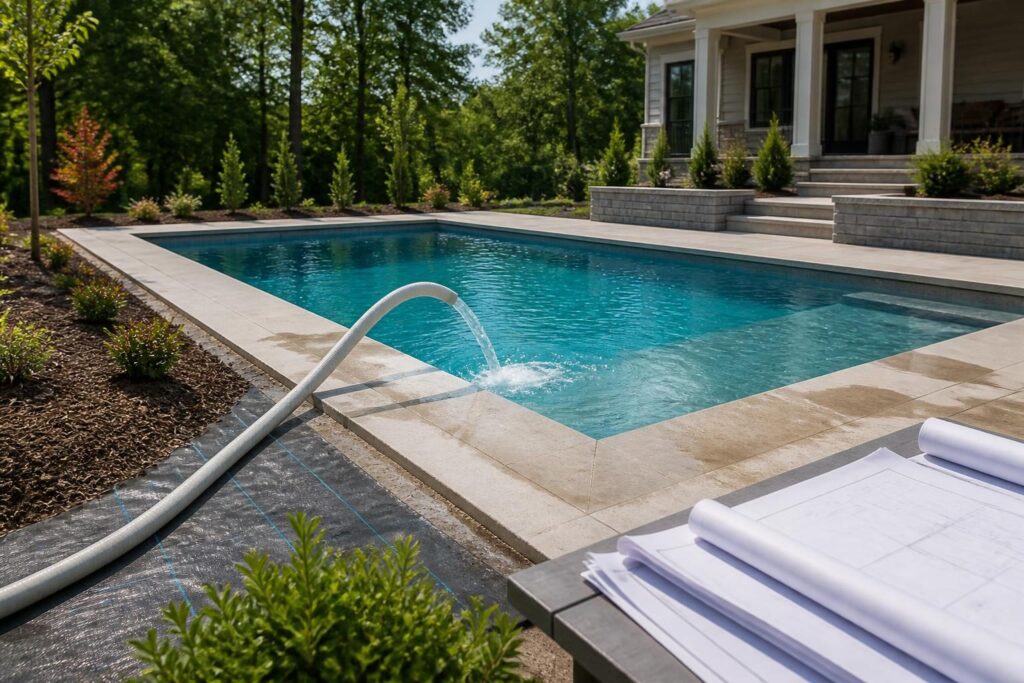
Pool water delivery planning North Carolina homeowners do before construction can prevent avoidable delays during the first fill. The right plan depends on your water source, pool size, access, local conditions, and the instructions for your pool finish and equipment.

A first fill involves more than putting water in the shell. You need to decide who supplies the water, how it reaches the pool, whether the source needs testing, and what happens if water must later be lowered or discharged. Because properties and local requirements differ, treat this guide as a planning framework rather than a universal procedure.
Start with the water source
Ask your pool contractor to identify the proposed water source in writing. Common possibilities include a public water connection, a private well, a delivered water load, or a combination of sources. Each option raises different questions about availability, quality, equipment, scheduling, and cost.
Public water may appear simple, but you still need confirmation of usable flow and service rules. A hose connection may take longer than expected if household demand, pressure, or restrictions affect the fill. Do not assume that a normal outdoor faucet can supply the entire project without a site-specific review.
Well water requires additional care. The well’s production, recovery, treatment equipment, and household demand may affect whether filling the pool makes sense. A pool fill can also introduce iron, manganese, hardness, or other substances that change the startup plan. Review your well records and refill options before construction. For related planning questions, see planning a pool near a private well.
Delivered water can reduce pressure on a household supply, but it introduces logistics. Ask whether the supplier provides potable water, treated water, or another product. Confirm how the supplier measures the water and how the crew transfers it. Keep the supplier’s written description with your project records.
Pool water delivery planning North Carolina should begin by matching the source to the pool finish, available access, and startup schedule. Ask the contractor to explain that match before you approve the delivery arrangement.
Questions for the contractor and supplier
- Which water source does the project scope include?
- Who arranges delivery, and who pays the supplier?
- What water-quality information can the supplier provide before delivery?
- How will the crew protect the pool finish during filling?
- What happens if the source, weather, or access changes?
- When should pumps, filters, and circulation equipment begin operating?
Do not accept vague language such as “water included” without asking what that phrase covers. It may refer to the water itself, transport, hoses, labor, testing, treatment, or only a limited allowance. Your contract should identify the responsibility clearly.
Plan delivery access before the truck arrives
Water trucks need a safe route and a practical discharge point. Review the driveway, gates, overhead branches, slopes, turning space, soft ground, and the distance from the truck to the pool. A hose may cross areas that cannot support vehicle traffic, but that arrangement also needs planning.
Access can change after excavation. Spoil piles, temporary fencing, equipment, open trenches, landscaping, and wet conditions may block a route that looked available during design. Walk the proposed path with the contractor before scheduling delivery. Photograph the route if its condition matters to the project record.
Protect finished surfaces and nearby property. Confirm whether hoses will cross a driveway, deck, planting bed, sidewalk, or neighbor’s access area. Ask who supplies mats, ramps, hose protection, or temporary covers. These measures should not create trip hazards or obstruct emergency access.
Weather matters as well. Heavy rain can soften soil and change vehicle access. Hot weather can affect scheduling and the time available for startup work. Ask how the contractor will coordinate the fill if weather interrupts delivery or if the pool must fill continuously.
Use an access checklist
- Measure or confirm the route from the delivery location to the pool.
- Identify gates, low branches, overhead utilities, slopes, and narrow turns.
- Mark finished surfaces and areas that need protection.
- Confirm where the truck may park without blocking neighbors or emergency routes.
- Plan who will be present when water arrives.
- Keep a backup plan for weather or an inaccessible route.
Never direct a large vehicle around overhead utilities or unstable ground without professional review. The driver, supplier, and contractor should determine whether the route is safe.
Ask about fill quality and testing
Water that looks clear may still affect the first chemical adjustment. Source water can contain minerals, metals, disinfectants, or other characteristics that influence pH, hardness, staining risk, and treatment choices. The appropriate tests depend on the source and the pool finish.
Before filling, ask which tests the contractor recommends and who will perform them. You may need a source-water sample before delivery and a pool-water sample after filling. The contractor or water-care professional should explain the results and next steps. Do not add chemicals based on a generic online chart when the pool finish, equipment, or source water has not received a professional review.
The Centers for Disease Control and Prevention provides general information about residential pool water testing, chlorine, and pH in its home pool water treatment and testing guidance. That information does not replace the startup instructions for your specific pool or advice from a qualified water-care professional.
Ask whether the pool finish has special filling instructions. Some finishes may require controlled filling, continuous observation, or prompt circulation and balancing. The exact procedure belongs to the finish manufacturer and the qualified installer. Request those instructions before the first truck is booked.
Record the test results
Create a simple fill record with the source, supplier, delivery date, approximate volume, test results, and chemical additions. Save laboratory reports, digital readings, invoices, and written startup instructions. Record the name or role of the person who performed each test without making unsupported conclusions about the results.
If the water changes color, becomes cloudy, or produces unusual deposits, pause before adding more treatment. Photograph the condition, note when it appeared, and contact the contractor or water-care professional. A clear record helps them distinguish source-water characteristics from later circulation or treatment issues.
Understand filling and startup coordination
The initial fill affects more than the water level. Once the pool reaches the operating level, circulation equipment, valves, heaters, salt systems, automation, and sanitizing routines may enter the startup sequence. These components should not operate outside the manufacturer’s instructions.
Ask who will monitor the fill. Someone should know when water reaches skimmers, returns, water features, overflow points, or other equipment-related levels. Confirm whether the contractor wants you to stop a hose, call the crew, or leave the system untouched until a technician arrives.
Do not switch on pumps, heaters, lights, or treatment systems simply because the pool looks full. Electrical work and equipment startup require appropriate professional direction. A licensed electrician or pool professional should address electrical safety and equipment operation for your installation.
Pool water delivery planning North Carolina should also account for household use. If the source is your home’s water supply, ask whether normal household activities should change during filling. If you have a well, coordinate with the well professional when supply or recovery seems uncertain. For broader source questions, review pool planning with a private well.
Plan what happens to excess or unwanted water
Water management does not end when the pool is full. You may later need to lower the water after heavy rain, maintenance, repairs, or a water-quality problem. Consider the discharge path before the pool is built, rather than improvising with a hose.
Pool water can contain chlorine, salt, treatment chemicals, sediment, or other substances. The acceptable discharge method depends on the water condition, receiving area, property layout, local rules, and nearby structures. Never assume that a street, storm drain, neighboring property, septic area, creek, or drainage swale is automatically suitable.
Ask the contractor or qualified drainage professional to identify the proposed discharge area and the controls needed to prevent erosion, nuisance flow, or damage. Keep the discharge plan with the site documents. For related grading and runoff questions, read how to plan pool drainage discharge away from house structures.
Construction runoff is a separate concern from routine pool water discharge. If the project involves land disturbance, review current state and local stormwater requirements. The North Carolina Construction Stormwater Program explains the state program, but local applicability and project-specific obligations require verification.
Document the discharge plan
- Describe the proposed discharge location and route.
- Note nearby buildings, wells, septic components, slopes, and property lines.
- Identify who approves the discharge before it occurs.
- Record any required treatment, waiting period, or flow-control method.
- Photograph the area before and after a planned discharge.
Put the first fill in your project records
Good records make the handover more useful. Start a fill-day entry with the pool’s condition before water arrives. Include the finish, visible debris, water source, delivery information, weather, access conditions, and any protection used along the route.
During filling, record start and stop times, interruptions, unusual observations, and the approximate water level when equipment connected. Ask the contractor to provide written startup steps rather than relying on a verbal explanation that you may forget.
After filling, save the first test results and a list of treatment products added. Note when circulation began and when the contractor demonstrated valves, controls, water features, and safety equipment. The initial fill creates a useful reference point for future maintenance.
Use pool water delivery planning North Carolina records as a baseline for later service questions. The source, test results, delivery details, and startup notes can help a qualified professional understand the pool’s starting conditions.
Keep these documents together
- Written water-source and delivery scope
- Supplier invoice or delivery receipt
- Source-water and pool-water test results
- Pool-finish filling instructions
- Startup and equipment-operation instructions
- Photos of access, fill progress, and the completed water level
- Discharge planning notes and approvals, when applicable
Make the plan specific to your property
There is no single filling method that fits every North Carolina pool. A municipal supply, private well, delivered load, hillside lot, septic property, compact yard, or stormwater-sensitive site may require different coordination.
Before scheduling delivery, ask your local inspections department about relevant requirements. Consult the licensed pool contractor about the shell, finish, equipment, and startup sequence. Involve a licensed electrician for electrical work, a surveyor or engineer for site questions, and a septic or well professional when those systems may be affected.
Build a Pool in North Carolina encourages homeowners to treat the initial fill as a documented construction milestone. Clear responsibilities, verified water information, safe access, and a planned discharge route can make startup more orderly without relying on assumptions.