
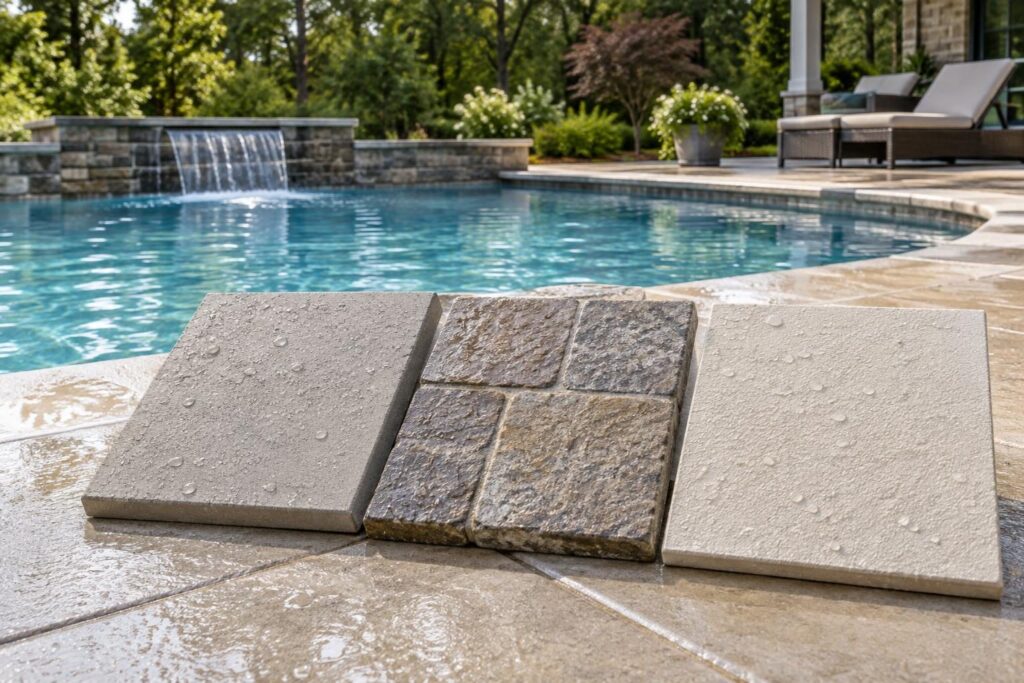
A wet pool deck slip resistance comparison should go beyond rubbing your hand across a dry sample. Texture matters, but so do the sealer, installation, wear, and contamination. The surface beside your pool may behave differently from the display board.
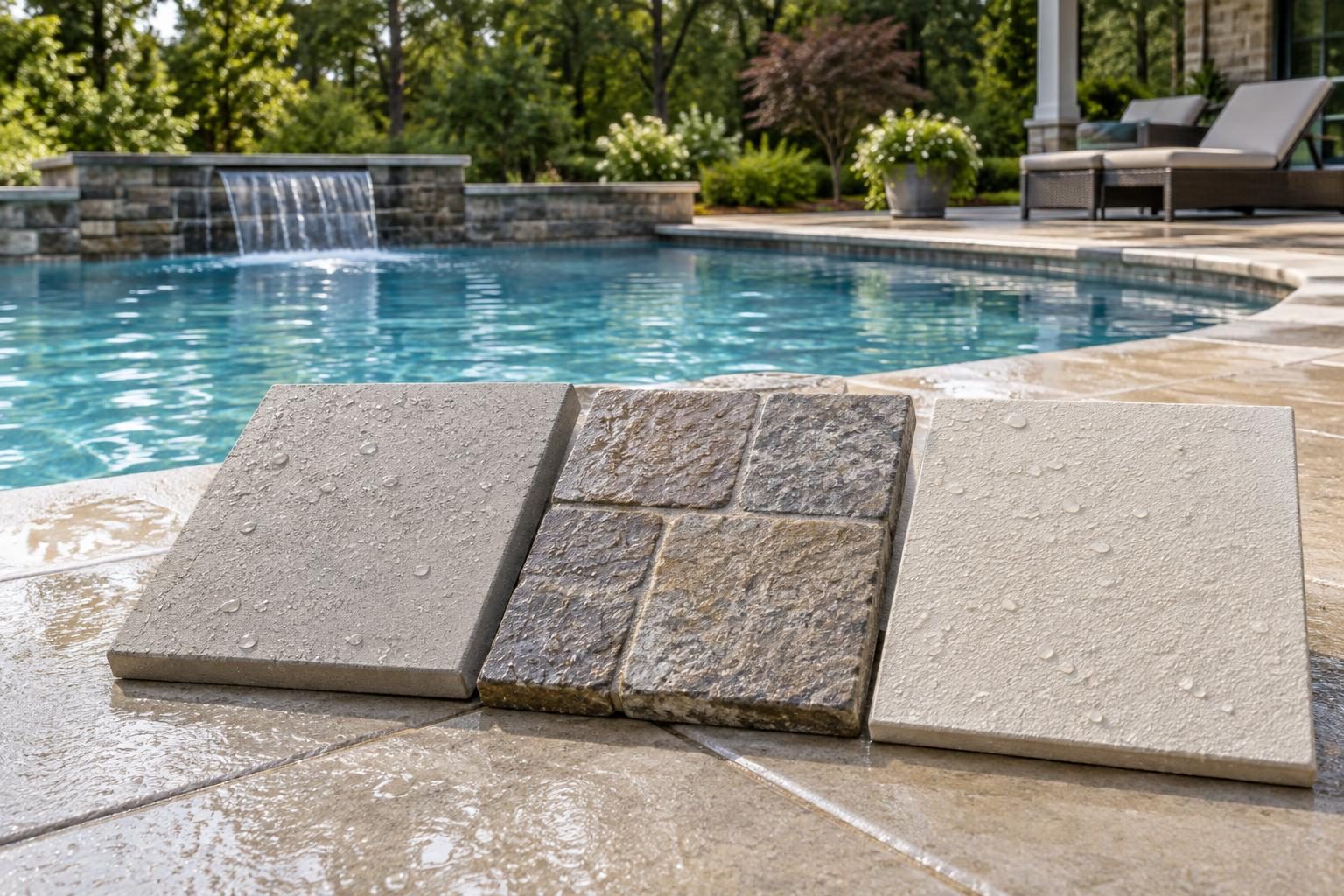
North Carolina homeowners should compare complete surface systems, not just material names. Ask what supports the seller’s traction claims and what maintenance those claims assume. Never treat a deck as slip-proof, even when a product carries a favorable test result.
Compare the installed deck surface, not the material label
Concrete, pavers, stone, tile, and coatings each include many finishes. A broad description such as “textured concrete” does not identify the surface you will receive. The installation method and protective treatment can also change its final condition.
Request a written description of the complete assembly. For a coated deck, that means the underlying surface, preparation, coating layers, and any traction additive. A traction additive is material mixed into or applied over a coating to change its texture.
- Record the manufacturer, product name, finish, and color.
- Identify the exact sealer or coating, including any additive.
- Ask whether the manufacturer recommends the product for exterior, wet, barefoot poolside use.
- Confirm that sample boards represent the proposed finished system.
- List any substitutions that require your written approval.
A sample without the specified sealer is an incomplete comparison. Likewise, a showroom finish may not represent a field-applied texture. Ask the installer to explain those differences before you approve the selection.
Request relevant wet-deck slip resistance information
Ask for the manufacturer’s technical information and available slip-resistance test reports. A test report describes performance under stated conditions. It does not guarantee that nobody will slip.
For a useful wet pool deck slip resistance comparison, find out exactly what each report measured. Different test methods or conditions may produce results that cannot be ranked directly.
- Which test method did the laboratory use, and who performed the testing?
- Was the specimen wet or dry?
- Did testing represent barefoot use, footwear, or another contact condition?
- Did the tested specimen have a sealer or coating, or did it remain untreated?
- Did testing assess a new specimen, wear, or exposure to cleaning products?
- Does the report cover the exact proposed finish?
Terms such as “coefficient of friction” describe resistance to sliding under particular test conditions. Do not treat a larger number from a different test as proof of a safer deck.
If the information is unclear, request an explanation from the manufacturer or a qualified testing professional. A seller’s general assurance is not a substitute for relevant product documentation.
Balance texture, barefoot comfort, and cleaning
More noticeable texture does not automatically make a surface the best choice. Pronounced texture may feel uncomfortable under bare feet or make debris harder to remove. A smoother finish may be easier to clean, but still needs relevant wet-use information.
Consider how household members will use the deck. Paths between the pool, outdoor shower, seating, and house deserve particular attention. Include steps, edges, and transitions in the discussion, rather than comparing only open deck areas.
Ask to view a representative installation or a larger finished mockup. A mockup is a trial area showing the proposed materials and workmanship. Review texture consistency, cleaning access, and comfort without deliberately trying to slide on it.
Do not create a homemade test using oil, sunscreen, or a slippery walking surface. If suitability remains uncertain, ask about professional evaluation.
Traction is only one selection factor. Use deck surface temperature planning to review heat and barefoot comfort separately.
Find out what sealers and recoating can change
A sealer is a protective treatment applied to a surface. Some products form a surface film; others penetrate the material. Their effects depend on the product, application, and underlying finish.
Ask whether the proposed sealer changes the surface texture or wet traction. Request information for the sealed system, not just the unsealed material. If the manufacturer recommends an additive, include its product and application instructions in the specifications.
- Who selects and approves the sealer?
- What preparation and application instructions must the installer follow?
- What restrictions apply before the deck returns to use?
- How will future recoating affect the existing texture?
- What happens if the maintenance contractor uses another product?
Keep container labels, product sheets, and application records. Photograph the surface before and after treatment from safe locations.
An unapproved coating change deserves clarification, not an immediate accusation. Verify the product used, request its technical information, and resolve the difference in writing before accepting the affected work.
Account for sunscreen residue and biological growth
Pool decks collect sunscreen, body oils, spilled drinks, soil, and other residue. These materials can change traction, including on a surface that felt secure when clean. Cleaning products can also leave residue if users apply or rinse them incorrectly.
Biological growth, such as algae, can create slippery areas. Shade, repeated wetting, and slow drying deserve attention during planning. Inspect sheltered corners, furniture footprints, and frequently splashed routes rather than relying only on the deck’s overall appearance.
Request a manufacturer-approved cleaning plan that addresses both oily residue and biological growth. Confirm compatible cleaners, tools, rinsing methods, and restrictions. Do not improvise chemical mixtures or assume an aggressive cleaner is safe for every finish.
If an area becomes slippery, keep people away until a qualified professional evaluates and addresses the problem. Cleaning may help, but persistent problems can require review of the finish, coating, or drainage.
For nearby vegetation, tree canopy and leaf-load planning can help you anticipate recurring debris and cleaning work.
Evaluate wear and maintenance costs before buying
A new surface is only one stage of the comparison. Foot traffic, furniture movement, weather exposure, and cleaning can change its condition. Ask how the manufacturer expects the proposed system to wear and what maintenance restores its intended finish.
Include long-term care in your wet pool deck slip resistance comparison. Avoid choosing solely by installation price when one option requires services you cannot realistically maintain.
- What routine cleaning does the manufacturer recommend?
- What signs indicate a need for professional service?
- Does maintenance require recoating, resealing, or another treatment?
- Can spot repairs create a noticeably different texture?
- Which care practices could affect warranty coverage?
- Who provides maintenance instructions and future service?
Request written pricing for defined maintenance work where available. Treat those proposals as current estimates, not promises of future cost.
Also check whether cleaning runoff needs special handling near landscaping, drains, wells, or septic areas. Ask the appropriate local authority or qualified professional about site-specific restrictions.
Keep drainage and traction decisions connected
Slip resistance cannot compensate for poor water management. Ask how the design handles splash water, rain, irrigation, and runoff from nearby planting beds. Surface depressions or blocked drains may prolong wet conditions.
Have the contractor explain drainage responsibility separately from material performance. If water collects, the response should not automatically be “choose a rougher finish.” The cause may need evaluation before anyone recommends a remedy.
Use safe observations of deck slope and water movement to prepare questions. Homeowner observations do not establish drainage compliance or replace professional measurements.
North Carolina requirements can vary by jurisdiction, adopted code, property conditions, utilities, septic systems, flood zones, and project scope. Confirm applicable deck, drainage, permit, and inspection requirements with your local inspections department. Ask whether a proposed resurfacing project needs review, rather than assuming it does not.
Put product promises and acceptance steps in writing
The contract should identify what the contractor will install and who will approve changes. For contractor research and written agreements, consult the North Carolina Licensing Board’s home-improvement contract guidance. Verify important representations independently instead of relying only on verbal assurances.
Before committing, request these project records:
- Exact finish, coating, sealer, and additive specifications.
- Available test reports and manufacturer suitability statements.
- An approved sample or mockup reference.
- Written installation and maintenance responsibilities.
- Payment milestones tied to defined work and documentation.
- A process for recording concerns, corrections, and substitutions.
- Warranty terms and final care instructions.
Photograph work before later layers cover it, without entering restricted work areas. Preserve contracts, change orders, written approvals, inspection records, and correction records.
Vague specifications, missing reports, or reluctance to document changes are reasons to pause and verify. They do not, by themselves, prove wrongdoing. Record unresolved punch-list items—the remaining corrections—and agree on their handling before closeout.
Choose the system you can maintain
The strongest wet pool deck slip resistance comparison connects evidence, installation, and ongoing care. Choose a documented surface system suited to the intended use, with maintenance you can realistically perform. Keep the final product records available for future cleaners and repair contractors.
Consult your local inspections department for requirements and a qualified pool contractor for installation questions. Seek an engineer for unresolved drainage or elevation concerns, and a septic professional when work may affect wastewater-system areas. For uncertain traction claims, request manufacturer clarification or qualified testing rather than relying on the sample board alone.