
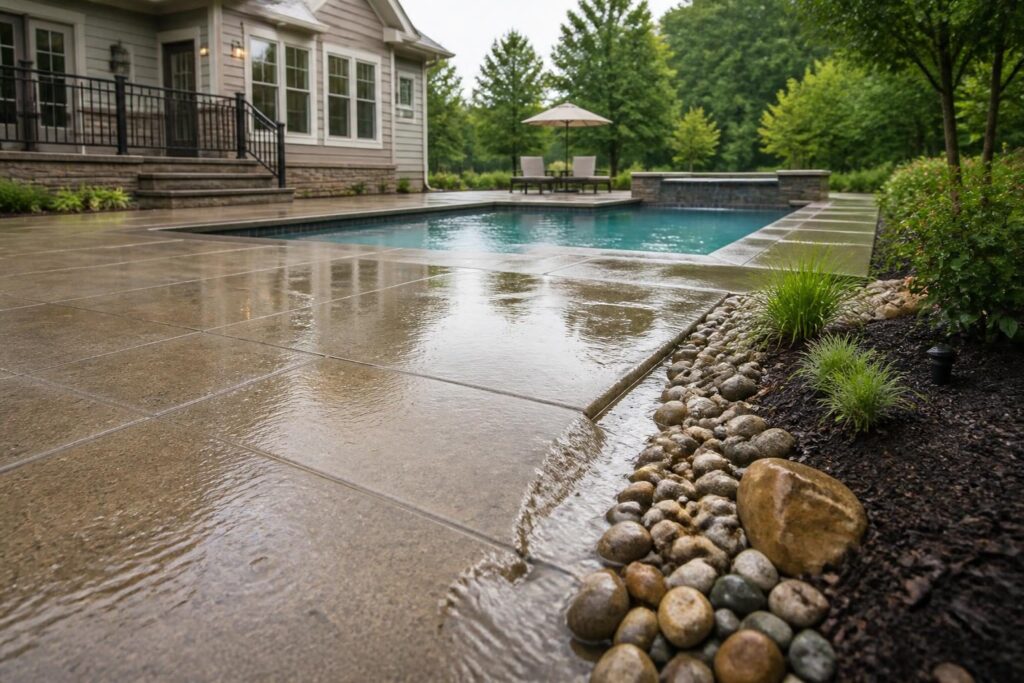
A pool deck slope verification homeowner guide can help you notice how water moves around a residential pool. You do not need to diagnose a drainage design or measure a code-required slope to make useful observations. Instead, watch where water collects, which direction it travels, and whether it approaches doors, walls, equipment, planting beds, or the pool itself.

These observations are most useful during planning, after deck installation, and following major landscaping changes. A pool deck slope verification homeowner guide can help you ask clearer questions of a pool contractor, drainage professional, surveyor, engineer, or local inspections department. It cannot replace a grading plan, survey, engineering review, permit review, or inspection.
What deck slope observations can and cannot tell you
A deck slope is the change in elevation across a surface. Around a pool, that surface may include concrete, pavers, coping, steps, walkways, transitions, and drainage features. Water movement depends on more than the visible deck. Soil, landscaping, roof runoff, irrigation, joints, nearby walls, and stormwater outlets can all affect the result.
Home observation can show patterns. For example, you may see a shallow puddle near a low spot, a wet line beside a door, or runoff crossing a walkway. Those clues deserve documentation and professional review. They do not prove that the deck was built incorrectly or that a particular rule has been violated.
North Carolina requirements and suitable drainage methods can vary by jurisdiction, adopted code, property conditions, flood risk, utilities, septic systems, and project scope. Ask the local inspections department which reviews apply. A qualified professional should evaluate technical questions about grades, retaining structures, surface drainage, soil, or water discharge.
Prepare for safe pool deck slope verification
Choose a calm observation period first. A light rain can reveal surface movement without the hazards of a severe storm. Never enter standing water near electrical equipment, damaged wiring, open excavations, unstable soil, or flooded structures. Stay away from fast-moving runoff and slippery surfaces.
Before observing, gather a phone or camera, a notebook, a simple site sketch, and a way to record the date and weather. This pool deck slope verification homeowner guide is for visual observation only. Do not remove grates, open electrical enclosures, lift covers, disturb soil, or alter drainage features. Ask a qualified professional before using any instrument near electrical systems or structural features.
Make a simple observation map
Sketch the pool, deck edges, house, doors, steps, equipment pad, downspouts, planting beds, walls, drains, and property boundaries as best you can. Mark the areas that appear higher, lower, wet, muddy, or eroded. Add arrows only for water movement you directly observed.
Use neutral descriptions. “Water remained beside the back door 30 minutes after rainfall” is more useful than “the deck has no slope.” Note whether the water came from rain, a hose, irrigation, splash-out, a downspout, or an unknown source.
Four practical ways to observe water movement
The following methods are for observation, not acceptance testing. Use one method at a time, and avoid creating water that could enter the house, undermine soil, affect a septic area, or reach electrical equipment.
1. Observe after ordinary rainfall
Rain is often the best first test because it shows the whole site at once. Watch from a safe location while water is falling, then return after the rain stops. Look for water flowing toward the house, collecting beside the pool, crossing a walking route, or leaving the deck toward a planting bed.
Record the approximate start and end of visible ponding. Photograph the same locations from the same angles. Include a fixed feature, such as a door threshold or pool corner, so the images remain easy to compare.
2. Trace a small, controlled flow
If conditions are safe and the area is not near electrical equipment, use a gentle hose flow on one limited section. Do not use high pressure. Do not flood the deck or create a stream toward a structure. Have another adult observe from a dry, safe position if the layout is difficult to see.
Start near the upper part of the suspected area and watch the first path taken by the water. Stop if water moves toward a door, wall, crawl-space opening, equipment pad, septic component, or neighboring property. This method can reveal a local low spot, but it cannot establish an overall design grade.
3. Watch drying patterns
After rainfall, note which areas dry last. A darker patch may reflect shade, porous materials, a joint, surface texture, or retained moisture rather than a slope problem. Compare similar surfaces under similar weather conditions.
Repeated drying differences are worth recording. One isolated wet mark may have a simple explanation. A recurring wet area beside a structure or at a transition deserves a closer review by the appropriate professional.
4. Check runoff at transitions
Transitions often reveal practical problems. Observe where the deck meets grass, mulch, pavers, steps, a driveway, a drain, or a door. Look for soil washout, mulch movement, staining, debris lines, or water that crosses a route people use.
Landscaping can change the result after a deck is installed. New soil, sod, edging, irrigation, or planting beds may block a previous flow path. For related observations after lawn work, see how to inspect drainage after sod installation.
What to record during each observation
A consistent record helps separate a one-time event from a recurring pattern. Create one entry for each rainfall or controlled observation. Keep the original photos, not only edited versions. If a contractor or specialist later reviews the issue, the sequence may matter.
- Date and time: Include when observation began and when you returned.
- Weather: Note recent rain, heavy rain, wind, temperature, and whether the ground was already wet.
- Water source: Identify rain, irrigation, hose water, splash-out, downspout flow, or an unknown source.
- Location: Use your sketch and fixed features to identify the area.
- Movement: Describe where water started, traveled, slowed, and stopped.
- Duration: Record when visible ponding began and how long it remained.
- Impact: Note slippery areas, erosion, soil movement, wet thresholds, or access concerns.
- Changes: Record recent construction, repairs, grading, irrigation, planting, or drain cleaning.
Do not scrape, patch, regrade, drill, or seal the surface before the issue is reviewed if those actions could hide the pattern. If immediate safety is a concern, keep people away from the area and contact the appropriate qualified professional.
Questions to ask before requesting a professional review
Bring your sketch, photographs, observations, plans, and any available elevation information. A useful review starts with a clear question. You can ask:
- Which professional should review this condition: the pool contractor, drainage specialist, surveyor, engineer, or another specialist?
- Does the observed water movement match the approved or current site plan?
- Could the water source be a downspout, irrigation line, surface runoff, splash-out, or groundwater?
- Are transitions at doors, steps, walls, drains, and planting beds shown correctly?
- Could landscaping or settlement have changed the intended flow path?
- Is the proposed discharge point suitable for this property and local requirements?
- Would a level survey, spot elevations, or other technical measurement help?
- Which changes require approval before work begins?
For plan discussions, review finished elevation reference points and grade plans. That information can help you understand the relationship between the pool deck, house, yard, and drainage features. It does not turn a homeowner observation into a professional elevation survey.
Red flags that deserve prompt attention
Contact a qualified professional promptly when water repeatedly reaches a structure, enters a building, exposes soil near a pool or wall, undermines a walkway, or accumulates around pool equipment. Also ask for review when a drain backs up, a retaining feature shows movement, or runoff crosses a property boundary.
Flooding and severe weather require extra caution. Do not perform a hose test during unsafe conditions. If flood exposure may affect the property, consult the FEMA Flood Map Service Center as one planning reference, then confirm current local information with the appropriate authority.
Erosion during construction or land disturbance may involve requirements beyond the finished deck. North Carolina homeowners can review the NC DEQ Erosion and Sediment Control Manual, while recognizing that project-specific decisions belong with the responsible professionals and authorities.
Keep the observation separate from code review
A homeowner can document water movement without deciding whether a deck complies with a building code, permit, contract, or engineering design. The correct slope may depend on the material, location, drainage system, site plan, adopted requirements, and professional design.
That distinction protects your records and improves communication. Use terms such as “observed ponding,” “runoff moved toward the wall,” or “water remained at the transition.” Avoid declaring a violation or assigning a cause before the appropriate review.
Build a Pool in North Carolina encourages homeowners to keep observations factual, dated, and easy to compare. A careful record can support a productive conversation without replacing technical judgment. Used as intended, this pool deck slope verification homeowner guide helps organize observations rather than determine compliance.
When in doubt, consult the local inspections department, a licensed pool contractor, drainage professional, electrician, engineer, surveyor, septic professional, or other qualified specialist as appropriate. Requirements and safe solutions vary by location and site conditions.