
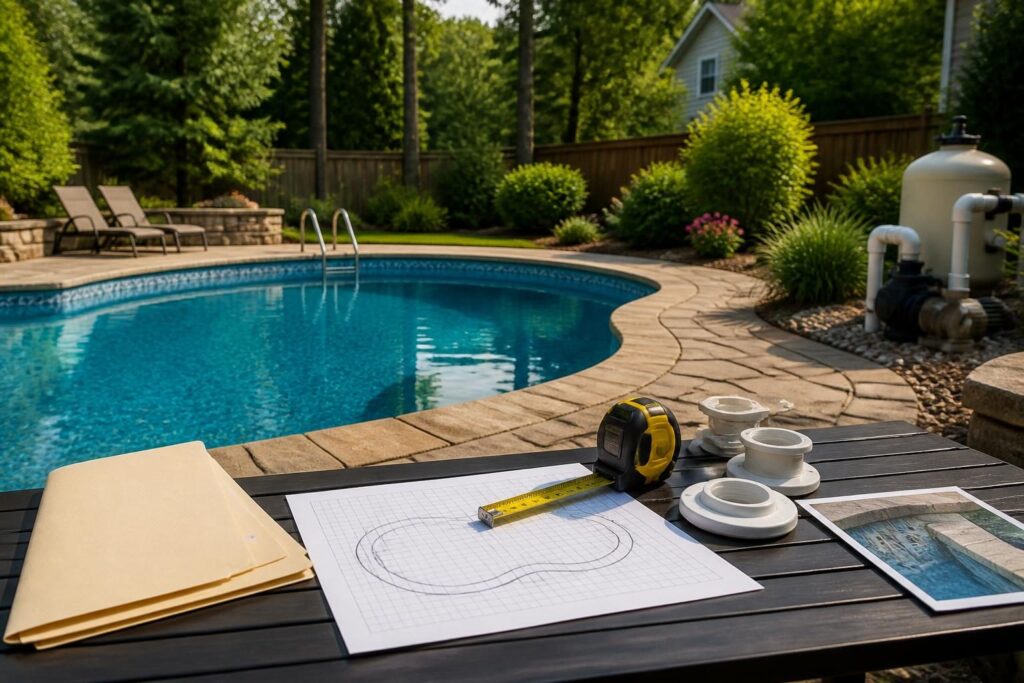
Pool liner replacement planning North Carolina homeowners do today can make a future service visit more efficient. A replacement liner requires more than length and width. The installer may need the pool’s shape, wall height, floor profile, stairs, returns, lights, drains, fittings, and liner pattern.

Old records also matter. They can show the original liner manufacturer, material, installation date, repair history, and changes made around the pool. Gather those details before the liner becomes brittle, faded, torn, or difficult to measure accurately.
This guide focuses on documentation and preparation. It does not replace an on-site assessment by a qualified pool professional. Pool shapes, construction methods, local conditions, and available replacement products vary.
Why measurements and records matter
A vinyl liner is a fitted membrane. It must match the pool’s interior geometry and the locations of openings through the liner. Even a pool that appears rectangular may have angled corners, safety ledges, stairs, coves, or changes in floor depth.
Manufacturers and installers may use different measurement forms. Some request field measurements. Others work from an original pattern, serial record, or template. A complete homeowner file gives the replacement professional more than one way to verify the order.
- Record the pool’s interior length and width at several points.
- Note each depth, slope, step, bench, ledge, and corner detail.
- List every wall fitting and its location.
- Save liner labels, invoices, warranties, and installation documents.
- Photograph the pool before water levels change or components come out.
If you are still comparing pool types, a fiberglass, vinyl, and concrete pool comparison can help explain why liner replacement records matter especially for vinyl pools.
Build a reliable pool measurement file
Do not rely on a single casual tape measurement. Create a dated record and identify who took each measurement. A professional may repeat the work, but your notes can reveal how the pool has changed or where uncertainty remains.
Record the basic geometry
Measure the inside pool length and width, not the surrounding deck. Note whether measurements run wall-to-wall, coping-to-coping, or between another reference point. Use a sketch with arrows and labels rather than a list of unexplained numbers.
For irregular pools, divide the shape into sections. Mark the transition points between straight walls, curves, angled corners, and steps. Photograph each section with a visible reference, such as a measuring tape, when safe and practical.
Document depth and floor shape
Record shallow-end and deep-end depths, plus any intermediate changes. Describe whether the floor is flat, sloped, hopper-shaped, dished, or otherwise shaped. The exact profile may affect the liner pattern and fit.
Note the locations of floor drains, underwater lights, steps, tanning ledges, and other features. A depth measurement without its location may be hard for someone else to interpret later.
Identify steps, benches, and special sections
Write down the step configuration. Include the number of treads, tread depth, riser height, step width, and the side where the steps meet the pool wall. Record benches, swim-outs, coves, or attached shallow areas in the same way.
Use photographs from several angles. Avoid assuming that a replacement product will match an older step design. Ask a qualified installer which dimensions and photos the selected liner system requires.
Map fittings and openings before removal
Every opening through the liner deserves attention. A fitting is a component that passes through or connects to the pool wall or floor. Examples include returns, skimmers, drains, lights, vacuum ports, and water features.
Create a fitting schedule. Give each item a number and place that number on a sketch. Record its side, distance from nearby corners, elevation, faceplate shape, screw pattern if known, and visible model or brand information.
- Skimmer: photograph the faceplate, cover, throat, and surrounding liner area.
- Returns: record the number, position, eyeball style, and faceplate appearance.
- Lights: photograph the niche or trim ring without opening electrical components.
- Main drains: record cover shape, location, and visible markings.
- Steps and ladders: note how the liner meets the structure and trim.
- Special fittings: include water features, cleaner ports, and automatic covers.
Do not remove faceplates, drain covers, light fixtures, or electrical parts unless directed by the appropriate qualified professional. The pool plumbing pressure testing documentation guide explains why concealed plumbing records can help, although replacement work may require different verification.
Check the base, walls, and liner condition
A liner is only one part of the pool interior. Beneath it, the base may include sand, vermiculite, concrete, or another material. Wall systems may use steel, polymer, concrete, or another construction method. These details can affect preparation and repair decisions.
Ask the current pool professional to describe the visible base condition during an inspection. Look for ridges, depressions, soft areas, rust, wall movement, staining, or signs of water intrusion. Homeowners should not enter an empty pool or disturb the liner base without professional direction.
Record what you know, what you can see, and what remains uncertain. A photo of a floor wrinkle does not prove the cause. It does, however, create a useful baseline for discussion.
Track past repairs
Make a repair log with dates, locations, materials, and the reason for each repair when known. Include patches, seam work, wall repairs, fitting replacements, leak investigations, and unusual water-loss events.
- Where was the repair located?
- Was it on the floor, wall, step, seam, or around a fitting?
- What product or patch material did the repair use?
- Did the repair remain stable through later seasons?
- Did anyone identify wall or base concerns at the time?
Keep invoices and service notes with the log. If a past repair remains visible, photograph it before cleaning or covering the area.
Gather product and installation documentation
Search your closing file, project folder, email account, and equipment records. Useful documents may sit under the pool builder, liner installer, remodeler, or previous homeowner.
Look for the liner brand, pattern name, thickness, color, warranty terms, installation date, order form, and original measurement sheet. Save photographs of labels and packaging. A product name alone may not identify the exact pattern or specification.
Also record the pool wall manufacturer, step model, fitting brands, faceplate materials, and any replacement parts used over time. Product documentation can help an installer identify compatible components, but it does not guarantee continued availability.
Keep digital copies in a consistent folder. Use filenames such as liner-2024-installation-invoice or skimmer-west-wall-photo. Add the date and a short description to every photograph.
Plan the replacement conversation
Commercial research should produce clear questions, not only a request for a price. Provide the installer with your sketch, fitting schedule, repair log, photos, and product records before the site visit.
Ask how the professional will verify measurements. Clarify whether the price includes draining, liner removal, base preparation, wall repairs, fitting replacement, water removal, startup, and disposal. Ask which conditions would require a written change before work continues.
- Who takes final field measurements?
- Which pool areas must remain accessible before the visit?
- How will the professional inspect the existing base?
- What repair materials or wall components may the professional recommend?
- Which fittings can the installer reuse, and which should the installer replace?
- What pattern, thickness, seams, and warranty documents will the supplier provide?
- How will the installer protect the new liner during filling and startup?
Compare written proposals by scope. A side-by-side proposal review can help you separate included work from allowances, exclusions, and homeowner responsibilities.
Account for North Carolina property conditions
Most liner work takes place inside an existing pool, but site conditions still matter. Access, drainage, weather, groundwater, septic areas, and equipment location can affect preparation and scheduling.
Confirm how the contractor plans to manage removed water and the empty pool. Do not assume discharge is acceptable everywhere. Local drainage conditions, neighboring properties, septic systems, and environmental concerns may require specific handling.
If the pool is near a septic area, keep the property records available. The article on documenting septic drainfield constraints covers broader planning issues that may also matter when access or drainage changes.
North Carolina requirements can vary by jurisdiction and project scope. If work changes electrical components, barriers, drainage, structural elements, or buried plumbing, ask the local inspections department and qualified professionals which current requirements apply. For official state code documents and interpretations, consult the North Carolina Office of State Fire Marshal resource page and confirm the current local interpretation.
Use a final homeowner checklist
Before requesting final proposals, organize one packet or digital folder containing:
- A scaled or clearly labeled pool sketch.
- Multiple measurements for length, width, depth, steps, and floor transitions.
- A numbered fitting map with photographs.
- Base, wall, wrinkle, staining, and repair photographs.
- Past invoices, service notes, warranties, and liner labels.
- Information about access, drainage, septic areas, and equipment.
- A written list of questions and uncertain measurements.
- Copies of proposals, selections, approvals, and change documents.
Keep the original records even after replacement. Add the new liner pattern, final measurements, fitting details, installer documents, water-care instructions, and warranty information to the same file.
Pool liner replacement planning North Carolina works best when the file distinguishes facts from assumptions. Good records cannot eliminate every field condition, but they can help the homeowner and installer identify questions before ordering materials.
Starting pool liner replacement planning North Carolina early also gives you time to locate missing invoices, clarify uncertain dimensions, and compare the proposed scope.
For measurements, base repairs, draining, fittings, electrical components, drainage, septic concerns, or current local requirements, consult the local inspections department, a licensed pool contractor, electrician, engineer, surveyor, septic professional, or other qualified specialist as appropriate. Build a Pool in North Carolina provides homeowner education, not a substitute for site-specific professional advice.
Good pool liner replacement planning North Carolina records also give future service professionals a clearer starting point when the original installer or product information is no longer available.