
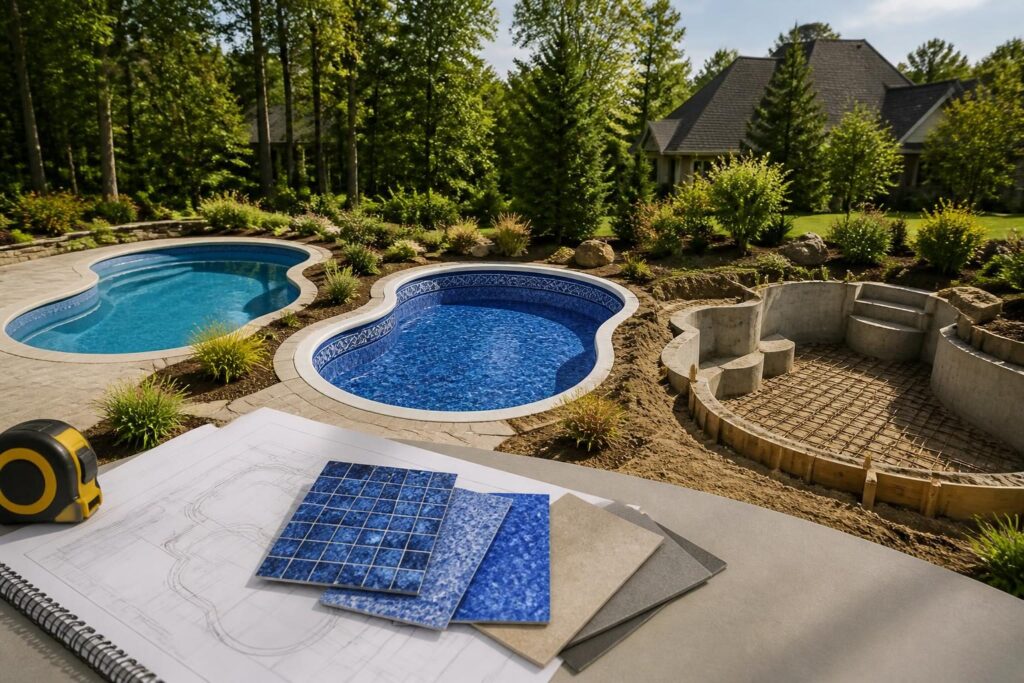
Choosing among pool shells and finishes is easier when you compare the whole project, not only the surface. This fiberglass vinyl concrete pool comparison looks at site access, design flexibility, construction, maintenance, surface life, repair considerations, and homeowner priorities. North Carolina soil, slopes, drainage, utilities, septic features, and local requirements can affect the practical choice.

Start with the three construction approaches
A manufacturer delivers a fiberglass pool as a finished shell. The builder excavates a prepared opening, places the shell, connects plumbing, backfills around it, and completes the surrounding deck and equipment work. The shell shape and dimensions usually come from a manufacturer’s design range.
A vinyl liner pool uses a framed structure, such as steel, polymer, or another approved system, with a flexible liner forming the water-holding surface. Owners can replace the liner. Its pattern and color can change the appearance, but the structure and available shapes still depend on the selected system.
A concrete pool takes shape and receives its finish on the property. Reinforcing steel, plumbing, concrete, interior finish, coping, and surrounding work require coordination as a custom build. This approach can support unusual shapes, varied depths, integrated features, and complex transitions.
None of these categories is automatically best. The right fit depends on the lot, the design brief, the construction plan, the expected use, and the owner’s tolerance for future care.
Fiberglass, vinyl, and concrete: site access and North Carolina conditions
Access can become a design constraint before excavation begins. A fiberglass shell must travel from delivery access to the pool location. The route may involve a narrow side yard, overhead obstructions, fences, slopes, or temporary protection for paving and landscaping.
Vinyl and concrete projects bring materials and equipment to the site in stages. They may offer more flexibility when a complete shell cannot reach the backyard, but excavation, forming, concrete delivery, and spoil handling still require careful planning.
Ask the design team to show how the proposed pool reaches the site and how construction traffic leaves it. Confirm who will review gates, fences, driveways, trees, overhead lines, grading, and restoration. A useful backyard access plan should be specific to your property.
Utilities and wastewater features also matter. Before approving a layout, review easements and utility corridors, and coordinate with the appropriate utility-notification service before excavation. If a septic tank, drain field, or repair area is present, involve the local health department or a qualified septic professional. North Carolina requirements and property-specific limits can vary.
For additional site context, homeowners can review the North Carolina pool site evaluation checklist. It is a planning aid, not a substitute for a survey, engineering review, permit review, or site-specific professional advice.
Customization: shape, depth, and features
Concrete generally provides the broadest design freedom. It can suit a tight corner, a freeform outline, multiple depth zones, tanning ledges, benches, vanishing edges, and unusual geometry. More design freedom also creates more decisions to document and coordinate.
Fiberglass offers a controlled menu of shapes, sizes, steps, ledges, and colors. That can simplify selection and produce a predictable shell. However, the available options may not match every property or every desired feature.
Vinyl liner systems occupy a middle ground. Many can support custom-shaped structures and varied layouts. The liner must fit the installed structure, so late changes to dimensions, steps, or wall details can prove difficult.
Questions for the design meeting
- Which dimensions are fixed, and which can change?
- How will the chosen structure handle the planned depth changes and features?
- Where will lights, returns, drains, steps, benches, and automatic covers go?
- Which features affect access, cleaning, circulation, or future repairs?
- Will the final drawings show elevations, equipment, drainage, deck limits, and finish selections?
Compare complete proposals rather than attractive renderings alone. The article on comparing residential pool design proposals can help you identify missing scope, allowances, owner responsibilities, and drawing differences.
Construction process and project coordination
Fiberglass construction can move quickly once the excavation, base, delivery route, shell placement, plumbing, backfill, and inspections are ready. The manufacturer produces the shell before delivery. That reduces on-site forming, but it does not remove site preparation or coordination.
Vinyl liner construction includes excavation, wall and floor preparation, structure assembly, plumbing, coping, liner installation, filling, and surrounding work. The liner needs careful handling during installation and later use. The condition of the structure below it remains important.
Concrete construction usually includes excavation, steel reinforcement, plumbing, shell forming, concrete placement, curing or preparation, interior finish, coping, deck work, equipment installation, and startup. The sequence and duration depend on design, access, weather, inspections, site conditions, and the selected finish.
Keep a written record of approved plans, changes, selections, inspection documents, equipment information, and final drawings. Ask how weather, groundwater, unsuitable soil, access limits, or changes in drainage could affect the work. Do not assume a verbal explanation changes the contract.
Construction can disturb soil and change runoff paths. The NC DEQ Construction Stormwater Program explains that land-disturbing work may involve stormwater and erosion-control considerations. Confirm project-specific requirements with the local authority and qualified professionals.
Fiberglass, vinyl, and concrete maintenance and ownership
All three pool types require routine water testing, circulation, filtration, cleaning, chemical storage, equipment care, and safe access control. The structure does not eliminate the need for balanced water or regular observation. For general residential water-care guidance, consult the CDC guidance on home pool water treatment and testing.
Fiberglass has a smooth manufactured surface that many owners value for routine cleaning. It can be less forgiving of certain installation or handling problems, so follow the builder’s and manufacturer’s care instructions. Monitor water chemistry and avoid assuming a smooth surface makes maintenance optional.
Vinyl liners need protection from sharp objects, unsuitable cleaning methods, and conditions that can damage or stain the material. The liner is a wear item. Sun exposure, water chemistry, use, weather, and installation quality can influence its service life.
Concrete interiors may require more attentive water-balance management and brushing. Finish type matters. Plaster, pebble, and aggregate surfaces differ in texture, appearance, cleaning behavior, and care. Read this pool surface finish comparison before selecting a concrete interior.
For many owners, a fiberglass vinyl concrete pool comparison becomes most useful when maintenance habits guide the decision. Consider who will test water, clean surfaces, schedule service, and respond to problems.
Surface life, repairs, and renewal
Surface life is not a single guaranteed number. It depends on materials, installation, sunlight, use, water chemistry, cleaning, weather, and maintenance. Ask each provider to describe expected wear without presenting an unsupported promise.
A fiberglass shell may resist ordinary surface wear, but damage from impact, movement, plumbing problems, or installation conditions can require specialized evaluation. Repairs may involve color matching or work that is more visible than routine maintenance.
Owners can patch some localized vinyl liner damage, subject to the product and repair method. Eventually, a liner may need replacement. Replacement can also prompt questions about the supporting structure, coping, fittings, steps, and any water or moisture issues.
Concrete interiors can receive new surfaces. The renewal process may involve preparation, finish selection, water handling, curing, and startup procedures. Cracks, hollow areas, leaks, tile, coping, or structural concerns need qualified evaluation rather than a cosmetic assumption.
Records worth keeping
- Manufacturer, shell, liner, finish, equipment, and installation information.
- Approved drawings, elevations, specifications, selections, and change documents.
- Water-care instructions, startup records, service notes, and test results.
- Photos of concealed plumbing, fittings, penetrations, drains, and equipment connections.
- Warranty terms, exclusions, maintenance duties, and contact procedures.
Match the pool type to your priorities
Choose fiberglass when a manufacturer’s shape fits the site and you value a predictable shell and a controlled selection process. First, confirm delivery access, shell dimensions, feature limits, and the site plan.
Consider vinyl when replaceable liner material and a broad range of structural layouts fit your goals. Ask about liner care, replacement planning, fitting details, and what remains covered when the liner is renewed.
Consider concrete when custom geometry, unusual depth, or integrated features matter more than a simpler surface-renewal path. Review finish maintenance, construction coordination, future resurfacing, and the skill sets required for repairs.
In this fiberglass vinyl concrete pool comparison, homeowner priorities should guide the choice. Think about access, customization, construction oversight, surface care, repair planning, and how long you expect to own the pool.
For any option, compare the complete scope. Include excavation, access protection, drainage, structural work, plumbing, electrical work, equipment, interior finish, coping, deck, startup, inspections, cleanup, and documentation. A lower initial proposal may exclude work that another proposal includes.
A practical decision checklist
- Site: Can materials and equipment reach the proposed location without unreasonable property disruption?
- Design: Does the available shape support your depth, steps, ledges, lighting, and circulation goals?
- Construction: Is the sequence clear, including excavation, inspections, weather delays, and restoration?
- Maintenance: What daily, weekly, seasonal, and professional care will the surface require?
- Renewal: What can be patched, refinished, replaced, or accessed later?
- Documents: Are specifications, exclusions, warranties, owner duties, and final records written down?
- Local review: Have you confirmed current permits, barriers, electrical requirements, setbacks, drainage, septic limits, and inspections?
This fiberglass vinyl concrete pool comparison should help you ask better questions, not produce a universal winner. A complete fiberglass vinyl concrete pool comparison also considers access, design limits, maintenance habits, and future renewal. North Carolina conditions vary by jurisdiction and property. Before committing, consult the local inspections department, a licensed pool contractor, licensed electrician, surveyor, engineer, septic professional, or another qualified specialist as the project requires. Build a Pool in North Carolina offers homeowner-focused planning resources to support that process.