
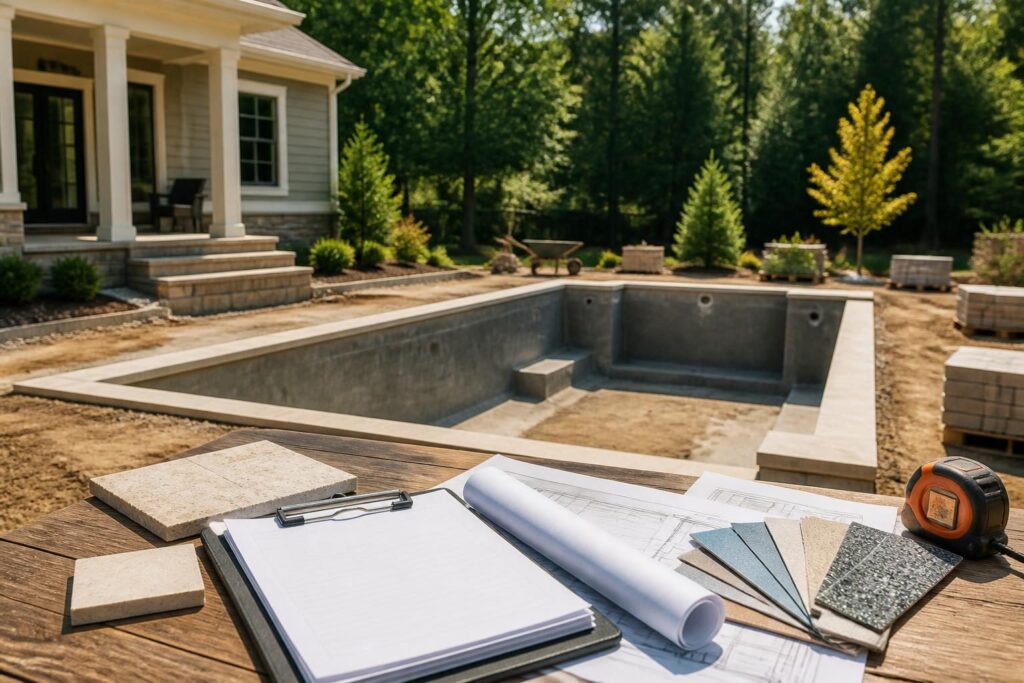
Clear pool construction payment milestones help North Carolina homeowners connect each payment with work they can identify, review, and document. A payment schedule should do more than divide a contract total into convenient dates. It should explain what the builder will complete, which materials will arrive, what inspections or approvals matter, and what records the homeowner should receive.
This article offers questions for planning a payment schedule. It provides general homeowner education, not legal advice. Contract terms, licensing rules, permit procedures, and payment rights can depend on the project, jurisdiction, contract language, and current North Carolina requirements. Consider asking a qualified professional to review important documents before you sign.
Why vague payment milestones create uncertainty
A phrase such as “after excavation” may sound clear until you ask what it includes. Does it mean the crew dug the hole, confirmed the layout, addressed unsuitable soil, and removed excess material? Or does it mean only that excavation equipment left the site?
Similar uncertainty can affect phrases such as “plumbing complete,” “equipment installed,” or “project substantially complete.” These labels may cover several tasks. They may also leave unclear whether the contractor must complete inspections and corrections before requesting payment.
Specific pool construction payment milestones create a shared reference point. They help homeowners track progress without treating a payment request as proof that every related task is complete. They also give both parties a clearer way to discuss changes, delays, missing materials, and unfinished work.
Questions that expose unclear wording
- What exact work must the contractor complete before this payment becomes due?
- What does “complete” mean for this stage?
- Which items fall outside the milestone?
- What documents, photographs, delivery records, or approvals support completion?
- What happens if one part of the stage remains open?
- Who confirms the milestone, and how will that confirmation appear in the records?
Build payments around defined work, not calendar dates
Calendar-based requests may simplify administration, but dates alone do not show project progress. A stronger schedule describes observable work. For example, a contract might separate mobilization, excavation, structural work, plumbing, electrical coordination, finishes, equipment startup, and handover. The exact stages will vary by pool type and scope.
Review the proposed pool construction payment milestones against the actual scope. If the contract includes a retaining wall, drainage work, heater, automatic cover, or extensive decking, ask where each item appears. A schedule that ignores major scope items can make completion difficult to measure.
Use the same names across the proposal, drawings, allowance schedule, change orders, invoices, and final records. Consistent labels reduce confusion when several trades work on related portions of the project.
Questions about each work stage
- Which tasks belong to this stage?
- Do labor, materials, equipment, cleanup, and related trades all belong in the amount?
- Does the stage depend on an approved drawing, selection, or change order?
- Which work must remain visible for review before coverage?
- How will incomplete work affect the payment request?
- Will the contractor update the schedule when the sequence changes?
For broader context, compare the payment stages with the typical sequence described in residential pool construction phases. That sequence provides education, not a substitute for the project-specific schedule.
Connect payment requests with inspections and approvals
Inspections may occur at important points, especially before workers cover construction. However, an inspection approval and a payment milestone do not automatically mean the same thing. Ask whether the contract requires a completed inspection, a passed inspection, a correction response, or only a request for inspection before payment.
Confirm who schedules each inspection and who receives the record. Local requirements can vary by jurisdiction, adopted code, property conditions, utilities, and project scope. The local inspections department can explain the current process for the property.
A payment schedule should address failed or delayed inspections without asking the homeowner to make technical findings. Ask how the team will document corrections, who will coordinate reinspection, and whether the related milestone stays open until the required work receives attention.
Inspection questions to ask before signing
- Which inspections does the project expect?
- Does payment depend on the inspection request, result, or completed correction work?
- Who handles reinspection or correction costs when the cause remains disputed?
- Will the homeowner receive inspection records and correction documents?
- Can workers cover construction before the homeowner receives relevant documentation?
Keep permit and inspection records with the contract. The guide on preparing for pool inspections in North Carolina provides a separate recordkeeping framework. For current state code documents and interpretations, consult the North Carolina Office of State Fire Marshal, then confirm local requirements.
Ask how materials and equipment trigger payment
Material deposits deserve careful attention. A contractor may need funds to order custom items, but “materials ordered” differs from “materials delivered, checked, and ready for installation.” Ask which event triggers payment and which evidence supports the request.
Important items may include structural materials, coping, tile, interior finish, pump, filter, heater, controls, lights, cover components, electrical equipment, and decking materials. The list depends on the design. Confirm whether allowances represent estimates or fixed selections. Ask how the parties will approve substitutions and price differences.
Delivery to the property does not prove that a product is correct, undamaged, complete, or compatible with the approved design. Homeowners should not make technical acceptance decisions alone. Ask the contractor and appropriate specialists to explain the review process.
Material documentation checklist
- Written description, model, size, finish, or specification
- Quantity and delivery status
- Approved selection or change-order reference
- Delivery ticket, invoice, or supporting record
- Storage responsibility and protection from damage
- Process for shortages, damage, substitutions, or discontinued products
Do not assume that a product name on an invoice proves installation or final operation. Ask where installation, testing, startup, manuals, and homeowner training appear in the schedule.
Define documentation as part of completion
Documentation should support decisions throughout construction, not only handover. Before work begins, ask which records will accompany each milestone and which records will arrive at the end.
Useful records may include approved drawings, permit information, inspection results, change orders, product records, equipment manuals, photographs of concealed work, operating instructions, water-care guidance, and a written list of unresolved items. The appropriate records depend on the project and the professionals involved.
Set a practical method for sharing documents. A dated email, project portal, or organized folder can create a reliable record. Use file names that identify the date, stage, and subject. Save the contract version that governed each payment request.
Questions about payment records
- Will every invoice identify the milestone and amount requested?
- Will credits, approved changes, allowances, and prior payments appear clearly?
- Can the contractor provide a current payment ledger?
- Which photos or documents support work that workers will soon conceal?
- When will manuals, serial numbers, warranties, and final records arrive?
If the scope changes, document it before the related payment becomes unclear. Use the pool construction change order checklist to compare revised work, price, schedule, materials, approvals, and payment timing.
Discuss retainage and unfinished work carefully
Retainage means holding back part of a payment until a defined point. Some homeowners ask about retainage when a stage includes punch-list work, testing, documentation, or unresolved items. Whether retainage makes sense or fits the agreement depends on the contract and circumstances.
Do not create a retainage arrangement through informal messages alone. Ask for written terms that explain the amount or percentage, the release event, and the process for disputed or incomplete work. A local attorney or other qualified professional can explain rights and risks under the specific agreement.
Also ask whether final payment requires more than a filled pool. Startup, equipment operation, safety features, cleanup, training, records, inspections, and correction work may all matter. The contract should identify the final completion standard instead of relying on “job finished.”
Final-payment questions
- What must the contractor complete before final payment?
- How will the parties record and resolve punch-list items?
- Do testing, startup, cleaning, and homeowner instruction appear in the scope?
- When will manuals, warranties, approvals, and closeout records arrive?
- What happens if a minor item remains open?
Use a payment review routine during construction
Before approving a request, compare the contract, latest approved changes, and visible project status. Then check the supporting records. This routine does not require the homeowner to inspect technical work personally. It helps identify missing information early.
- Match the invoice to the stated milestone.
- List the included work.
- Confirm approved changes and credits.
- Check inspection or delivery records when required.
- Photograph general progress without disturbing the worksite.
- Write down open questions and request written clarification.
- Save the invoice, response, and related documents together.
Keep safety first. Do not enter excavations, move equipment, open electrical enclosures, or test construction systems unless the responsible professional authorizes and directs that activity. A payment review documents progress; it does not replace qualified inspection.
Questions to ask before approving the schedule
Use this short list during the contract meeting:
- Can each payment connect to a defined scope item?
- What proves completion?
- Which inspections, permits, or approvals affect payment?
- Which materials trigger deposits, and what records support them?
- How will the parties record changes, credits, substitutions, and delays?
- What happens when work is partly complete?
- Are retainage terms written clearly?
- What records belong with final completion?
- Who answers payment questions, and when will records update?
A clear schedule cannot remove every construction risk. It can make expectations easier to compare and open items easier to track. Keep the pool construction payment milestones with the complete project file, rather than in a separate email thread. Review these pool construction payment milestones against each invoice before approving it.
Before signing or withholding a payment, consult the local inspections department about current permit and inspection procedures. Ask a licensed pool contractor, electrician, engineer, surveyor, septic professional, attorney, or other qualified specialist to address questions within that person’s field. North Carolina requirements and project conditions can vary, so verify important details locally.