
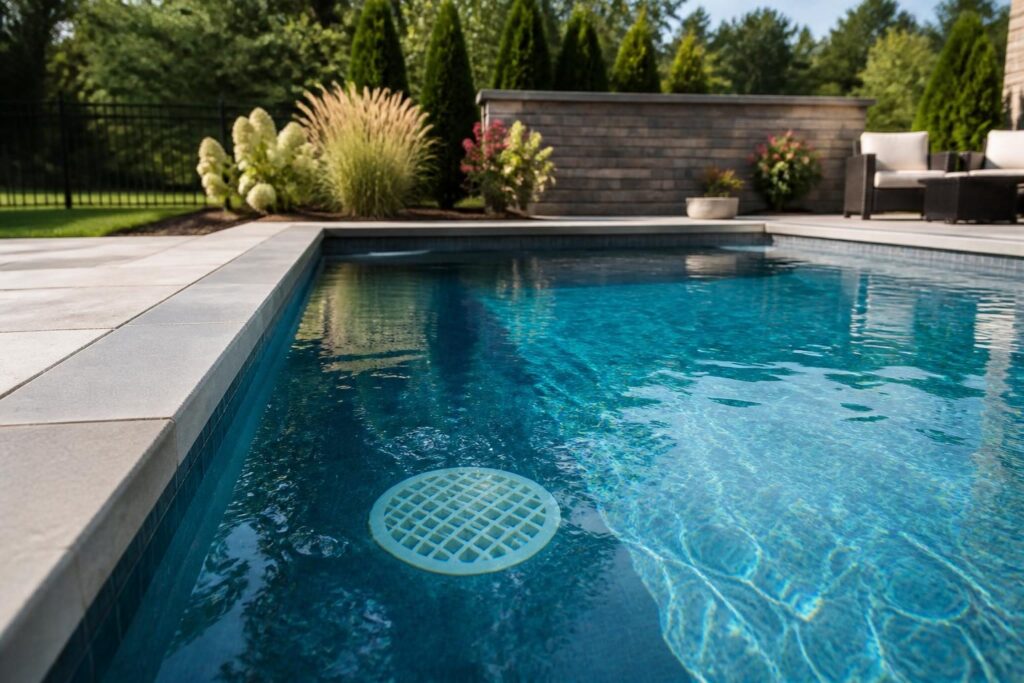
A residential pool drain cover safety checklist can help North Carolina homeowners notice visible concerns before they become confusing service questions. Drain covers and suction fittings sit in the pool shell, so a careful visual review matters. However, homeowners should not remove, loosen, test, or repair these components themselves.

Pool suction safety involves more than one cover. It can include floor drains, wall suction outlets, skimmer openings, plumbing, valves, pumps, and related protective parts. The exact arrangement depends on the pool design and equipment. Use this guide to observe safely, preserve useful records, and decide when a qualified pool professional should evaluate the system.
Why drain covers deserve careful attention
A drain cover is the visible grate or fitting over an opening connected to pool circulation plumbing. Water moves through that opening toward equipment or another circulation point. A return fitting sends treated water back into the pool. These components serve different functions, although both may appear near the pool floor or walls.
Suction becomes a safety concern when a cover goes missing, suffers damage, comes loose, becomes obstructed, or does not suit its installed location. The risk cannot be judged reliably from appearance alone. Internal fasteners, the fitting body, plumbing, and system design may require professional review.
Age, sunlight, chemicals, freezing weather, impact, cleaning tools, and construction work can affect visible parts. North Carolina pools may also experience seasonal debris and temperature changes. A cover that looks acceptable from above still deserves attention if it moves, cracks, or does not sit correctly.
Federal consumer guidance encourages multiple layers of protection around pools. Read the U.S. Consumer Product Safety Commission’s Pool Safely safety tips alongside your local requirements and the instructions for your equipment.
Residential pool drain cover safety checklist: what to observe
Perform a visual review only when the area has good lighting and the water remains clear enough to see the fitting. Keep swimmers out of the pool during the review. Do not put your hands, feet, tools, or a pole near an opening to check its strength.
- Location: Note each visible drain, suction outlet, skimmer, and return fitting. Compare the locations with the pool drawings if you have them.
- Cover presence: Confirm that each expected cover appears in place. Do not assume an opening is safe because it has partial coverage.
- Surface condition: Look for cracks, breaks, sharp edges, severe discoloration, missing sections, or obvious distortion.
- Fit: Check whether the cover appears flush with its frame. A tilted, lifted, sunken, or visibly loose cover needs professional attention.
- Fasteners: Look for missing, broken, corroded, or visibly mismatched screws. Do not tighten or replace them yourself.
- Obstructions: Observe whether leaves, toys, cleaning tools, or other objects cover an outlet. Remove only loose debris from a safe distance, without reaching toward the fitting.
- Nearby surfaces: Note cracking, movement, settlement, sharp edges, or damage around the fitting and pool finish.
- Water behavior: Record unusual turbulence, vortex-like movement, rattling, vibration, or a sudden circulation change. Do not deliberately block an outlet to test it.
Take photographs from the deck or another stable location. Include a wider image that shows the fitting’s position and a closer image that shows its condition. Avoid entering the water merely to obtain a better photograph.
Questions about labels and compatibility
Some covers include markings, dates, model information, or flow-related information. Record what you can read without disturbing the part. A faded label or missing marking does not prove that a cover presents a hazard, but it may make identification harder.
Ask a qualified pool professional to identify the installed component and confirm whether the replacement, frame, fasteners, and opening work together. Do not substitute a generic grate based only on size, color, or appearance. Compatibility may involve the outlet body, flow design, mounting pattern, and the overall circulation system.
Warning signs that call for prompt professional evaluation
Stop using the affected pool area and seek qualified guidance when a cover goes missing, breaks, detaches, develops a sharp edge, or appears loose. Keep people away from the opening. If the pool cannot be secured safely, ask the appropriate professional how to restrict access until evaluation occurs.
Also request an evaluation after a significant impact, unexplained fitting movement, unusual suction behavior, or work that may have affected the pool shell or circulation plumbing. A drain-cover concern may involve more than the visible grate. A professional may need to identify the component, inspect its attachment, review the circulation layout, and determine whether the system should remain in service.
Do not operate a pump with a known damaged or missing suction cover unless a qualified professional has provided safe, property-specific instructions. Do not enter the water to retrieve a detached part. Never improvise with wire, adhesive, a household screw, a drain basket, or a homemade cover.
These steps provide safety precautions, not a code determination. North Carolina requirements can vary by jurisdiction, adopted code, pool type, alteration scope, and site conditions. Contact the local inspections department for current requirements and ask a qualified pool professional about the equipment condition.
Records to keep with your pool documents
Good records help a professional understand what changed and when. They also give you a consistent reference for future maintenance. Store copies with your pool plans, equipment manuals, warranty papers, and inspection records.
- A dated map or marked plan showing visible drains, suction outlets, skimmers, and returns.
- Clear photographs taken from the deck, with notes about the location and lighting.
- Manufacturer name, model, label, or other identification visible on each component.
- Installation, replacement, or service invoices that describe the work without adding assumptions.
- Reports, recommendations, and written instructions from qualified professionals.
- Dates and descriptions of observed cracks, movement, missing parts, unusual sounds, or circulation changes.
- Related inspection, permit, or approval documents supplied for the pool project.
- Notes about access restrictions or temporary precautions used after a concern was found.
Separate observations from conclusions. For example, write “cover appears lifted on the right side” rather than “cover failed.” This keeps the record factual and gives the evaluator a clearer starting point.
If you approve a repair or replacement, save the written scope, component identification, photographs before and after work, and any operating instructions. If the work changes the pool layout or equipment, compare the revised information with the original documents. Our guide to the pool design revision checklist explains why updated drawings and records matter.
Questions to ask a qualified pool professional
Prepare questions before the appointment. You do not need to diagnose the problem. Your goal is to describe what you observed and learn what evaluation fits the situation.
- What type of fitting or cover does this location use?
- What visible condition caused concern, and what additional inspection do you recommend?
- Do the cover, frame, fastener, and outlet appear to form a matched system?
- Should the pump or affected circulation equipment remain off until review?
- Could nearby finish damage or movement affect the fitting’s attachment?
- What component information should I record for future replacement?
- Will the proposed work alter plumbing, electrical equipment, the pool shell, or the approved design?
- Which local authority or licensed specialist should review the work, if applicable?
- What written instructions should the homeowner follow after service?
Ask for a written description of the observed condition and the recommended next step. Keep the answer with your project file. For broader handover records, use the new pool handover checklist to collect manuals, service details, and safety information.
How drain safety fits into the larger safety plan
A sound drain cover does not replace supervision, barriers, safe access habits, or appropriate equipment maintenance. Review gates and doors separately, because a secure pool boundary addresses a different risk. You can use this pool gate and door safety checklist for that part of the review.
Keep toys and loose objects away from circulation openings. Teach children never to sit, stand, or play near drain covers. Do not rely on a cover, alarm, camera, or adult presence alone. Layered precautions work together, and each layer can fail or be bypassed.
Electrical components near the pool add another separate concern. If a drain repair involves a pump, lighting, bonding, grounding, or other powered equipment, use a licensed electrician for the electrical portion. Do not open equipment panels or make wiring changes as part of a drain inspection.
When to pause and call for help
A residential pool drain cover safety checklist supports observation, not self-repair. Pause the inspection if the water is cloudy, lighting is poor, access is unstable, or you cannot identify the fitting. Do not enter the pool to investigate a suspected defect.
Keep children and other swimmers away when a cover has damage, goes missing, or remains uncertain. Record the condition from a safe position, follow any immediate instructions from a qualified professional, and retain all written information. For local permits, inspections, or adopted code questions, consult your local inspections department. For component evaluation, use a qualified pool contractor, and involve a licensed electrician, engineer, surveyor, or septic professional when the project conditions call for one.
Using a residential pool drain cover safety checklist is most useful when it leads to safe documentation and qualified evaluation, rather than an improvised repair.