
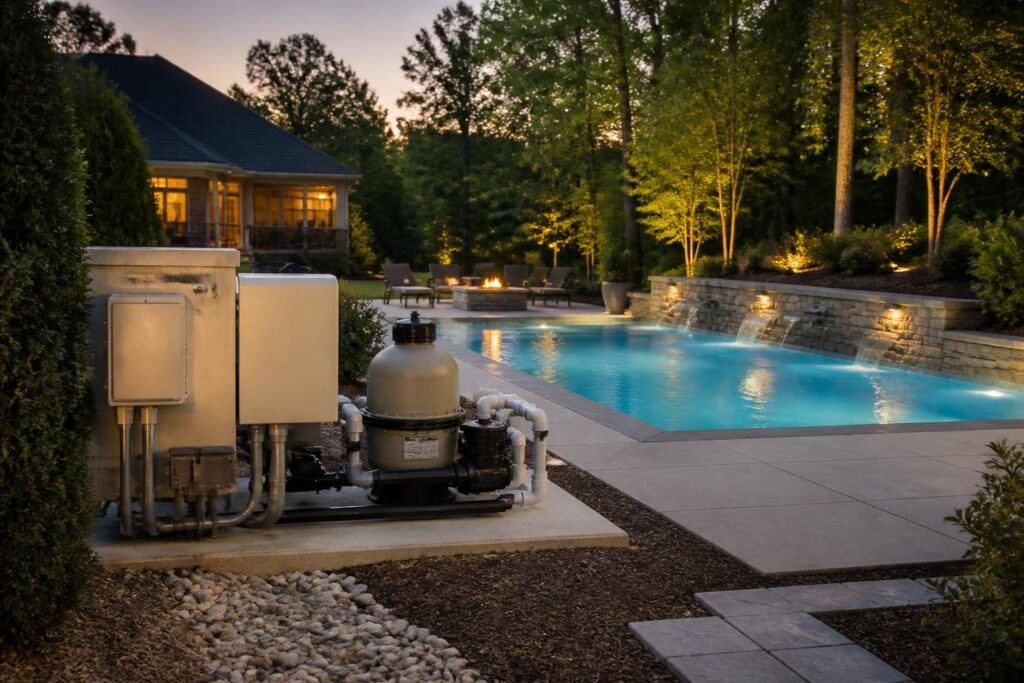
These residential pool electrical bonding grounding review questions can help North Carolina homeowners prepare for a final conversation with the appropriate qualified professionals. You do not need to understand every wire or measurement. You do need a clear record of what someone installed, what someone tested, and what still requires local approval.

Bonding and grounding are related, but they are not the same task. In general terms, bonding connects conductive metal parts so they remain at a similar electrical potential. Grounding connects electrical systems to an approved grounding path. A licensed electrician or other qualified professional must determine how those concepts apply to your pool, equipment, property, and current requirements.
Why electrical review deserves a final-project conversation
Pool electrical work can involve the circulation pump, heater, automation controls, receptacles, underwater lights, metal components, equipment enclosures, and nearby structures. The correct approach depends on the project design and the electrical system serving the home.
North Carolina requirements can vary with the local jurisdiction, adopted code, property conditions, utility arrangement, and project scope. The North Carolina Office of State Fire Marshal documents can provide code-related resources, but homeowners should confirm current requirements and local interpretation with the inspections department.
Final review is also a documentation exercise. A homeowner should be able to identify which professional performed each part of the work, which items someone tested, and where the records are stored. If a record is missing, ask whether the professional can provide it or whether a qualified professional should evaluate the installation.
residential pool electrical bonding grounding review questions for the electrician
Use plain-language questions rather than attempting to inspect energized equipment yourself. Ask the electrician to explain each answer in terms you can record and understand. These residential pool electrical bonding grounding review questions work best when you discuss them before final acceptance, not after a concern develops.
- Which pool-related parts did you include in the bonding plan?
- How did you address the pool structure, metal components, equipment, and other applicable conductive parts?
- Which grounding paths serve the pool equipment and controls?
- Did you change any existing home circuits, panels, disconnects, or grounding arrangements?
- Which equipment has ground-fault protection, and how do you test that protection?
- How should I test or reset the protective devices during normal ownership?
- Did you include the underwater lights and their transformers, junction points, or controls in the review?
- Are all outdoor covers, enclosures, disconnects, and labels accessible and clearly identified?
- Which work did your firm complete, and which work did another trade complete?
- What should I do if a device trips repeatedly, becomes warm, shows damage, or will not reset?
Do not remove covers, open panels, alter wiring, or reach into equipment to verify an answer. A visible label or switch does not prove that an installation is safe or complete. Ask for professional evaluation when the answer involves testing, concealed conductors, panel work, or a code decision.
Questions about equipment connections and the equipment area
The equipment area should support safe operation and future service. Review it with the pool contractor and electrician together when responsibilities overlap. The goal is not simply to confirm that the pump starts. You want to understand how the equipment receives power, operates, stays protected, and receives maintenance.
- Which equipment is connected now, and which future equipment did the plan only anticipate?
- Are the pump, heater, salt system, chemical controller, automation panel, and other devices identified?
- Does each disconnect or control have a clear label?
- Can a qualified service professional reach the equipment without moving stored items or landscaping?
- Are electrical components protected from expected water exposure and weather?
- Did anyone change equipment after the original drawings or proposal?
- Do the final equipment names and locations match the approved project documents?
- Who should approve any future equipment addition before someone connects it?
Keep a final equipment list with model information, circuit identification, controls, and service contacts. The pool equipment startup checklist can help you organize handover questions without replacing an electrical review.
Ask about changes near water and drainage
Water movement matters around an equipment pad. Ask whether drainage, splash, irrigation, runoff, or standing water could affect electrical equipment. Do not assume a raised pad or weather-resistant enclosure resolves every concern.
Have the electrician and relevant site professional explain any required separation, protection, or drainage changes. Record who gave the direction and which drawing, inspection record, or field change supports it.
Lighting questions that homeowners can ask safely
Underwater and landscape lighting can involve different fixtures, transformers, wiring methods, controls, and service needs. A light that operates during a demonstration does not, by itself, prove that someone completed every part of the installation review.
Ask these questions before accepting the lighting work:
- What type of underwater lighting did you install?
- Where are the transformer, junction points, controls, and disconnects?
- How do the lights operate, and what happens after a power interruption?
- Which areas can a professional service without entering the pool?
- Did anyone change fixture locations or quantities during construction?
- What symptoms require immediate shutoff and professional evaluation?
- Are replacement parts and compatibility information included in the records?
For design context, review the earlier guide on pool lighting planning before construction. That article addresses placement and use. Your electrician must address installation-specific safety and connection questions.
Inspection records and final approval questions
Homeowners often receive scattered emails, photographs, invoices, and permit notices. Create one electrical section in your project file. Ask for readable copies, then compare them with the final equipment and site conditions.
Records to request
- Electrical permit information, when applicable.
- Inspection results, approvals, corrections, and final sign-off records.
- Electrical drawings, marked-up plans, or as-built information, if prepared.
- Equipment schedules and circuit identification.
- Manufacturer instructions for lights, transformers, controls, and protective devices.
- Testing or commissioning records supplied by the qualified professional.
- Documentation of approved changes affecting electrical work.
- Names and contact details for the professionals responsible for later service.
Ask the local inspections department which records its permit system provides. Requirements for permits, inspections, documentation, and final approval can vary. Do not treat a contractor’s statement that an item is “complete” as the same thing as jurisdictional approval.
If the project remains in progress, compare the final electrical scope with the written contract. The residential pool construction contract scope checklist can help you locate responsibilities, exclusions, and included documentation.
A nontechnical final review checklist
Walk through the following list with the appropriate professionals. Mark each item as documented, explained, pending, or not applicable. Keep the completed list with your project records.
- Identify the responsible professionals. Record the electrician, pool contractor, equipment installer, and inspections department contact.
- Confirm the scope. List every pool-related electrical component someone installed or changed.
- Discuss bonding. Ask which conductive parts the professional addressed and how the professional verified the work.
- Discuss grounding. Ask which equipment and circuits received grounding connections and protection.
- Review protective devices. Learn which devices protect the system and how an owner should respond to a trip.
- Review lighting. Confirm fixture information, controls, transformers, access, and service instructions.
- Compare documents with reality. Check equipment locations, labels, and controls against the final installation.
- Collect approvals. Keep inspection outcomes and correction records with the permit file.
- Record unresolved items. Use a dated list. Assign each question to a named professional without guessing the answer.
- Plan future changes. Ask who must approve new heaters, pumps, lights, controls, or outdoor electrical work.
Warning signs that call for professional follow-up
Stop and seek qualified evaluation if you notice damaged covers, exposed conductors, unexplained tripping, tingling sensations, corrosion at electrical components, water inside an enclosure, missing labels, or equipment that operates differently after rain. Keep people away from questionable equipment until the responsible professional gives clear direction.
Repeatedly resetting a protective device can hide a developing problem. Do not bypass a device, use an extension cord as a permanent solution, or rely on online instructions for panel or pool wiring changes.
Records also deserve follow-up. A missing inspection result, unclear responsibility, or mismatch between the approved plan and installed equipment should become a documented question. It does not automatically prove a defect. It does mean the issue deserves an answer from the appropriate authority or licensed professional.
Keep a simple electrical handover file
Store digital copies in a backed-up folder and keep a printed quick-reference sheet near, but not inside, the equipment area. Include the final equipment list, labels, emergency shutoff information, inspection records, manuals, warranties, and service contacts.
Add photographs of labels and accessible equipment conditions. Avoid opening electrical enclosures for photographs. Date the images and note any later changes, service visits, or replacement parts.
Use these residential pool electrical bonding grounding review questions to keep the final conversation focused, documented, and understandable. Build a Pool in North Carolina can help homeowners organize questions across the broader project. Electrical decisions still belong with the local inspections department and qualified professionals who can evaluate the actual installation.
Before final acceptance, consult the local inspections department for current permit and inspection requirements. Ask a licensed electrician to evaluate bonding, grounding, protection, equipment connections, and lighting. Depending on site conditions, also consult the pool contractor, engineer, surveyor, or another qualified specialist. Local requirements and professional judgment should control the final decision.