
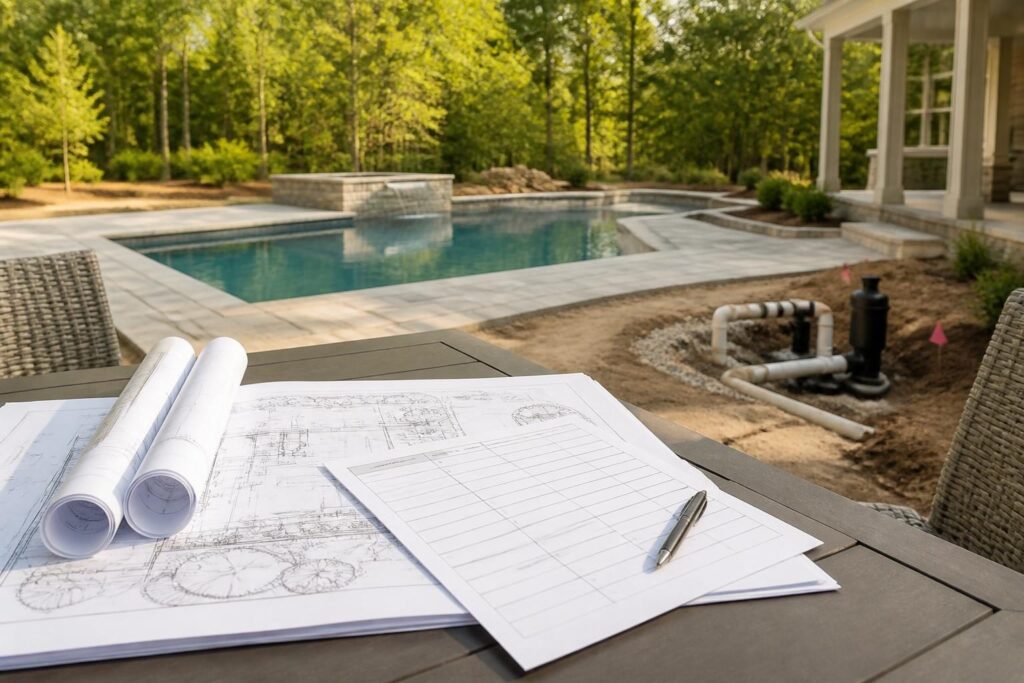
A pool construction allowances and exclusions checklist can help North Carolina homeowners compare proposals more fairly. Two proposals may show similar pool sizes and attractive features while assigning very different costs to excavation, drainage, electrical work, permits, finishes, and restoration.

The goal is not to choose the longest proposal. It is to understand what each price includes, what remains uncertain, and what could become an extra charge. This pool construction allowances and exclusions checklist also gives you better questions for a licensed pool contractor and other qualified professionals.
Start with a scope comparison, not the headline price
A proposal sets out the planned work and payment. It may include drawings, specifications, allowances, exclusions, assumptions, and homeowner responsibilities. Read these parts together.
An allowance is a budget placeholder for an item that you have not selected or fully priced. Examples may include a light fixture, coping material, landscape repair, or electrical connection. An exclusion identifies work or materials outside the quoted scope.
Neither term is automatically a problem. The risk appears when the description is too vague to estimate the likely final cost. A proposal that says “standard equipment” gives you less information than one that names the equipment type, capacity basis, controls, installation, and included accessories.
Build one side-by-side comparison sheet
Use the same headings for every proposal. Record the exact wording, not only your interpretation. Add a column for “uncertain,” “owner responsibility,” or “confirm locally” when the document does not answer the question.
- Pool dimensions, depth, shape, elevations, and construction method
- Interior finish, tile, coping, steps, benches, and water features
- Decking, concrete limits, drainage features, and surface restoration
- Excavation, rock or groundwater assumptions, haul-off, and access
- Equipment, plumbing, controls, electrical work, and startup
- Permits, drawings, inspections, utility coordination, and fees
- Fencing or other barriers, gates, alarms, and safety-related work
- Landscaping, irrigation repair, seeding, grading, and erosion control
- Payment stages, change procedures, warranty documents, and closeout records
For a broader review of written scope, see the pool construction contract scope guide. It can complement this allowance-focused review.
Find vague allowances before they become budget surprises
Allowances deserve special attention because the quoted total may depend on them. Ask whether each allowance covers only the product or also delivery, installation, trim, wiring, controls, taxes, and disposal.
For each allowance, write down four items: the budget amount, the unit or quantity, the selection deadline, and the process for a credit or increase. A fixture allowance without a quantity may not tell you the real budget. A decking allowance without a square-foot basis may also be difficult to compare.
Questions for common allowances
- Finish materials: What product range and installed quantity does the allowance cover?
- Decking: Is the amount based on a stated area, thickness, reinforcement, finish, and access condition?
- Electrical: Does the allowance cover the equipment connection, bonding, controls, trenching, and permit-related work?
- Landscape repair: Does it include soil, grading, seed, sod, plants, irrigation adjustments, and cleanup?
- Excavation: What conditions are assumed for rock, unsuitable soil, groundwater, access, and excess spoil?
- Drainage: Is the amount tied to a defined design, outlet, pipe size, grading change, or professional plan?
Ask the contractor to replace important allowances with selected products or measurable specifications before signing, where practical. If selection must wait, ask how the allowance will be reconciled in writing. This pool construction allowances and exclusions checklist works best when each uncertain item has a stated decision process.
Do not assume a low allowance is a bargain. It may simply move more decisions and cost risk into the construction period.
Read exclusions as carefully as inclusions
Exclusions often contain the work that makes a pool fit the property. Look for phrases such as “by owner,” “if required,” “not included,” “allowance only,” and “subject to site conditions.” Then ask what event would activate an added cost.
Commonly overlooked categories include permit fees, surveys, engineering, utility locating, tree removal, access repairs, spoil removal, rock excavation, groundwater management, retaining structures, drainage, electrical service upgrades, fencing, and landscape restoration.
North Carolina properties vary widely. Local requirements may differ by jurisdiction, adopted code, utilities, septic systems, flood zones, easements, soil, and project scope. A proposal should identify its assumptions without pretending that every site condition is known in advance.
Separate unknown site conditions from omitted work
Some costs require evaluation by a qualified professional or confirmation during work. That does not mean the proposal should stay silent. Ask how the contractor will document the condition, price added work, obtain approval, and record any schedule effect.
For example, groundwater may affect excavation and construction decisions. Review questions about groundwater and hydrostatic pressure before treating excavation as a fixed, risk-free item.
Drainage and land disturbance also need property-specific review. The NC DEQ Construction Stormwater Program explains that construction stormwater requirements can depend on the project and site. Confirm applicability with the appropriate authority or qualified professional.
Compare site work and restoration in measurable terms
Headline pool features are easy to notice. Site work is easier to overlook and can affect the finished yard. Compare the assumptions behind excavation, access, grading, drainage, and cleanup.
- Where will machinery enter, and what surface protection does the proposal include?
- Does excavation pricing include loading, hauling, disposal, or only moving soil on site?
- What happens if the property has rock, wet soil, buried debris, or limited truck access?
- Does the price include final grading, and which areas will the contractor restore?
- Are damaged walks, driveways, fences, irrigation, plantings, and lawn included or excluded?
- Who supplies temporary erosion controls and maintains them during construction?
- Where will drainage discharge, and who confirms that the proposed approach fits the property?
Take photographs of existing conditions and attach a written site-access plan to the proposal when possible. Clear records can reduce confusion about pre-existing conditions and agreed restoration.
Utility and septic issues require separate verification. Use the utility easement planning guide when an easement may affect placement, access, excavation, or future repairs. Ask the local health department or septic professional about property-specific wastewater constraints.
Check equipment, electrical work, and startup details
Equipment lists should identify more than brand names. Compare the type, size basis, controls, installation location, included valves and fittings, service access, and startup instructions. If a proposal says “complete equipment package,” request a separate schedule.
Electrical scope often creates uncertainty. Ask whether the price includes the circuit work, equipment connections, bonding, grounding, trenching, disconnects, controls, inspections, and service changes. A licensed electrician should determine the appropriate electrical work for the property and installation.
Also confirm what happens at startup. A useful closeout package may include equipment manuals, model information, warranties, operating instructions, water-care guidance, inspection records, and approved changes. These records matter when you later need service or warranty support.
Compare the operating plan, not only the equipment
A lower initial price may reflect fewer controls, different heating assumptions, or less included automation. A higher price may include features you do not need. Ask each contractor to describe intended use, energy decisions, maintenance tasks, and future service access.
For heating questions, compare the factors in this guide to pool heater options. Keep product selection separate from installation scope so you can see whether the quote covers both.
Use a written question-and-answer process
Send the same written questions to each contractor. Request answers beside the relevant proposal item or in a revised scope. Verbal explanations can help, but important decisions belong in the contract, exhibit, drawing, or signed change document.
Useful questions include:
- What is the exact quantity, unit, product range, or performance basis?
- What assumptions apply to access, soil, groundwater, utilities, and disposal?
- Which tasks does the proposal exclude but commonly need for this property?
- How are allowance credits, upgrades, and unused amounts calculated?
- What written approval is required before extra work begins?
- Which party obtains each permit, inspection, approval, or professional design?
- What records will the contractor deliver at completion?
Review the contractor’s licensing and contract information through the North Carolina Licensing Board for General Contractors consumer overview. Confirm current requirements and project-specific licensing questions through the appropriate official source.
Make the final comparison decision-ready
After clarification, recalculate each proposal using three labels: included, priced allowance, and unresolved. Do not combine an unresolved item with the base price as though it were complete. Instead, show a separate risk list and ask what information would reduce it.
Use this pool construction allowances and exclusions checklist one final time before selecting a proposal. A last review can reveal differences that remain hidden in headline totals.
A decision-ready comparison should let you answer:
- Are the pool dimensions, materials, and features genuinely equivalent?
- How consistently do the proposals describe site work and restoration?
- What homeowner responsibilities does each proposal assign?
- Which proposal covers permits, inspections, utilities, barriers, and professional services?
- Can you explain how changes and allowances will be priced?
- Will the final records support operation, maintenance, and future service?
Choose the proposal you understand best, not simply the one with the lowest starting number. Clear scope does not eliminate site uncertainty, but it makes uncertainty visible and easier to manage.
Build a Pool in North Carolina provides homeowner education, not project-specific legal, engineering, electrical, environmental-health, or code-compliance advice. Before approving a proposal, consult the local inspections department, licensed pool contractor, electrician, engineer, surveyor, septic professional, or other qualified specialist when the issue falls within that person’s expertise.