
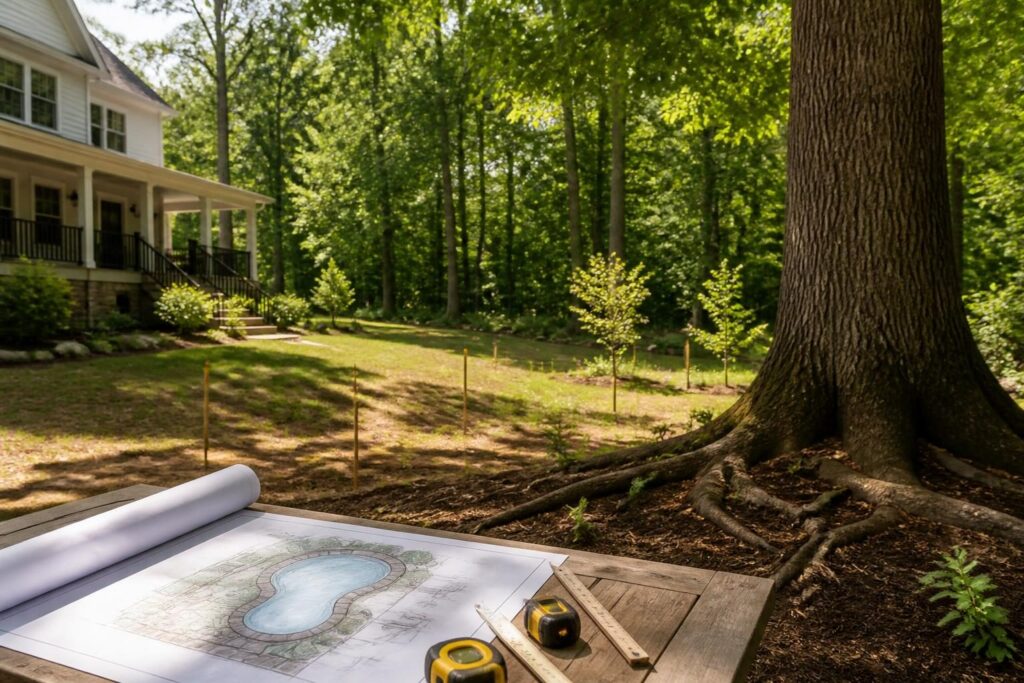
Pool construction near trees North Carolina homeowners often involves more than choosing a sunny area in the backyard. Trees can affect excavation, drainage, construction access, water quality, deck maintenance, and the comfort of the finished pool.

A tree does not automatically rule out a pool location. However, the decision should account for the tree’s size, species, health, root zone, canopy, slope, and likely future growth. The best layout may require a different pool position, selective pruning, professional tree work, or a qualified review of site conditions.
Use the questions below during early planning. Requirements can vary by local jurisdiction, property conditions, adopted codes, utilities, septic systems, and project scope. Ask the local inspections department and appropriate professionals to confirm current requirements.
Start with a tree-by-tree site review
Begin before a pool designer draws a final layout. Walk the proposed pool area with a simple site sketch, recent photographs, and a list of every nearby tree. Mark trunks, visible roots, slopes, fences, overhead branches, and areas where water collects.
Do not judge a tree’s underground spread from the trunk alone. Roots may extend beyond the canopy, and visible conditions can change with soil type, moisture, grading, and past construction. A licensed arborist can assess tree health and likely construction concerns. An engineer or other qualified professional may also help when excavation could affect slopes, walls, structures, or unusual soil conditions.
- What species and approximate age is each tree?
- Are trunks leaning, damaged, hollow, or showing signs of disease?
- Are large limbs positioned over the planned pool, deck, house, or equipment?
- Does the site contain exposed roots, soft ground, standing water, or erosion?
- Could construction equipment reach the pool area without damaging trees or soil?
- Will the proposed pool interfere with future access for pruning or tree care?
Keep these observations separate from professional conclusions. Photos and notes help the design team understand existing conditions, but they do not replace an arborist’s assessment or a site-specific plan.
Understand how roots can affect excavation
Pool excavation removes soil from a defined footprint and may require working space around that footprint. Cutting through roots can stress a tree, create instability, or complicate construction. The outcome depends on the tree, root size, soil, excavation method, and distance from the trunk.
Roots can also create practical problems for construction access. Heavy equipment may compact soil around remaining trees. Compaction reduces pore space and can affect air and water movement. Stockpiled soil, concrete washout, fuel, and other materials should stay away from protected trees and drainage paths.
Pool construction near trees North Carolina requires early coordination between the pool contractor and tree professional. Ask them to coordinate before excavation:
- Which trees should remain, and what protective area should surround each one?
- Will the proposed excavation cut roots or change soil levels near a trunk?
- How will equipment travel across the property?
- Where will excavated soil, materials, and wash water be managed?
- What happens if roots appear in the planned pool footprint?
- Who approves a layout change before work continues?
Get important decisions in writing. A drawing should identify trees to remain, trees approved for removal, protection measures, and any areas that require professional review. If field conditions differ from the plan, pause the affected decision and document the change.
For broader site constraints, compare your tree observations with a North Carolina pool site evaluation checklist. A boundary survey may also clarify easements and structures that limit the available layout.
Evaluate shade, falling debris, and pool comfort
Shade can make a pool area more comfortable during hot weather. It can also reduce direct sunlight on the water and create cooler surfaces. Those benefits should be weighed against leaves, seeds, flowers, sap, bird activity, and branches that may fall during storms.
Debris adds work for skimming, baskets, filters, covers, and water testing. Organic material can also consume sanitizer as it decomposes. The amount varies by tree type, season, wind exposure, and the distance between the canopy and water.
Consider the entire canopy, not only the pool edge. A branch that does not reach the water today may become a concern as the tree grows. Seasonal changes matter, too. Visit the site during leaf drop, spring pollen, heavy rain, and windy weather when possible.
Questions about shade and maintenance
- Will shade cover the pool during the hours your household expects to swim?
- Which trees shed leaves, cones, seeds, flowers, or sticky material?
- Can a cover protect the water without creating difficult access or safety issues?
- Will branches block lighting, views, fencing, or emergency access?
- Can pruning reduce debris without harming the tree’s health or structure?
- Where will leaves collect after wind or rain?
Tree-related maintenance should be part of the ownership estimate. More skimming may be manageable for one household but frustrating for another. If you plan an automatic cleaner or robotic device, ask how debris load and pool shape may affect its use. A filter may also require more frequent attention when the surrounding landscape produces heavy debris.
For related seasonal care, see this guide to North Carolina pollen pool maintenance and the practical guide to cleaning a residential pool filter based on pressure and water conditions.
Review drainage and changing ground levels
Trees influence water movement through roots, soil structure, canopy interception, and fallen organic material. Pool construction can change that movement by removing soil, adding a deck, building walls, or redirecting runoff. The finished plan should show how rainwater moves around the pool and away from the house.
Pool construction near trees North Carolina can change runoff patterns when grading, hard surfaces, or tree removal alter the ground. Do not assume a tree will absorb enough water to solve a drainage problem. Nor should you assume removing a tree will eliminate wet ground. Drainage depends on grades, soil, roof runoff, hard surfaces, groundwater, and nearby features.
Ask for clear answers about:
- Where will runoff go during an ordinary storm?
- Could water collect between the pool, house, deck, or property boundary?
- Will grading bury roots, expose roots, or direct water toward a retained tree?
- Does the site have a basement, crawl space, steep area, swale, or retaining wall?
- Will construction disturb enough ground to require erosion or sediment controls?
North Carolina’s construction stormwater program may apply based on land-disturbing activity and project circumstances. Review the NC DEQ Construction Stormwater Program, then confirm the current requirements with the responsible local or state authority. The pool contractor, designer, or erosion-control professional can help identify which questions need formal review.
If groundwater or saturated soil appears during planning or digging, that is a separate technical issue. Read about groundwater and hydrostatic pressure questions, and ask a qualified professional to evaluate site-specific conditions.
Decide whether removal or pruning makes sense
Removing a tree may improve access, reduce debris, or create room for a better layout. It may also change shade, privacy, wind exposure, soil stability, drainage, and the appearance of the yard. Removal is therefore a design decision, not only a clearing task.
Before approving removal, ask whether a local ordinance, development restriction, conservation condition, HOA rule, easement, or other property limitation protects the tree. Requirements can differ by municipality and property. The local planning or inspections office can explain which authority should be contacted.
Hire a qualified tree professional for tree work. Do not direct a crew to remove a tree based only on a pool sketch. The professional should consider nearby structures, overhead lines, access, stump removal, root disturbance, and the health of trees that remain.
A removal decision checklist
- Has a qualified tree professional reviewed the tree’s condition and removal risks?
- Does a local rule, easement, HOA document, or other restriction protect the tree?
- Will stump grinding or root removal affect the future pool footprint?
- Could removal increase erosion, runoff, wind, or sun exposure?
- Will replacement planting interfere with the pool, deck, utilities, or drainage?
- Does the pool plan show the removal area and the final grading?
Pruning can be a useful alternative, but it should protect the tree’s structure and long-term health. Ask an arborist what pruning is appropriate. Avoid treating aggressive trimming as a permanent solution to a poor pool location.
Plan the finished landscape and future care
Tree planning does not end when the pool shell is complete. The finished landscape must leave room for safe access, pruning, deck cleaning, drainage inspection, and equipment service. New trees should be selected for mature size, root behavior, litter, water needs, and placement.
Keep vegetation away from equipment air intakes and service panels as directed by the equipment manufacturer and qualified installer. Irrigation should not spray directly onto the pool, deck, house, or electrical equipment. Coordinate planting and irrigation with the pool layout instead of adding them after construction without a plan.
Maintain a project record containing:
- The site plan showing trees to remain and trees to be removed
- Arborist, survey, engineering, drainage, or septic documents
- Photographs taken before clearing and excavation
- Written decisions about root protection, pruning, removal, and grading
- Updated drawings when the pool location changes
- Planting, irrigation, drainage, and equipment-care information
A thoughtful layout may preserve a valuable tree while placing the pool far enough away to reduce future conflict. In other cases, moving the pool or removing one tree may create a safer, easier-to-maintain yard. Compare those options before excavation makes the decision more expensive.
Make the tree decision before approving the pool site
Pool construction near trees North Carolina requires coordination among the homeowner, pool designer, contractor, tree professional, and any other specialist who understands the property. Focus on roots, canopy, debris, shade, drainage, access, mature growth, and local restrictions.
Build a Pool in North Carolina encourages homeowners to ask for drawings that show the whole site, not only the pool shape. When roots, grading, removal, drainage, septic components, utilities, or structural concerns appear, consult the local inspections department, a licensed pool contractor, licensed electrician, arborist, engineer, surveyor, septic professional, or other qualified specialist as appropriate. Confirm current local requirements before work begins.