
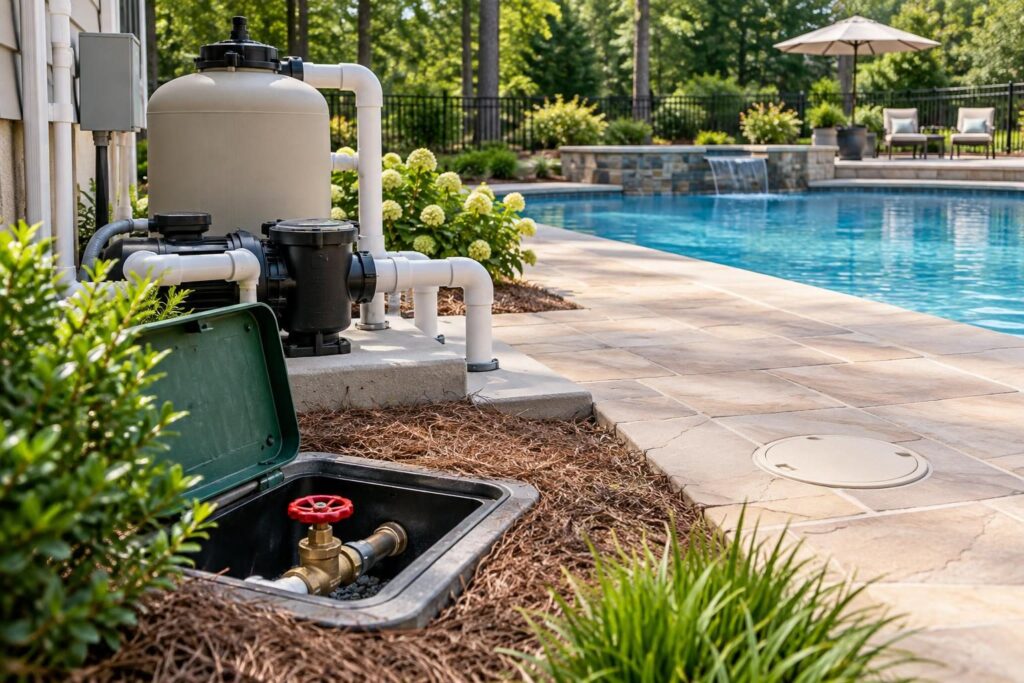
Good pool autofill shutoff planning North Carolina homeowners can use starts with a simple question: how will you stop incoming water? An autofill adds water automatically when the pool level drops. That convenience deserves careful planning before plumbing disappears beneath decking or landscaping.
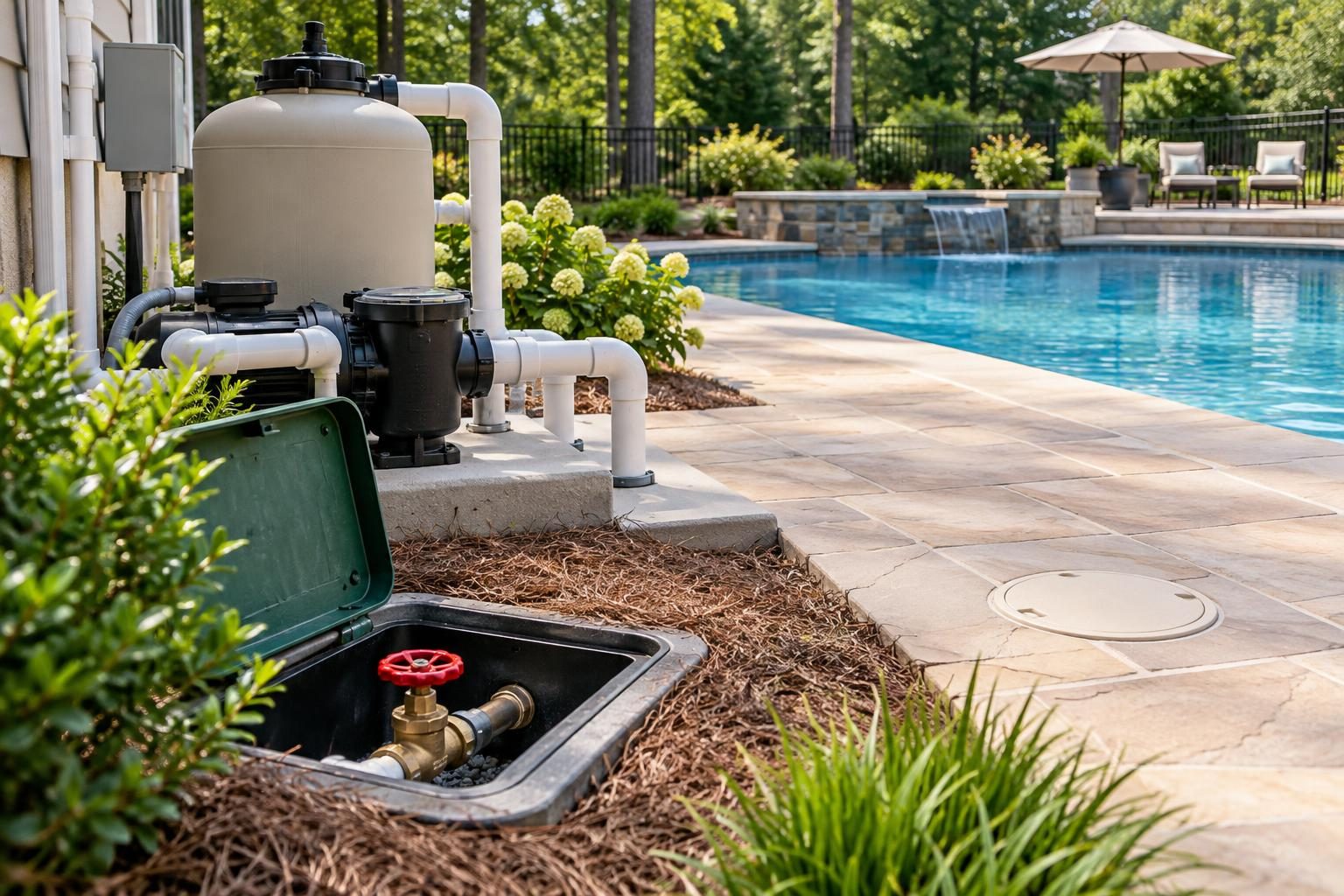
Compare more than the purchase price. Ask how each arrangement detects low water, closes its supply, signals trouble, and supports maintenance. A complete proposal should explain shutoff access, water-use monitoring, local connection review, and installation records.
Compare autofill arrangements by how they stop filling
A mechanical float system uses a floating component to operate a fill valve. An electronic system uses a water-level sensor and controls to operate a valve. Some electronic products offer alerts or filling limits, but features vary by model.
Manual filling remains another option. It requires active supervision and a connection arrangement accepted for the property. None of these choices removes the need to watch water use.
- Mechanical float: Ask how the valve is accessed, inspected, adjusted, and replaced.
- Electronic control: Ask what happens during sensor faults, power loss, and lost communications.
- Manual filling: Ask how filling will be supervised and stopped without creating a trip hazard.
Request the exact model and manufacturer instructions before approving a substitution. Do not assume that an app, alarm, or automatic timeout exists because a proposal says “smart autofill.”
Plan a dedicated, accessible pool autofill shutoff
An isolation valve stops water to a particular branch of plumbing. Ask the installer to identify the valve that isolates the autofill without shutting off unrelated household uses. Make valve access a priority in your pool autofill shutoff planning North Carolina checklist.
The automatic fill valve and the manual isolation valve serve different purposes. A control command is not a substitute for a clearly identified physical shutoff. Have the installer explain which valve homeowners may safely operate.
- Where is the dedicated shutoff shown on the drawing?
- Can someone reach it without moving heavy equipment or entering the pool?
- Will mulch, planting, furniture, or future decking obstruct access?
- How will the valve remain identifiable after landscaping?
- Who will demonstrate its operation at handover?
Keep valve boxes and service covers accessible. Do not assume a utility-owned valve is available for homeowner operation. If the proposal lacks a dedicated shutoff, request a written explanation and review the arrangement before installation.
Verify property-specific water-supply requirements
The source of fill water matters. Public water and private wells raise different questions about connection approval, supply capacity, maintenance, and seasonal operation.
Ask the local inspections department and water supplier which requirements apply to the proposed connection. For a private well, involve a qualified well professional when supply capacity or system operation is uncertain.
Requirements can vary with jurisdiction, adopted code, utilities, septic systems, flood zones, property conditions, and project scope. The North Carolina Office of State Fire Marshal documents resource provides state code materials. Confirm current applicability and local interpretation with the reviewing authority.
Backflow means unwanted reverse movement of water toward the supply. Ask qualified installers and officials what protection the connection requires. Our autofill connection-protection checklist covers that separate review in more detail.
Keep written responses, approved details, and inspection records. A verbal statement that an arrangement is “standard” does not confirm suitability for your property.
Make water-use visibility part of the purchase
An autofill can maintain a steady waterline while replacing water lost through evaporation, splashing, leakage, or unintended discharge. A normal-looking level therefore does not establish that water use is normal.
Ask what the proposed equipment actually measures. A controller’s valve-open time is not necessarily a measurement of water volume. A household meter also includes uses unrelated to the pool.
- Does the product record filling events or operating time?
- Can the installer offer suitable water-use monitoring for the fill branch?
- Are alerts included, optional, or dependent on a subscription?
- Who receives alerts, and what happens if internet service fails?
- What observations should prompt a service call?
Keep a simple log of weather, swimming activity, water-feature operation, and available fill records. Compare patterns rather than treating one unusual day as proof of a leak. Persistent unexplained filling deserves investigation, even when the pool stays full.
Separate autofill control from overflow awareness
An autofill adds water; it does not manage heavy rainfall. Even a system that stops filling correctly needs a separate plan for high water and surrounding runoff.
Ask the installer to explain the intended operating level and how the selected system responds above that level. Have the designer identify any overflow route and its discharge destination. Do not assume a visible fitting establishes an approved drainage arrangement.
Unexplained filling combined with water leaving an overflow deserves prompt review. Record the waterline, controller status, recent weather, and visible discharge. These observations help a qualified professional distinguish a control problem from other causes.
For broader site questions, review pool overflow and heavy-rain planning. Do not improvise a discharge connection or lower the pool substantially without professional guidance.
Turn the proposal into a specific written scope
Use your pool autofill shutoff planning North Carolina checklist to compare complete installations, not equipment names alone. Ask each bidder to identify included work and exclusions.
- Autofill model, sensor or float location, and intended operating level.
- Supply connection, pipe route, and accessible isolation-valve location.
- Responsibility for required protection, permits, and inspections.
- Electrical and control work, when applicable.
- Monitoring features, subscriptions, and account ownership.
- Service access, seasonal procedures, and replacement access.
- Testing, homeowner instruction, warranty documents, and final drawings.
Separate fixed selections from allowances, which are budget placeholders rather than fully specified purchases. Require written approval for changes affecting access, controls, or connection details.
Clarify who coordinates the pool contractor, plumber, electrician, and water supplier. Unclear responsibility can leave necessary work outside everyone’s quoted scope.
Document buried work before it disappears
Request photographs before approved work is covered. Record the supply route, valve locations, connection details, and nearby fixed landmarks. Photograph from safe, accessible locations without entering excavations or opening electrical equipment. Include these photographs in your pool autofill shutoff planning North Carolina file.
Ask for an as-built drawing: a record showing what was actually installed. Compare it with the approved plan and document changes. Keep product labels, manuals, written approvals, and inspection or correction records together.
Warning signs include unexplained route changes, inaccessible valve locations, missing model numbers, and pressure to approve covered work without records. These signs do not establish wrongdoing. Ask what changed, why it changed, and how the installation will be verified.
Match payment requests to the written milestones. If required records or corrections remain outstanding, document the issue and discuss the contract process before treating that stage as complete.
Require a handover demonstration and response plan
Have the installer demonstrate normal filling, automatic stopping, and manual isolation using the manufacturer’s procedures. Ask how a filling fault would be recognized and who should respond.
Record the demonstrated settings and any unresolved items. Do not accept an app screen alone as proof that physical water flow has stopped. Ask the installer how that result is verified for your arrangement.
- Label the homeowner-operable shutoff and photograph its location.
- Save service contacts and equipment warranty information.
- Obtain written seasonal shutdown and restart instructions.
- Confirm who handles alerts during absences.
- Document punch-list corrections and any required rechecks.
Before traveling, include these instructions in your pool vacation maintenance plan. Automatic filling does not replace water testing, equipment checks, or responsible supervision.
Consult local inspections staff and your water supplier before approving an uncertain connection. Use a qualified pool contractor, plumber, electrician, or well professional for work within their expertise. Seek engineering review when drainage or site conditions warrant it. Clear access and complete records make convenience easier to manage.