
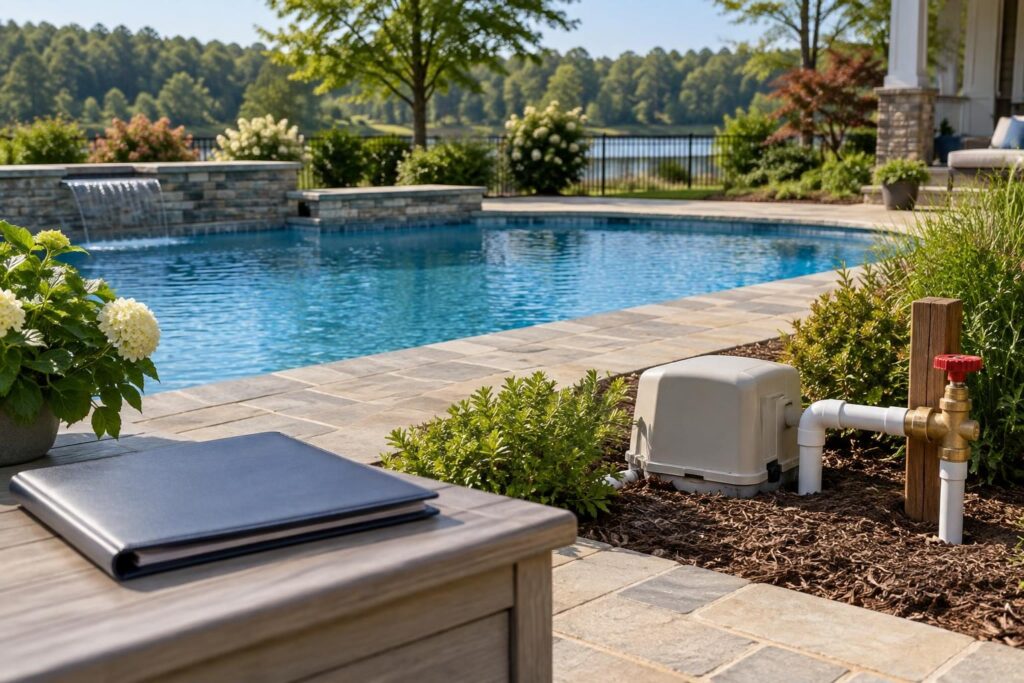
This guide covers pool autofill backflow protection planning North Carolina homeowners should review before approving a connection. An autofill adds water when the pool level drops. That convenience deserves a written plan for water-source protection, accessible shutoffs, monitoring, and seasonal service.
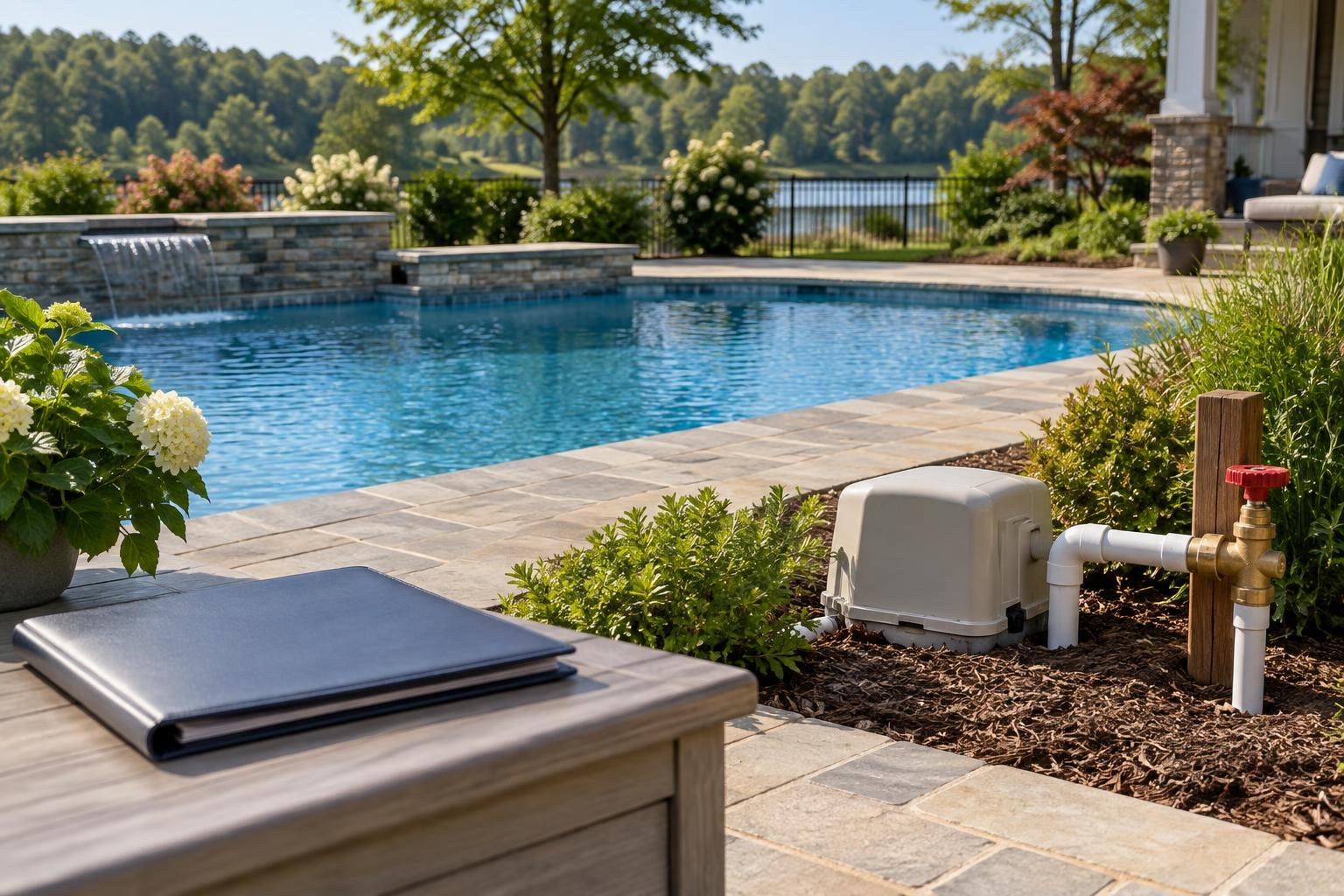
A steady waterline does not prove that a pool holds water. Automatic replacement can conceal ongoing losses from plumbing, equipment, or the pool itself. Before buying, ask how the proposed system protects your supply and makes refill activity visible.
Compare autofill convenience with the attention it still requires
An automatic filler can reduce manual hose use and help maintain the intended operating water level. It does not diagnose why water is disappearing. It also does not replace equipment checks, water testing, or pool supervision.
Mechanical systems commonly use a float, a moving part that responds to water level. Electronic systems use sensors and controls. Features differ, so compare the actual model rather than the description “automatic.”
- How does the unit detect low water and stop filling?
- What happens if its float sticks or a sensor stops working?
- Does it record refill activity or only control the water level?
- Are alerts, limits, or automatic shutoffs included, optional, or unavailable?
- Can replacement parts be serviced without removing finished decking?
Request the model number and manufacturer instructions before approval. Compare installation, monitoring, service, and repair responsibilities—not just the equipment price. A simpler system may suit your needs, provided you understand what it cannot detect.
Verify backflow protection with the water supplier
Backflow means water moves opposite its intended direction. A cross-connection is a connection that could expose drinking water to another water source. Connecting a treated pool to a drinking-water supply raises that protection question.
A fill valve controls incoming water. Do not assume that it also provides the required backflow protection. Likewise, a proposed check valve is not proof that the complete connection meets local requirements.
Ask your water supplier and local permitting authority:
- What protection applies to this property’s proposed pool connection?
- Who must approve the connection arrangement and device selection?
- Are permits, inspections, testing, or registration required?
- Who may install and service the required components?
- What access and placement conditions must the design preserve?
Requirements can vary with jurisdiction, adopted code, utilities, water source, and project scope. The North Carolina Office of State Fire Marshal documents provide state code resources. They do not replace confirmation of your property’s applicable requirements.
Obtain written confirmation or retain your inquiry and the authority’s response. A verbal assurance from the seller is not independent verification. For pool autofill backflow protection planning North Carolina homeowners can rely on, start with those property-specific answers.
Review the water source and connection route
Identify where the autofill will obtain water before comparing proposals. Municipal service, a private well, and other supply arrangements present different questions. An existing irrigation connection should not be treated as automatically suitable.
For a private well, ask a qualified well professional about available supply, system operation, and connection protection. If trenching approaches septic components, involve the appropriate septic professional or local environmental-health office.
Have the installer show the proposed line route on a drawing. Identify existing utilities, shutoffs, protection devices, and areas that will become inaccessible after decking or landscaping.
If irrigation shares the surrounding work area, review these irrigation and backflow coordination questions. Keep the responsibilities for each system clear.
Refill water can also affect pool chemistry. Discuss source-water testing and treatment needs using these pool fill-water questions. An autofill adds water; it does not test or balance that water.
Make the autofill shutoff easy to find and use
Ask for a clearly identified way to isolate the autofill supply. Isolation means stopping water to that branch without unnecessarily shutting down unrelated service. Have the qualified installer determine the appropriate arrangement.
A shutoff hidden behind equipment or under dense planting can turn a small problem into a difficult service call. Review access with the finished yard in mind, not just the open construction site.
- Where is the homeowner-accessible shutoff?
- Can it be reached without entering the pool or dismantling equipment?
- Which direction and procedure stop the refill supply?
- Will landscaping, covers, or storage block access?
- Who should be contacted if the valve will not operate?
Request durable identification and a labeled photograph in the handover file. During the walkthrough, have the installer demonstrate the approved operation. Do not force a stuck valve or disassemble a protection device.
For electronic equipment, also request the documented power and control shutdown procedure. Refer electrical changes or faults to a qualified electrician.
Plan leak awareness before automatic filling begins
Water loss can come from evaporation, splash-out, maintenance, or a leak. An autofill can replace each without explaining the cause. Build an observation routine around actual refill activity rather than the waterline alone.
Ask whether the proposed system offers a dedicated usage reading, fill-event history, unusual-use alert, or run-time limit. Verify each feature in the product documents. A control app does not necessarily measure water consumption.
- Record refill activity alongside weather, swimming, and water-feature use.
- Note wet areas near the fill line, equipment, and surrounding yard.
- Keep photographs of recurring damp spots or unexplained overflow.
- Save alerts and service findings rather than relying on memory.
- Ask how household water-use records could support an investigation.
Household meter readings include other water uses unless the refill branch is separately measured. Ask the supplier how to interpret available records.
If filling increases unexpectedly, contact the installer or a qualified leak-detection professional. Obtain guidance before suspending refill for an extended test. Maintain the operating level required by the pool equipment, and do not drain the pool to investigate.
Separate low-water control from overflow planning
An autofill generally addresses falling water levels. It is not a stormwater plan. Heavy rain and a fill valve that fails to close can create different high-water problems.
Ask what happens if incoming water continues after the intended level is reached. The proposal should explain available safeguards, homeowner response, and service access. Do not accept “it will never happen” instead of a documented explanation.
Review where excess water could travel near the house, equipment, and neighboring property. Ask a qualified professional to evaluate uncertain grades or drainage routes. Use this pool overflow planning guide to organize those questions.
Do not add an improvised overflow or discharge line without reviewing its destination and local requirements. Keep water-supply protection and drainage responsibilities distinct in the contract.
Clarify winter service and restart responsibilities
North Carolina winter exposure varies by location and installation. Buried pipe, exposed valves, controls, and protection devices may need different care. “Winterized” is too vague unless the service record explains what was done.
Ask the installer for a model-specific seasonal procedure and a written division of responsibilities:
- Which parts must be isolated, drained, protected, or otherwise serviced?
- Who handles the backflow device and any required testing?
- Does disabling the controller also stop the water supply?
- How will the pool’s water level be monitored while autofill is unavailable?
- What checks must occur before spring operation resumes?
Have qualified service providers perform work beyond the documented homeowner procedure. Do not improvise compressed-air treatment, device removal, or valve changes.
Keep winter service and restart records with the equipment manuals. Confirm warranty care requirements directly in the manufacturer documents, especially when different companies handle installation and seasonal maintenance.
Put specifications, approvals, and closeout in writing
Use pool autofill backflow protection planning North Carolina homeowners can verify as the standard for comparing bids. Each proposal should identify the equipment, connection design, responsible trades, and approval process.
Request a written scope covering:
- Supply route, connection point, shutoff location, and specified protection.
- Equipment models, monitoring features, and service access.
- Permit, inspection, testing, and documentation responsibilities.
- Excavation, surface restoration, allowances, and exclusions.
- Startup demonstration, seasonal instructions, and warranty contacts.
Independently verify installer qualifications for the work involved. Ask the local authority which credentials apply; a general-contractor credential alone does not answer every plumbing or electrical qualification question.
Photograph accessible work before it is covered, without entering unsafe areas. Preserve drawings, written communications, approved change orders, inspection results, and correction records. Request an as-built drawing showing the actual installed route.
Vague scope, unexplained substitutions, or early payment requests warrant clarification, not an automatic accusation. Ask what work supports the invoice. Track unresolved items against the contract before the related payment milestone.
Choose convenience you can monitor and maintain
An autofill is easier to evaluate when its benefits and limits are explicit. Favor a proposal with verified connection requirements, usable shutoffs, observable refill activity, and a complete service plan. Treat pool autofill backflow protection planning North Carolina homeowners can document as part of the purchase, not an afterthought.
Build a Pool in North Carolina encourages homeowners to keep approvals and operating instructions together. Consult your water supplier and local inspections department about connection requirements. Use qualified pool and plumbing professionals for installation and service. Bring in an electrician, well specialist, septic professional, or engineer when the property’s conditions require that expertise.