
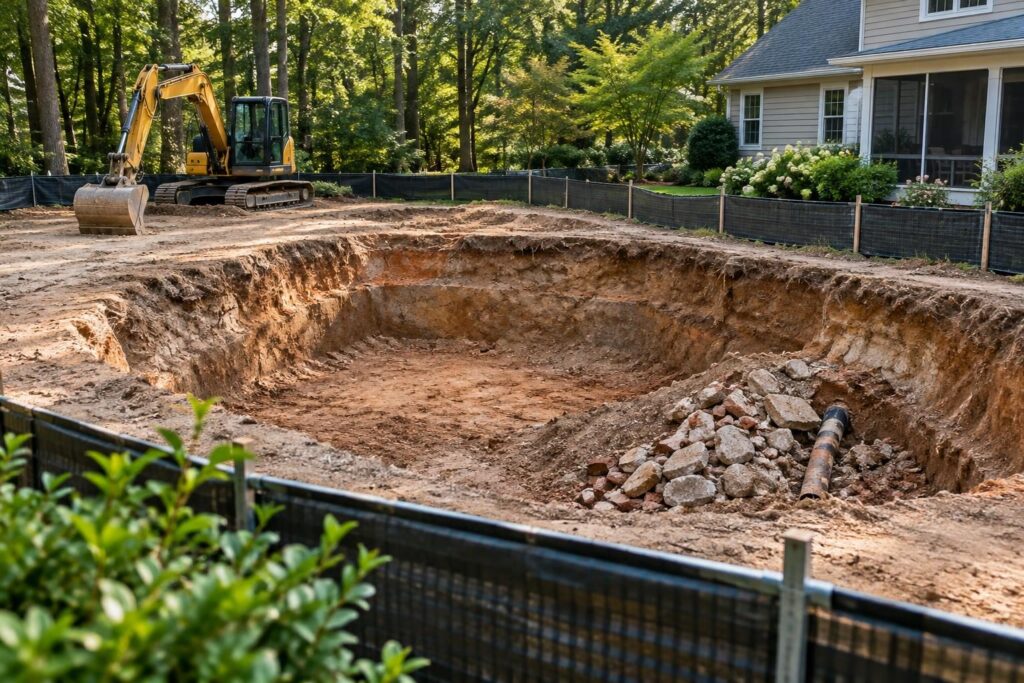
Finding buried debris during pool excavation raises questions that appearance alone cannot answer. Broken masonry might be old fill. An unidentified pipe might still serve a building. A container or curved metal surface needs qualified identification before anyone disturbs it further. For North Carolina homeowners, the first priorities are separation, communication, and a documented plan—not deciding who caused the condition.

Unexpected material does not, by itself, establish misconduct or a construction defect. Treat the discovery as a site-safety question. Keep people away, ask the contractor to pause disturbance in the affected area, and verify who should assess it.
Pause Disturbance and Keep People Away
Notify the site supervisor without approaching operating equipment. Ask the contractor to stop digging, loading, or moving material in the affected area. Let qualified personnel determine whether surrounding work can continue safely.
Do not enter the excavation, stand near its edge, or climb onto soil piles for a closer look. Keep children, visitors, and pets away. Ask who will maintain secure access restrictions during the pause and overnight.
- Do not touch, open, puncture, cut, drain, or move unknown objects.
- Avoid handling suspicious soil, fragments, powders, or liquids.
- Never lean closer to smell material or try a household identification test.
- Do not pressure-wash debris or hose liquids into the yard.
If you notice escaping gas, fumes, smoke, an active leak, or illness, move away immediately. Call 911 from a safe location for an immediate danger. Do not attempt containment or shutoffs yourself. Utility-notification services are not substitutes for emergency response.
Separate Observations From Assumptions About Buried Material
Describe what is visible without assigning an identity. For example, record a metal surface with an attached pipe rather than declaring an abandoned fuel tank. Age, rust, color, and location cannot establish whether something is empty, disconnected, or safe.
Rubble and mixed fill
Concrete, brick, wood, and mixed fragments may raise disposal and soil-support questions. Fill means material previously placed to change ground levels. Ask whether qualified review is needed before using that area to support the pool, deck, or nearby structures.
Do not assume everything mixed with recognizable masonry belongs in an ordinary debris load. Unusual coatings, fibrous fragments, or containers warrant assessment before sorting or hauling.
Pipes, containers, and possible tanks
Unknown pipes may relate to utilities, irrigation, wells, septic systems, or former equipment. Their purpose and status need verification. A pipe that looks unused is not proof of disconnection.
Leave containers and possible tanks undisturbed. Do not remove caps, probe openings, test contents, or climb on exposed surfaces. Qualified specialists should determine identification, hazards, and next steps.
Find the Right North Carolina Contact
For buried debris during pool excavation, the right contact depends on what is known—and what remains uncertain. Ask the contractor to identify the responsible specialist, then independently confirm that person’s role and relevant qualifications.
- Unknown utility lines: Contact the suspected utility owner and consult North Carolina 811 about current notification and locating procedures.
- Possible septic components: Ask county environmental health staff and a qualified septic professional about records and assessment.
- Possible tanks or suspicious soil: Seek direction from local officials and the appropriate NC DEQ program about assessment and applicable requirements.
- Unstable fill or buried structures: Ask whether an engineer with relevant soil or structural expertise should evaluate the area.
Ask what existing utility markings cover and whether private lines need separate locating. Never treat markings as identification of every buried object.
Requirements can vary by jurisdiction, adopted code, utilities, septic systems, flood zones, property conditions, and project scope. Verify current requirements with local inspections staff and the appropriate authority.
Document the Discovery Without Entering the Work Area
Create a dated discovery record for buried debris during pool excavation while details are fresh. Take overview photographs only from a safe, permitted vantage point. Ask the contractor or specialist for closer images when they can obtain them safely.
- Record the date, discovery location, and construction activity underway.
- Describe visible material without making unsupported hazard claims.
- Note who observed it and who received notification.
- Save existing plans, utility records, and relevant property documents.
- Retain written recommendations, assessment reports, and official correspondence.
- Track which work paused and who will coordinate the next decision.
Separate firsthand observations from reported statements. If someone identifies a pipe as disconnected, record who said so and request supporting verification.
Preserve original photographs and messages. Ask for documentation before material is removed or covered, without delaying emergency protective action. Photographs support the record; they do not replace identification, testing, or inspection.
Agree on Identification Before Removal or Disposal
A proposal to haul everything away may leave important questions unanswered. Before routine removal proceeds, ask for a written explanation of the material classification and proposed handling method.
Material classification means identifying what the material is and how it should be managed. Where uncertainty remains, ask whether a qualified environmental professional should assess it. Let that professional determine whether sampling or laboratory analysis is appropriate.
- Who will identify the material, and what evidence will support the conclusion?
- Do officials require notification, permits, testing, or oversight?
- Who will select a receiving facility that accepts the identified material?
- What transport, disposal, or cleanup records will the homeowner receive?
- How will affected soil or water be evaluated?
Do not collect samples yourself or place unknown material in household trash. Ask specialists to direct any separation or temporary storage. Avoid mixing suspect material with ordinary excavated soil before receiving guidance.
Protect the Open Excavation During the Pause
A work pause still needs active site management. Ask the contractor to explain temporary access controls, excavation protection, and weather preparations. Homeowners should not install supports, reshape excavation walls, or move machinery themselves.
Rain and groundwater can complicate an unresolved discovery. Do not pump potentially affected water onto the lawn, into a street, or toward neighboring property. Ask the responsible professional to determine appropriate water management before pumping begins.
Our guide to groundwater and temporary pumping questions can help organize that discussion. It does not establish whether water from a particular discovery is suitable for discharge.
If specialist vehicles need a new route, document access and restoration responsibilities. Review the site access agreement checklist before authorizing changes that affect driveways, fences, landscaping, or neighboring land.
Put Scope, Costs, and Payment Decisions in Writing
Finding buried debris during pool excavation may change the work, but the discovery alone does not settle financial responsibility. Review the contract’s unexpected-condition provisions, exclusions, and allowances. An allowance is a budget placeholder, not necessarily a fixed price.
Request a written change order describing assessment, removal, disposal, replacement soil, and any design changes. Identify who coordinates specialists, obtains required approvals, and supplies completion records. Separate investigation costs from later work that depends on the findings.
- What work is authorized now, and what requires another decision?
- Which charges are fixed, estimated, or based on documented quantities?
- What evidence will support each payment milestone?
- How will the discovery affect upcoming construction activities?
- Who pays for temporary protection under the agreement?
Vague descriptions, unexplained payment requests, or reluctance to document commitments warrant clarification—not automatic accusations. Ask for supporting records and a written response. Seek legal advice if contract responsibility remains disputed.
Verify the Restart Plan and Preserve Closeout Records
Before covering an area affected by buried debris during pool excavation, request the specialist’s findings and the contractor’s revised work plan. Ask which authority or professional must confirm that the affected work can resume.
- Obtain identification, assessment, and disposal records as applicable.
- Confirm required notifications, approvals, inspections, and corrections.
- Request photos before replacement soil or concrete conceals the area.
- Keep revised drawings showing changed pipes, structures, or pool locations.
- Document any specified soil preparation and verification work.
- Resolve remaining cleanup and restoration items before project closeout.
An inspection record addresses its stated scope; it may not resolve separate environmental or soil-support questions. The inspection correction tracking guide can help organize required follow-up.
Consult local inspections staff when permit or inspection questions arise. Bring in a licensed pool contractor, utility representative, electrician, engineer, septic professional, or environmental specialist as the discovery warrants. Your role is to keep clear records and verify decisions—not identify or handle unknown buried materials yourself.