
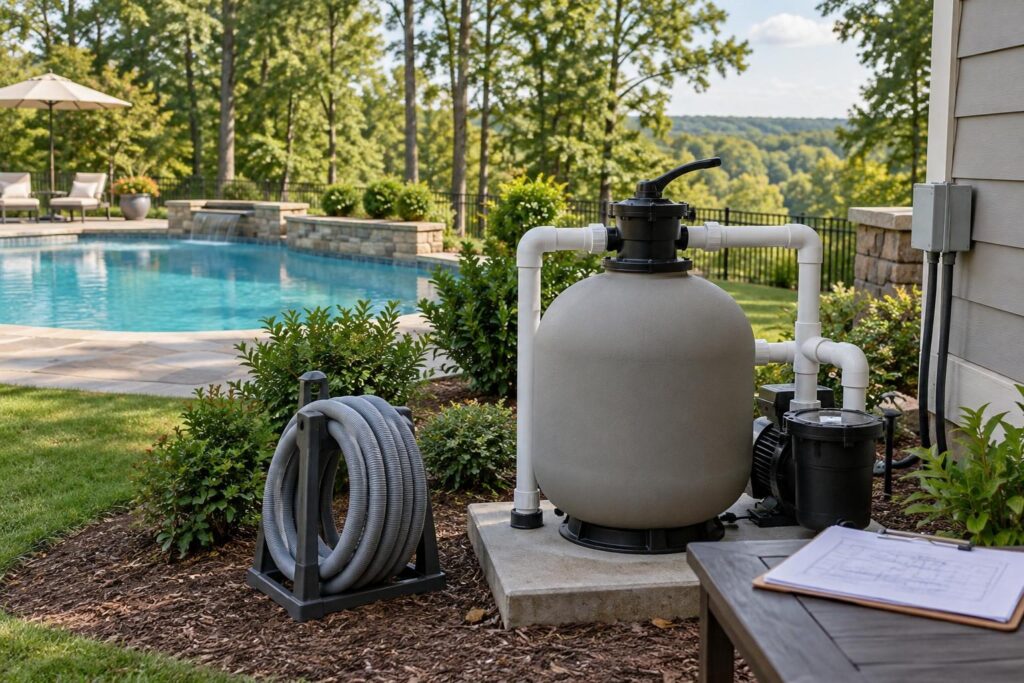
Planning pool filter backwash disposal in North Carolina starts with a question: who has confirmed where the water may go? A hose reaching a drain or lawn does not establish an acceptable destination. Filter waste can contain treatment chemicals, trapped debris, and filter material. Your equipment, property, and local requirements all matter.

There is no destination this article can approve for your property. Do not assume a storm drain, sanitary sewer, yard, or septic system is suitable. Before the first cleaning, identify the waste stream and obtain direction from the authorities responsible for the proposed destination.
Identify what your filter cleaning produces
Backwashing reverses water flow through certain filters to flush out trapped material. Not every filter uses this process. Obtain the exact model number and manufacturer’s cleaning instructions before discussing disposal options.
- Sand filters: Backwashing produces water carrying accumulated dirt and other trapped particles. Replacing the sand creates a separate material-disposal question.
- Diatomaceous earth filters: Often called DE filters, these use a fine powder as filtering material. Cleaning can release that powder with captured debris. Ask whether your service provider must collect solids separately.
- Cartridge filters: These typically require removing and rinsing a pleated element rather than backwashing. Rinse water still needs an appropriate destination.
Specialty media and cleaning methods can change the waste stream. A chemical soak also differs from an ordinary water rinse. Ask your service provider to list each expected waste type, not simply label everything “pool water.”
Separate backwash disposal from other pool drainage
A disposal plan should distinguish filter cleaning from rain overflow, equipment draining, and partial or full pool draining. These activities can produce different quantities and concentrations of waste. Do not treat approval for one activity as approval for every activity.
For pool filter backwash disposal in North Carolina, describe the expected event before asking where authorities allow discharge. Have the contractor estimate water volume, discharge rate, and cleaning frequency using the proposed equipment. Record the basis for those estimates rather than accepting an unexplained number.
Bring a simple property sketch showing the equipment pad, proposed route, structures, drains, and nearby water features. Our drainage outlet planning guide helps organize route questions. Keep the filter-waste decision separate from general site runoff planning.
Describe treatment chemicals before seeking approval
Clear water is not necessarily suitable for discharge. Report the sanitizer system and recent treatments, including algaecides, stain products, clarifiers, and filter cleaners. Saltwater pools still use chlorine, and lowering chlorine does not remove dissolved salt.
Ask which measurements the receiving authority requires. Chlorine and pH may matter, but they do not describe every chemical or solid present. Never assume a swimming-water test result establishes discharge acceptability.
- Provide product names and labels for recent treatments.
- Identify any acid wash, chemical soak, or unusual cleaning step.
- Ask whether solids need separate capture and disposal.
- Request the required testing method and documentation.
- Clarify who will perform and record any required treatment.
The CDC’s home pool treatment and testing guidance addresses swimming-water care. It does not authorize a disposal route. Follow product labels, and do not improvise chemical mixtures to make wastewater appear acceptable.
Ask different questions for storm drains and sanitary sewers
A storm drain collects runoff and may lead to a ditch, stream, pond, or other waterway without wastewater treatment. A sanitary sewer carries wastewater toward treatment. Neither the appearance of an opening nor a contractor’s description proves which system it serves.
Questions for the stormwater authority
Contact the municipal or county stormwater office, or ask local government who handles discharge questions for your address.
- Does your guidance specifically address residential filter backwash and filter solids?
- Where does the proposed inlet or roadside ditch lead?
- Is this discharge prohibited, or does it require additional review?
- Which agency should review possible effects on nearby waterways?
Do not use a storm drain while its status remains unresolved. A ditch is not an automatic alternative.
Questions for the sewer utility
Ask the wastewater utility whether it accepts this particular waste stream from your address. Describe chemicals, solids, salt, estimated volume, and discharge rate.
- Is permission required before each event or before installing a connection?
- Which access point, if any, may a homeowner or service provider use?
- Are pretreatment, testing, flow controls, or scheduling conditions involved?
- Does a proposed permanent connection require plumbing review or inspection?
Do not open a manhole, use an unidentified cleanout, or connect piping based on convenience. Obtain utility direction and qualified plumbing review where needed.
Review soil, slopes, and nearby waterways before considering land disposal
A large yard does not prove that land disposal is acceptable. Clay-rich or compacted soil can absorb water slowly. Saturated ground, shallow groundwater, and steep slopes can create additional concerns. Sandy soil does not establish permission either.
Water placed on grass may travel beyond the intended area. Review downhill paths toward neighboring property, foundations, drainage channels, wells, wetlands, and surface water. Chemicals and salt may also affect plants or soil.
If an authority identifies land disposal as a possible option, request property-specific conditions before proceeding. Ask whether soil review, an engineered approach, or environmental review is needed. Do not conduct a discharge experiment to see whether the yard can handle it.
Rain overflow presents related but different questions. Review pool overflow planning separately so the two water sources do not share an unverified outlet.
Keep septic systems and private wells in the review
A septic system treats household wastewater onsite. Its drainfield distributes treated effluent into soil. Additional water, chemicals, or solids warrant specific review; do not assume the system can receive filter waste.
Locate the tank, drainfield, and designated repair area before proposing an outlet. The repair area is land reserved for potential replacement wastewater treatment components. Avoid treating that space as unused lawn.
Gather septic location records and ask the county environmental-health office to review the proposal. Include private wells, even when the proposed outlet is not beside the wellhead.
The North Carolina onsite wastewater rules provide an official reference. Ask local environmental health to explain the current rules for your property. This article does not interpret a septic approval or authorize discharge onto a drainfield.
Put the disposal plan into the construction and service scope
Resolve pool filter backwash disposal in North Carolina before approving equipment and waste-line installation. Filter selection affects routine cleaning, but choosing a cartridge filter does not eliminate wastewater planning.
Require the written scope to identify:
- The filter model and each expected cleaning waste stream.
- The verified destination and any conditions imposed by the responsible authority.
- Required collection equipment, piping, valves, labels, or professional reviews.
- Who obtains permissions and supplies testing or disposal records.
- Included costs, allowances, exclusions, and recurring service responsibilities.
- The process if the responsible authority rejects the proposed destination.
Photograph waste piping before crews cover it and retain the final routing drawing. Record changes through written change orders. Tie relevant payment milestones to the contracted work and required documentation, not merely delivery of a filter.
If onsite options remain unresolved, ask authorities about approved collection and offsite disposal services. Verify that any proposed receiving facility accepts the specific waste before hiring a hauler.
Verify assurances and keep a usable maintenance record
A vague outlet description, missing drawing, or reluctance to document permission deserves follow-up. These warning signs do not prove wrongdoing. Ask for the responsible authority’s contact information and independently confirm the proposal.
Save written responses with the property address, filter type, proposed destination, and applicable conditions. When guidance comes by phone, record the date and contact name. Request written confirmation of important conditions.
At handover, retain the operating instructions, inspection and correction records where applicable, warranties, and completed punch list. Ask the installer to explain the cleaning sequence without releasing waste to an unverified outlet. Filter housings can retain pressure; follow manufacturer shutdown and pressure-release instructions before service.
Keep cleaning dates, relevant test results, chemical treatments, and disposal receipts together. Recheck the plan after equipment changes, landscaping changes, or different cleaning products.
Questions about pool filter backwash disposal in North Carolina often need more than one specialist. Consult the sewer or stormwater authority about destination approval. Use local inspections, environmental health, and a licensed pool contractor for installation and property questions. Bring in a qualified plumber, engineer, or septic professional when the proposed approach requires their expertise.