
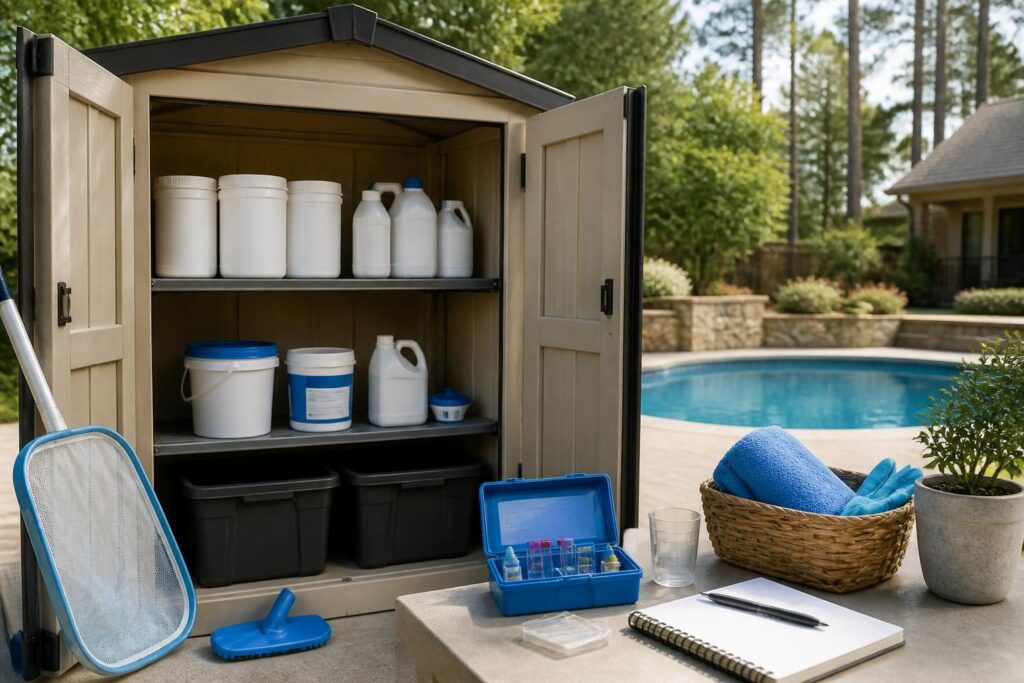
A pool chemical delivery storage workflow gives your household a repeatable way to receive, separate, label, ventilate, and record pool products. The goal is not to create a substitute for product instructions or professional advice. It is to reduce confusion before a container reaches your storage area.

Pool products can include sanitizers, pH adjusters, algaecides, shock products, test reagents, and cleaning treatments. Each product may have different handling, storage, incompatibility, and disposal instructions. Read the current label and safety data supplied with every product. If instructions conflict, stop and ask the manufacturer, retailer, hazardous-waste program, or qualified professional for clarification.
Start the pool chemical delivery storage workflow before ordering
Safe organization begins before the delivery arrives. First, identify which products you actually need for your pool and equipment. Avoid buying large quantities simply because a product is discounted. A smaller, clearly recorded supply may be easier to inspect and manage.
Ask your pool professional to identify the intended product type, concentration, and use for each item. Do not assume that two products with similar names are interchangeable. The label, container, and equipment instructions should agree with the water-care plan for your pool.
- Choose a delivery location away from children, pets, food, living areas, and ignition sources.
- Confirm that the surface is stable, dry, and protected from rain, flooding, and direct heat.
- Plan how you will keep products upright and prevent containers from tipping.
- Make room for labels and records before adding new products.
- Decide who in the household may receive or use pool chemicals.
Do not store products in an area that can flood or drain toward a well, waterway, garden, crawl space, or living area. Property conditions vary across North Carolina. A local environmental-health office or qualified professional can help with questions about site-specific concerns.
Receive every delivery with a visual check
The delivery handoff is a decision point. Move containers only when you can inspect them safely. Do not open, sniff, mix, or transfer a product to investigate a damaged package.
Use a receiving checklist
- Compare the delivered product with your order and water-care plan.
- Check the product name, concentration, quantity, lot information, and expiration or manufacture date when provided.
- Look for wet packaging, bulging containers, corrosion, leaks, broken seals, or missing labels.
- Keep incompatible products separated during unloading.
- Photograph the container and packaging if the shipment appears damaged.
- Contact the seller or manufacturer for handling and return instructions.
Use gloves, eye protection, or other protective equipment only as the product label directs. If a container is leaking, isolate the area without touching it and follow the label’s emergency instructions. For a significant spill, strong fumes, injury, or uncertainty, leave the area and contact emergency services or the appropriate hazardous-material resource.
Keep the original container whenever possible. Product labels communicate critical information that can be lost during a transfer. Never place an unlabeled substance in a bottle, food container, drink container, or other package that could be mistaken for something else.
Separate products by compatibility and access
Separation is a central part of the pool chemical delivery storage workflow. Do not rely on one general shelf for every product. Some pool chemicals can react dangerously when mixed, contaminated, or stored too close together. The exact separation rules come from the product label and safety data sheet.
A practical storage plan uses separate, clearly identified areas for different product groups. For example, you may designate one location for dry products and another for liquid products, subject to the manufacturer’s instructions. Keep oxidizing products away from acids, fuels, oils, organic materials, and other incompatible substances when the label requires it.
- Keep containers closed unless the label directs otherwise.
- Store products in their original containers with readable labels.
- Keep incompatible products from sharing a tray, bin, shelf, or spill-containment area.
- Keep storage areas free of rags, paper, leaves, fertilizer, gasoline, and household cleaners.
- Do not stack containers in a way that can crush, puncture, or hide a label.
- Prevent access by children, visitors, and pets with appropriate physical controls.
Never combine old and new product in one container. Do not pour unused material into another container to save space. If you cannot identify a product or its condition, do not use it. Ask the manufacturer or local waste authority how to handle it.
Build ventilation into the storage decision
Ventilation means allowing air to move through the storage area as the product instructions require. It does not mean directing fumes toward a door, window, air intake, crawl space, or neighboring property. A closed cabinet may not be suitable for every product.
Read the label and safety data for storage temperature, moisture, sunlight, ventilation, and container-position requirements. Do not improvise a sealed enclosure. Avoid storing chemicals in a mechanical room unless the product instructions, equipment requirements, and a qualified professional support that arrangement.
North Carolina heat and humidity can affect storage conditions. Seasonal temperature changes, storms, and power interruptions may also change how a garage, shed, or pool house performs. Inspect the area after extreme weather and after any building or landscaping change.
For equipment-area questions, review the manufacturer’s requirements and consult a qualified pool contractor or specialist. Our guide to equipment ventilation and clearance planning can help organize questions before installation or storage changes.
Label shelves, locations, and household instructions
Good labels help a second person understand the system without guessing. Label the storage zones, not only the products. A simple sign might identify “dry products,” “liquid products,” “test supplies,” and “do not place incompatible products together.” Use wording that matches the current product instructions.
Post a short household procedure near the storage area. It should direct users to read the label, wear required protective equipment, keep containers closed, avoid mixing products, and wash hands after handling. It should also identify who to contact when a container is damaged or the product is unknown.
Keep emergency information accessible, but do not place important instructions where a leak could make them unreadable. Store safety data sheets in a dry digital folder and, when practical, keep a printed copy in a protected location. Record the product name and manufacturer so you can locate current guidance.
Record quantities, dates, and product instructions
A record turns storage into a manageable routine. It also helps prevent duplicate purchases and forgotten containers. Use one entry for each product and update it when a container arrives, moves, opens, or leaves the property.
| Record field | What to note |
|---|---|
| Product identity | Exact name, form, concentration, and manufacturer |
| Delivery details | Date received, supplier, quantity, and condition |
| Storage location | Zone, shelf, bin, or cabinet reference |
| Label information | Use, warnings, storage conditions, and expiration information |
| Opening date | When the container was first opened, if relevant |
| Quantity estimate | Approximate remaining amount without opening the container |
| Disposition | Used, returned, empty, damaged, or awaiting disposal guidance |
For a fuller record format, see this pool chemical inventory and expiration log. Keep the record separate from decisions about dosage. Water treatment amounts depend on the product label, pool volume, test results, and professional guidance.
Connect storage with safe pool-care routines
Storage safety does not end when you place a container on a shelf. Before using a product, verify the current label, check the water-care plan, and confirm that the container is intact. Use only the amount and method directed by the product instructions.
Never mix pool chemicals together. Do not add water to a chemical unless the label specifically directs that procedure. Keep products away from the pool deck while they are not being used. Close and return each container promptly after use.
Testing also belongs in the workflow. Use an appropriate test method, follow its instructions, and record results separately from chemical additions. The CDC guidance on home pool water treatment and testing provides general information about testing, chlorine, and pH. It does not replace the product label or local professional advice.
If a feeder, chlorinator, or dosing device is part of your system, keep its instructions with the chemical records. Use a visual inspection routine rather than opening equipment or handling product unnecessarily. You can also review this chemical feeder inspection checklist for questions about labels, tubing, connections, and operating instructions.
Review the system after weather and household changes
Make the pool chemical delivery storage workflow part of seasonal maintenance. Inspect the storage area after heavy rain, flooding, high heat, construction, or a storm. Check for damaged packaging, moisture, blocked ventilation, shifted containers, and unreadable labels.
Review the system when a child or pet joins the household, when the pool-care provider changes, or when you add a heater, automation system, feeder, or new treatment product. Reconcile the physical containers with your record. Remove products that are no longer identified, needed, or stored according to current instructions.
Use your local household hazardous-waste program or manufacturer for disposal guidance. Do not place pool chemicals in ordinary trash, pour them into drains, or combine them for disposal unless an authorized instruction specifically allows it.
A simple homeowner workflow
- Plan: Identify the product, quantity, storage conditions, and responsible household user.
- Receive: Inspect the package without opening damaged containers.
- Separate: Place products in compatible storage zones based on label instructions.
- Secure: Control access and protect containers from heat, moisture, flooding, and contamination.
- Label: Keep original labels readable and mark storage areas clearly.
- Record: Log delivery, location, dates, condition, and disposition.
- Review: Recheck the area after weather, equipment, household, or product changes.
This simple pool chemical delivery storage workflow makes product identity, separation, instructions, and next steps obvious.
This system is intentionally simple. The safest choice is usually the one that makes product identity, separation, instructions, and next steps obvious.
When a storage location, ventilation arrangement, spill, disposal question, or treatment plan is unclear, consult the product manufacturer and an appropriate qualified professional. A licensed pool contractor, local authority, hazardous-waste program, or other specialist can address conditions that general homeowner guidance cannot.