
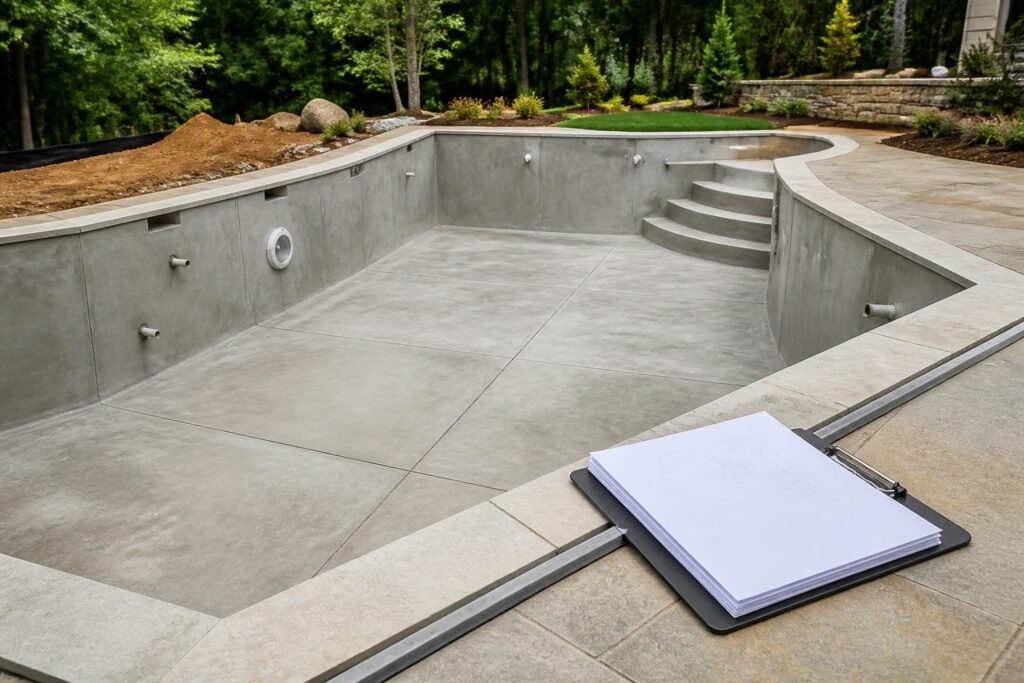
Before tile, plaster, aggregate, or another interior finish covers the shell, pool waterproofing joint detail review questions can help you organize a careful homeowner discussion. The goal is not to approve technical work yourself. Instead, identify visible details, ask how the team designed them, and preserve information that qualified professionals may need later.

Joints, penetrations, and transitions deserve attention because they connect different materials or interrupt a continuous surface. Examples include construction joints, control or movement areas, pipe penetrations, light niches, drains, skimmers, steps, benches, and the pool-to-deck edge. Each project has different materials, drawings, site conditions, and construction methods.
North Carolina requirements and professional recommendations can vary by jurisdiction, adopted code, property conditions, groundwater, soil, weather, and project scope. Treat this article as a conversation guide, not an engineering, waterproofing, electrical, or code-compliance inspection.
What this review should accomplish
A useful review creates a shared record before finishes hide the substrate. It should connect the approved design, installed details, product information, photographs, and unresolved questions. This record can also make future service conversations more precise.
Ask the project team to explain the review boundary. Does it include only the pool shell, or also the coping, deck edge, equipment penetrations, retaining structures, drainage interfaces, and attached features? A clear boundary prevents an important transition from falling between responsibilities.
- Which drawings or detail sheets control the installed work?
- Which products did the team select for joints, penetrations, patches, and surface preparation?
- Did field conditions differ from the design?
- Who will review and accept the technical preparation?
- What must the team complete before tile, plaster, pebble, or another finish begins?
- Which observations require a licensed professional, manufacturer, or design professional?
Do not rely on a general statement that the shell is “waterproof.” Ask what the team installed, where it installed it, and which written instructions or project details support that description. Avoid demanding a performance conclusion from a visual walk-through. These pool waterproofing joint detail review questions help define the discussion without turning the homeowner into an inspector.
Review joints before finishes cover them
A joint is a planned or existing line where materials, pours, sections, or movements may meet. The name matters less than the location, purpose, material, preparation, and documentation. A construction joint may separate concrete placements. Movement joints may allow designed movement between materials. Repair joints may reflect field corrections.
Walk the shell with the project representative and mark joint locations on a plan or photograph. Note whether each line appears intentional, continuous, clean, filled, sealed, or otherwise treated according to the project documents. Do not scrape, cut, fill, or test a joint yourself.
Questions about joint treatment
- What type of joint is this, and what function does it serve?
- Does the design show the joint, or did construction conditions create it?
- How did the team clean and prepare the surface?
- What material or system did the team use, and where is its product data?
- Did temperature, moisture, curing, or installation conditions matter?
- Does the detail continue through tile, coping, deck, or another adjacent finish?
- How should someone observe and maintain this location after handover?
For context about deck movement areas and adjacent hardscape records, see this pool deck joint layout planning guide. A deck joint is not automatically the same as a pool-shell joint, so keep the details separate in your records.
Examine penetrations and fittings
A penetration is a place where a pipe, light, drain, fitting, anchor, conduit, or other component passes through or enters the shell. These locations interrupt the shell surface and often involve more than one trade. Once the finish covers them, they may become difficult to inspect.
Use a marked plan or photo set to identify every visible penetration. Include fittings inside the pool and components near the shell, such as skimmers, returns, vacuum fittings, main drains, niche assemblies, water features, automatic-cover components, and handrail anchors.
- What component sits at this location?
- Which trade installed it, and who reviewed the interface?
- How does the detail address the pipe, fitting, shell, and finish?
- Are any fittings loose, damaged, misaligned, temporarily capped, or incomplete?
- Can the team provide product instructions for the fitting and its surrounding preparation?
- Will the finished surface meet the fitting cleanly without an unplanned gap or sharp edge?
- How will someone access the location if a future repair becomes necessary?
Electrical components need special care. Have the qualified electrician and other required professionals review a light niche, conduit, bonding connection, or related component. Homeowners should not open electrical equipment or judge electrical safety from appearance alone.
For a broader pre-backfill record, link the observations to the pool shell inspection before backfill. That review can preserve locations and dimensions before soil conceals the exterior. Keep these observations alongside your pool waterproofing joint detail review questions and written responses.
Study transitions between materials
A transition is where one material, plane, elevation, or construction system meets another. Common examples include the shell and coping, coping and deck, tile and interior finish, steps and floor, benches and walls, or a pool edge near a retaining wall.
Ask the team to identify which surfaces should meet directly and which require a separation, sealant, movement allowance, trim, or other detail. The visible line may be planned. It may also signal incomplete preparation. Only the project’s qualified professionals can determine which explanation applies.
Questions for edge and finish transitions
- What is the intended elevation and slope at this transition?
- Which material should remain continuous, and where should separation occur?
- How will water move at the pool-to-deck or wall-to-deck edge?
- Does the selected finish require a particular substrate condition or primer?
- Are corners, radiuses, steps, benches, and recesses ready for the selected finish?
- Will the transition remain accessible for inspection or future maintenance?
- What visual variation is expected, and what condition would require review?
Record the planned finish at each area. A tile transition may need different preparation from a plaster or aggregate transition. Product data and installation instructions should control technical decisions, rather than a generic checklist.
Confirm finish preparation without overstepping
Finish preparation can include cleaning, curing, removing loose material, correcting projections, treating repairs, shaping corners, and confirming that surfaces meet the selected system’s instructions. The exact steps depend on the finish and substrate.
Ask the pool contractor or finish installer for a written readiness checklist. Request product data for the finish and preparation materials. If the manufacturer requires an inspection, moisture condition, surface profile, or other test, ask who performs it and how the result enters the project record.
- Has the substrate reached the condition required by the finish system?
- Did the team review patches, cracks, voids, tie points, and rough areas?
- Are all temporary caps, debris, laitance, dust, and construction residue addressed?
- Have workers protected fittings and set them for the intended finish thickness?
- Did weather or water conditions affect the planned installation?
- What work remains before the finish crew arrives?
- What process applies if the finish installer identifies a preparation concern?
“Ready for finish” should connect to a defined inspection and record. It should not mean that a homeowner must personally certify the shell. If the answer is unclear, pause the decision and ask the responsible professional to explain the next step in writing. Use pool waterproofing joint detail review questions as prompts, not as proof of performance.
Build a photo and document record
Take photographs before finishes cover the work, subject to site-safety rules and the contractor’s access instructions. Use wide views for location and close views for detail. Place a ruler, plan reference, or other non-damaging scale only when the project team agrees.
Label each file with the date, area, view direction, and related drawing or change order. Keep original files. Pair photographs with product data, installation instructions, inspection notes, approved changes, and written responses.
Useful records include:
- Marked plans showing joints, penetrations, fittings, and transitions.
- Photographs before preparation, after preparation, and before finish installation.
- Product names, model numbers, batch information, and applicable instructions.
- Notes about repairs, field changes, weather interruptions, or unusual site conditions.
- Names or roles of the professionals responsible for technical review.
- A list of open questions, responses, and the date each item closed.
For a repeatable photo process, use this pool construction photo documentation system. Product records can also be organized with the pool construction material submittals homeowner record.
Know when a question needs specialist review
Some observations should not be resolved through homeowner experimentation. Ask for qualified review when you see an unexplained crack, active water, an unsealed or damaged fitting, a changed joint location, a transition that differs from the approved design, or preparation that conflicts with product instructions.
Request clarification before finishes proceed when a technical answer is missing. Depending on the issue, the appropriate person may be a licensed pool contractor, finish manufacturer representative, engineer, surveyor, electrician, or local inspections department. North Carolina requirements may also depend on the local jurisdiction and the currently adopted code. The North Carolina Office of State Fire Marshal documents page offers code-related material, but local officials remain the proper source for project-specific verification.
A calm, documented review helps homeowners ask better questions without making unsupported promises about long-term performance. Keep the approved details, photographs, product records, and written responses together. Consult the local inspections department and the appropriate licensed pool contractor, electrician, engineer, surveyor, septic professional, or other qualified specialist whenever the issue involves permitting, structural judgment, electrical work, drainage, waterproofing design, or finish-system requirements.