
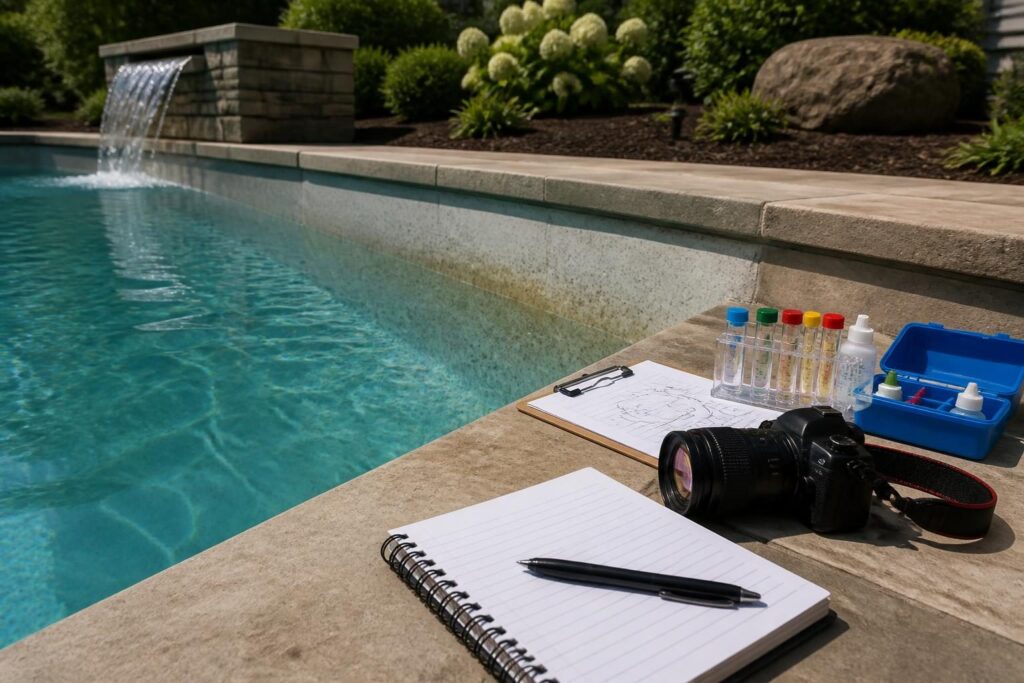
A pool finish stain investigation log helps you slow down before applying a treatment. A mark on plaster, pebble, or tile may relate to water chemistry, metals, organic debris, equipment, landscaping, or the finish itself. The appearance can change after brushing, shocking, draining, or using a stain product. Good records preserve useful clues.

This guide focuses on observation and documentation. It does not diagnose a stain or recommend a chemical treatment. North Carolina conditions vary by water source, weather, landscaping, equipment, and maintenance routine. If the mark spreads, damages the finish, or remains unclear after basic documentation, ask a qualified pool professional or water-treatment specialist to evaluate it.
Start with a dated stain record
Create one file for each separate area. A phone note, spreadsheet, or printed form can work. Give every area a simple name, such as “deep-end wall, east side” or “step below return.” Avoid relying on memory. A small change may matter when someone compares the mark with earlier photos or test results.
Record the basic facts
- Date and approximate time of each observation.
- Pool water level and whether the pool was covered.
- Recent rain, storms, heat, pollen, leaf debris, or nearby yard work.
- Last brushing, vacuuming, filter cleaning, water addition, or water replacement.
- Recent changes to sanitizer, pH, alkalinity, salt, or other products.
- Whether the pool was recently opened, resurfaced, repaired, or filled.
Also note whether the mark appeared suddenly or developed gradually. “First noticed” is not always the same as “first formed.” Ask household members when they last saw the area clearly. Check maintenance messages, service invoices, and earlier photographs for comparison.
Keep product labels and batch information for anything added near the suspected start date. Link those records to the entry without assuming that a product caused the stain. Your goal is a reliable timeline, not an early conclusion.
Use the pool finish stain investigation log as a neutral record. Write what you observed, not what you think caused it.
Map location, pattern, and finish type
Location often provides more useful context than color alone. Mark the area on a simple pool sketch. Include walls, floor, steps, benches, drains, returns, lights, skimmers, tile bands, waterline areas, and nearby equipment connections. Note the direction, depth, and approximate size of each mark.
Describe whether the stain is isolated, clustered, ring-shaped, streaked, mottled, or spread across a broad surface. Record whether it follows a waterline, grout joint, return fitting, slope, step edge, or place where debris collects. Note if nearby surfaces look normal.
Describe the surface without scraping
- Identify the visible finish: plaster, exposed aggregate, pebble, ceramic tile, glass tile, grout, or another material.
- Describe the texture as smooth, rough, raised, gritty, flaking, cracked, or unchanged.
- Record whether the mark appears embedded, sits on top, or shows mainly in grout.
- Note whether the area feels different only if a professional has advised a safe inspection method.
Do not chip, scratch, sand, acid-wash, drain, or rub an unknown area aggressively to “test” it. Those actions can alter the evidence or harm a finish. Follow the manufacturer’s care instructions for your specific surface. If you do not have them, ask the builder, finish supplier, or pool professional for the applicable information.
A useful surface discoloration tracking log can supplement this investigation. Use it for repeatable photographs, location notes, texture observations, and seasonal comparisons.
Photograph the stain before cleaning
Photographs should show both scale and context. Take a wide image that identifies the pool area, a medium image that shows the pattern, and close images that show texture or edges. Include the same nearby feature in repeated photos, such as a return fitting or tile joint.
Use consistent lighting when possible. Avoid glare from direct sunlight, and photograph underwater marks through clear water. If the pool is cloudy, record that condition instead of treating the lack of detail as proof that the stain changed.
- Keep the camera angle as square to the surface as practical.
- Include a ruler or other non-damaging scale reference when safe.
- Take photos before brushing or applying any product.
- Save original files with the date, location, and view in the filename.
- Do not edit color or contrast in the evidence copies.
Repeat the same views after a reasonable observation period or after a documented maintenance action. Record whether the mark became lighter, darker, larger, smaller, sharper, or unchanged. Do not interpret a photo alone as proof of a chemical or material cause.
Add each image reference to the pool finish stain investigation log. Consistent filenames make later comparisons easier.
Record water results and recent changes
Water results provide context, but a single test is only one point in time. Record the test date, time, method, sample location, and results. Include sanitizer, pH, total alkalinity, calcium hardness, stabilizer, salt, metals, or other values that your testing professional or product instructions identify as relevant.
Write down whether the sample came from the deep end, a return, a skimmer, or another location. Follow the test kit or laboratory instructions. If a result seems unusual, repeat the test or ask a qualified water professional how to confirm it. Do not change several variables at once, because that makes later comparison harder.
For completeness, add each water result and related observation to the pool finish stain investigation log before changing the maintenance routine.
The CDC guidance on home pool water treatment and testing offers general information about residential pool testing, chlorine, and pH. Local conditions and your finish manufacturer’s instructions may require additional guidance.
Record water additions separately. Municipal water, private-well water, and delivered water may have different starting characteristics. A recent fill or top-off can change the investigation timeline. Compare your notes with any available fill-water results using the pool fill water testing guide.
Look for nearby metals and outside sources
Metal-related discoloration is one possibility, not a conclusion. Record whether the pool has a heater, metal fixtures, stainless components, copper-containing equipment, metal furniture, or a water feature near the affected area. Note any recent equipment service, replacement, corrosion, or unusual water color.
Outdoor sources deserve equal attention. Photograph or describe irrigation overspray, fertilizer, mulch, soil, leaves, berries, flowers, rusting items, and runoff paths near the pool. Record whether a sprinkler points toward the waterline or whether rain carries material into the pool.
North Carolina yards can change quickly during wet weather, construction, planting, and seasonal growth. A nearby source may be intermittent. Record what was present when the stain appeared, even if it is no longer visible. For irrigation and runoff observations, see this guide to landscape irrigation overspray and backflow questions.
Questions to add to the log
- Was the mark first noticed after rain, irrigation, or a water-level change?
- Did someone service equipment or replace a metal part?
- Was the pool given a new product, water source, or cleaning method?
- Were leaves, soil, fertilizer, or another object left on the surface?
- Is the pattern near a return, drain, light, step, or waterline?
Document cleaning attempts carefully
Every cleaning attempt belongs in the record, including an attempt that seemed harmless. Write down the date, product or tool, amount used if known, location, contact time, water conditions, and result. Include brushing, vacuuming, tile cleaning, enzyme products, metal treatments, oxidizers, and any other intervention.
Do not combine products based on guesses. Read the label, follow its directions, and keep people and pets away as required. Some treatments can affect water balance, equipment, surfaces, or later testing. A qualified professional should help evaluate treatments that involve strong chemicals, altered water conditions, draining, or surface work.
Separate observation from interpretation. For example, write “lighter along the upper edge after brushing” rather than “organic stain removed.” The first statement records what happened. The second assumes a cause and may mislead the next decision.
Before choosing treatment, complete the pool finish stain investigation log and share it with the reviewer.
Know when the record is ready for review
Your file is ready for professional review when it contains a timeline, location map, finish description, photographs, water results, nearby-source notes, and cleaning history. Add product labels, finish-care instructions, service records, and any original material information you have. The material submittals homeowner record may help identify the installed finish and its care limits.
Ask the reviewer what evidence they need before recommending a treatment. Useful questions include:
- What possible causes fit the location and pattern?
- Which additional water or surface tests are appropriate?
- Could the proposed treatment affect plaster, pebble, tile, grout, equipment, or warranties?
- What should you photograph or test before work begins?
- How will you measure success or further change?
For a new pool, recent resurfacing, or a visible finish defect, keep the contractor and finish supplier informed in writing. Share the record without stating that a particular person or product caused the problem. If warranty questions arise, follow the written process in your documents and seek qualified advice about your options.
Use the log to make a safer decision
A stain investigation log cannot identify every cause. It can prevent rushed treatments, preserve before-and-after evidence, and help a qualified reviewer work from facts. Continue ordinary maintenance according to your pool and finish instructions while the issue receives evaluation. Avoid major changes that erase the pattern unless a professional advises them.
Consult your local inspections department for regulated project changes or local requirements. Contact a licensed or otherwise qualified pool professional for surface diagnosis and treatment. Ask an electrician, engineer, surveyor, septic professional, or water specialist when the evidence points to that field. Build a Pool in North Carolina provides homeowner education, not a substitute for site-specific advice.