
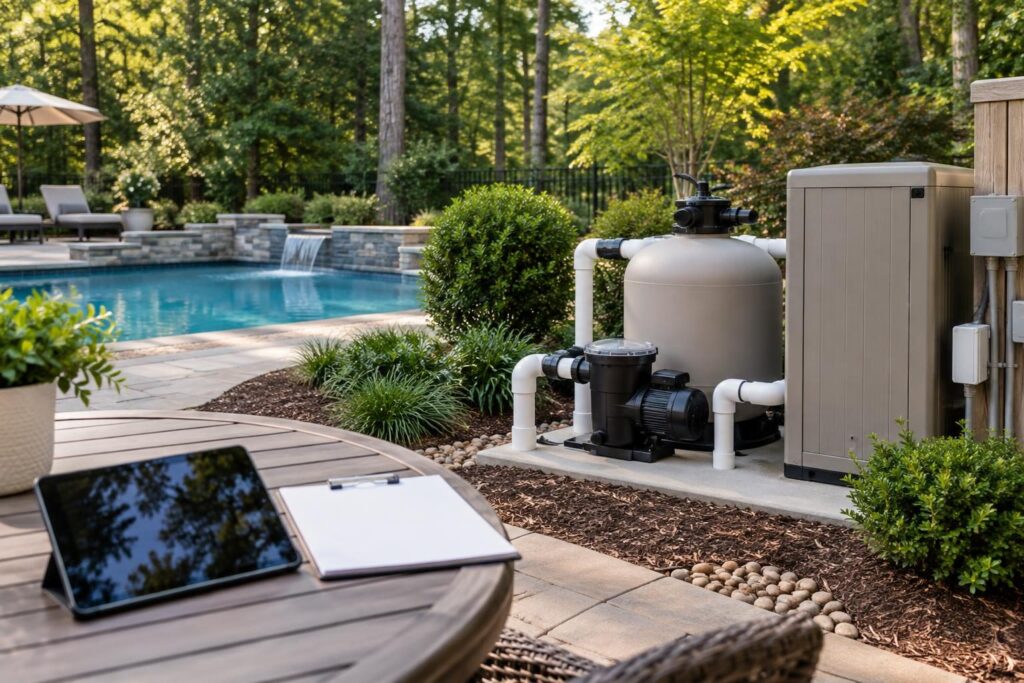
A practical pool warranty repair completion verification process starts with one question: did the repair address the problem you reported? A completed visit, replaced part, or cleared alert helps document service. None alone confirms that the original symptom has stopped under the conditions that previously triggered it.

For North Carolina homeowners, the goal is a clear record, not a technical investigation. Connect your original report to the service diagnosis, completed work, installed parts, and safe operating observations. Then distinguish resolved items from concerns that still need evidence or follow-up.
Start with the original symptom, not the service summary
Retrieve the message, photo, or service request that opened the issue. Keep its original date and wording. If you reported the issue verbally, write a dated summary now and identify it as your recollection.
Describe what you observed without assigning a cause. An intermittent display alert is an observation. A failed sensor is a diagnosis that requires supporting evaluation.
- Which equipment or pool area did the concern involve?
- What happened, and under which operating conditions?
- Was the symptom constant, occasional, or tied to a particular mode?
- Which photos, videos, readings, or messages captured it?
- Did the visit address every reported concern or only one item?
Give separate concerns separate tracking entries. Otherwise, a successful correction to one item can obscure another unresolved problem. Keep earlier records even when the service explanation changes.
Connect the diagnosis to the work performed
The central task in pool warranty repair completion verification is tracing the explanation from symptom to result. Ask for a written service report that separates findings, suspected causes, completed work, and recommended next steps.
A suspected cause may remain uncertain until the equipment operates again. That uncertainty does not establish poor service. It does mean the report should identify what remains unconfirmed.
- What did the technician observe or measure?
- Did the technician reproduce the reported symptom during the visit?
- Did the technician confirm a cause, suspect one, or leave it undetermined?
- What did the technician repair, adjust, clean, reset, or replace?
- How does that work address the reported symptom?
- What tests followed, and what results did the technician record?
Request relevant readings with their units and operating conditions. A bare statement that equipment passed a test offers less context than a documented test method and result.
If explanations conflict, ask the provider to reconcile them in writing. Preserve both versions rather than editing the earlier report yourself.
Verify replacement parts and changed settings
When service includes replacement parts, request enough detail to identify what the technician installed. “Part replaced” is not a useful long-term equipment record.
- Record the part description, manufacturer, model, and part number.
- Save serial numbers when available, especially for complete equipment replacements.
- Ask whether the replacement is new, refurbished, or another specified condition.
- Request written confirmation of compatibility with the existing system.
- Save any approval for a substitution from the original specification.
- Record changes to operating schedules, speeds, temperature settings, and alerts.
Photograph accessible labels without opening equipment. Ask the technician for photos of concealed work before covers or backfill hide it. Do not remove protective covers to obtain your own evidence.
Independently compare part identifiers with your equipment records and manufacturer documentation. If compatibility remains unclear, ask the manufacturer to confirm it. A verbal assurance alone may not identify the exact installed component.
For sensor-related work, these questions about sensor checks and calibration can help organize follow-up. Calibration means checking or adjusting a sensor against an appropriate reference.
Agree on safe post-repair operating checks
Before restarting equipment, ask whether normal operation is safe and whether any restrictions remain. Obtain written instructions for observation, including what should prompt you to stop using the affected equipment.
Never bypass an alarm, safety switch, or protective device to reproduce a symptom. Do not open electrical enclosures, loosen pressurized components, or perform gas-system tests. Leave those tasks to qualified professionals.
Ask the service provider to define the relevant operating check:
- Which normal operating mode should you observe?
- What equipment settings and pool conditions matter?
- What result would support closing this particular concern?
- How long or through which cycles should observation continue?
- Who reviews the results, and when will follow-up occur?
There is no universal observation period for every repair. A continuously visible leak and a weather-dependent symptom require different follow-up plans.
Comparable conditions make pool warranty repair completion verification more useful. Record differences in settings, weather, or water conditions rather than assuming two observations are equivalent.
Preserve evidence of post-repair operation
Keep a short operating log tied to the service date and ticket number. Record only information you can obtain safely through normal controls and visible observations. Use this log as the evidence file for pool warranty repair completion verification.
Your log might include the date, operating mode, displayed readings, visible moisture, sounds, and whether the original symptom returned. Preserve original photo and video files. Save copies of app alerts and written communications outside the service portal.
Use the same viewpoint for comparable photographs when practical. Note nearby rain, irrigation, or other conditions that could affect interpretation. A wet equipment pad alone does not identify the source of water.
If you have earlier readings, compare them with the provider’s guidance. This equipment readings log guide explains how to organize operating context. Older readings are reference points, not proof that every previous setting was correct.
Before crews cover work, request photographs, test reports, and any required inspection records while access remains available. If coverage already occurred, ask what documentation remains available.
Record unresolved concerns without assigning blame
A neutral follow-up separates your observations from the technician’s explanation. Use a consistent format rather than combining facts, assumptions, and conclusions in one paragraph.
- Original concern: Describe the symptom and when you reported it.
- Service explanation: Attribute the diagnosis to the dated service report.
- Completed work: List documented repairs and installed parts.
- Current observation: State what you saw, when, and under which conditions.
- Open question: Identify what remains untested, missing, or unexplained.
- Requested next step: Ask for review, clarification, or another visit.
A returning symptom does not by itself prove that the same component failed again. Likewise, a brief symptom-free check cannot establish performance under conditions that never occurred.
Ask the provider to acknowledge the remaining concern and identify the next responsible contact. Confirm whether the existing ticket stays open or a linked follow-up ticket will track it.
Review warranty terms, charges, and completion forms
Ask how the service affects coverage for the replaced component and the surrounding equipment. Do not assume that replacement restarts, extends, or reduces the warranty. Request the applicable written terms and retain the claim authorization.
Confirm whether labor, parts, travel, diagnostics, or follow-up visits carry charges. Compare any invoice with written approvals. If new work exceeds the authorized scope, request a written description and approval process before proceeding.
Read completion forms before signing. Distinguish acknowledgment of a visit from acceptance that the provider resolved every concern. If wording does not match the current status, request clarification or a corrected form. Seek legal advice about releases or disputed rights.
Missing records, unclear charges, or pressure to sign deserve clarification; they do not establish wrongdoing. Ask for the missing document and a specific response date. Keep payment questions separate from your factual operating log.
Choose a documented status before closing the issue
Finish pool warranty repair completion verification by assigning a status that matches the evidence:
- Resolved: The agreed check is complete, required records are available, and no related concern remains open.
- Monitoring: Work is complete, but relevant operating conditions or observation cycles remain pending.
- Follow-up needed: The symptom persists, records are missing, or further evaluation is necessary.
These are homeowner tracking labels, not legal conclusions or safety certifications. Save a dated summary and ask the provider to confirm any remaining obligations.
North Carolina requirements vary by jurisdiction, adopted code, property conditions, utilities, septic systems, flood zones, and repair scope. Ask local inspections staff whether the work requires permits or inspections. The North Carolina Office of State Fire Marshal documents provide official code resources, but do not establish approval for your repair.
Consult a properly licensed pool contractor or electrician for equipment and electrical concerns. Bring structural, drainage, survey, or septic questions to the appropriate specialist. If accounts remain difficult to reconcile, consider a narrowly scoped independent professional review. Clear records help that professional evaluate the open question without reconstructing the entire project.