
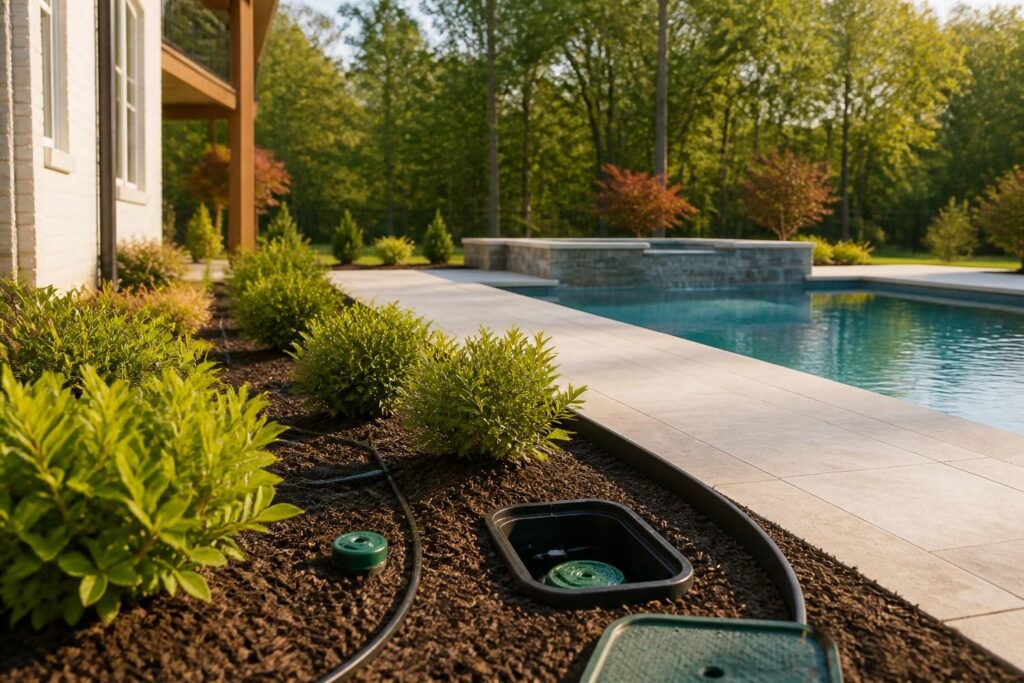
Pool landscaping root barrier planning belongs in the design conversation before plants go into the ground. A root-management measure may deserve review when a planting bed sits near the pool shell, deck, coping, drainage features, irrigation lines, or equipment access route.

That does not mean every poolside plant needs a barrier. Root behavior depends on the plant, soil, moisture, available space, and nearby construction. The goal is to identify potential conflicts early, then ask the right landscape, pool, drainage, or engineering professional for property-specific guidance.
Why discuss root management before planting?
Landscaping offers more flexibility before crews install soil, irrigation, edging, and plants. Once a bed is finished, changing its shape may disturb roots, expose utilities, damage hardscape, or create a new drainage problem. Early planning also helps you compare plant choices instead of treating root control as an afterthought.
Roots usually grow where they find moisture, air, and workable soil. Irrigation leaks, regularly wet planting beds, downspout discharge, and compacted areas can influence root distribution. A plant with modest growth may behave differently beside a frequently irrigated bed than in a dry, open part of the yard.
Pool construction adds more features to consider. The shell, deck, coping, drains, retaining structures, fences, lighting conduits, water lines, and equipment connections all occupy space. Homeowners should not assume that a visible surface gap shows the full underground separation.
A documented pool landscaping root barrier planning discussion can also clarify who coordinates the planting plan with pool construction and drainage work.
Review these questions before approving a planting layout:
- How close will mature plants sit to the pool and deck?
- What are the expected mature height, width, and root characteristics?
- Will irrigation water collect near the shell, hardscape, or utility route?
- Can someone reach valves, drains, cleanouts, equipment, and fences after planting?
- Could roots lift edging, paving, coping, or other finished surfaces?
- Will future pruning require access through the pool area?
A useful starting point is the broader pool landscaping planning process. It connects plant selection with sight lines, drainage, barriers, water quality, and routine care.
Match plant selection to the available space
Plant selection should begin with the mature plant, not the size of the nursery container. Ask for expected spread, canopy form, growth rate, water needs, and any known root concerns. A small plant can eventually occupy a much larger area than the original design suggests.
Large trees deserve particular attention. Their trunks, surface roots, shade patterns, leaf litter, and irrigation needs may affect the pool area for decades. Smaller ornamental trees and shrubs can also create problems if their mature width reaches a narrow deck edge or blocks service access.
Consider the entire planting group. Several individually modest plants may form a dense root zone when planted close together. Groundcovers can spread beyond their intended bed. Vines may reach barriers or equipment. Aggressive or spreading species may need more frequent control than the original maintenance plan allows.
Build a plant review sheet
For each proposed plant, record its common and botanical name, mature size, sun exposure, watering needs, pruning needs, seasonal debris, and location on the plan. Then ask the landscape professional whether the plant suits the available soil volume and distance from nearby structures.
This sheet helps homeowners compare alternatives. A plant may look attractive in a rendering but require more space, water, or pruning than the finished yard can provide. Substituting a better-suited species before installation may be simpler than adding a root-management product later.
North Carolina conditions vary across the state. Piedmont clay, coastal sands, slopes, drainage patterns, winter temperatures, and local planting conditions can all affect performance. Use local horticultural advice rather than relying on a generic distance or plant list.
Where root-management measures deserve review
A root barrier is a physical product or designed separation intended to guide or limit root growth. It cannot guarantee protection against every future movement, leak, settlement issue, or hardscape problem. Its suitability depends on the plant, installation detail, soil, water movement, and nearby construction.
Discuss root-management measures when planting beds are narrow and close to hardscape. Review them when a tree or vigorous shrub sits near the pool shell, deck, coping, retaining wall, drain line, or irrigation route. A review may also help where the design leaves little room for future pruning or replacement.
Root management deserves careful discussion when the bed stays routinely wet. A barrier can affect how roots and water move through the soil. It may redirect growth or create a confined area that needs different irrigation and drainage management. Do not select a product from a catalog without considering the complete site condition.
Ask the qualified professional to explain:
- What problem the proposed measure should address.
- Which plant or plants create the concern.
- Where the measure would begin, end, and connect.
- How it interacts with drainage, irrigation, and existing utilities.
- How the installation will avoid damage to pool construction features.
- What maintenance or inspection the measure will need afterward.
Keep the recommendation, product information, drawing, and installation responsibility in your project records. If the measure matters to the design, identify it in the landscape scope rather than relying on a verbal promise. Good pool landscaping root barrier planning also makes future repair responsibilities easier to discuss.
Coordinate roots with irrigation and drainage
Roots and water planning are closely connected. Irrigation should support selected plants without spraying the deck, wetting the pool equipment area, or washing soil toward the water. Poorly placed emitters can encourage roots toward a hardscape edge or create persistently saturated soil.
Show irrigation zones, valves, sleeves, drains, downspouts, and planting beds on a coordinated plan. Mark locations that must remain accessible. The finished landscape should not hide a valve box behind a shrub or place a tree where future irrigation repairs require removing hardscape.
Root barriers also should not become an accidental dam. Changes in soil volume or barrier alignment can influence how water leaves a bed. Ask landscape and drainage professionals to review low points, overflow routes, and the relationship between planting soil and pool-area grading.
For more detail on spray patterns and equipment safeguards, see pool landscaping irrigation planning. If runoff concerns you, review swale drainage near the pool with the project team.
Protect hardscape edges and maintenance access
Pool decks, coping, pavers, curbs, and landscape edging need room for inspection and maintenance. Roots are only one possible cause of movement or cracking. Soil settlement, water, freeze-thaw cycles, construction conditions, and material details can also matter.
Do not treat a root barrier as a substitute for proper hardscape design or drainage. Instead, use the planting plan to reduce avoidable conflicts. Keep vigorous plants away from narrow joints, small service areas, and locations where future repairs would prove difficult.
Draw the maintenance route on the plan. Include access to the pump, filter, heater, electrical equipment, drains, irrigation controls, fence hardware, and pool cover storage. Show where a worker would stand, carry tools, prune plants, or remove failed irrigation components.
Review edge details before planting. The article on pool coping and overhang details can help homeowners frame questions about edge appearance, drainage, comfort, and maintenance.
Use a practical pre-planting checklist
Before landscape installation, compare the final planting plan with the pool plan, grading information, utility locations, irrigation layout, and equipment access requirements. Ask the project team to identify conflicts in writing.
- Confirm mature plant dimensions, not only installation size.
- Mark the pool shell, deck, coping, drains, walls, utilities, and barrier.
- Identify plants that may spread, sucker, or need frequent pruning.
- Review soil depth, drainage, irrigation frequency, and overflow paths.
- Decide whether root-management measures need professional evaluation.
- Record the proposed location, limits, product, and installer if approved.
- Keep photos before soil covers irrigation or root-management work.
- Schedule a final walk-through before mulch and plants hide access points.
Also check whether new vegetation could affect the barrier. Planters, branches, trellises, irrigation components, and growing plants can create safety or inspection concerns. The guide on landscaping clearance near pool barriers provides a related homeowner review.
Questions for the landscape and pool teams
Commercial planning often begins with a clear scope discussion. Ask who selects plants, who designs irrigation, who verifies utility locations, who installs any root-management measure, and who coordinates with the pool contractor.
Clarify what the proposal excludes. A landscape price may not include soil replacement, irrigation relocation, drainage work, utility locating, root barriers, hardscape repair, or future plant replacement. Written exclusions help you compare proposals fairly.
Ask how the team will document completed work. Useful records may include the final planting plan, plant list, irrigation map, product information, photos, maintenance instructions, and professional recommendations. These records can help a future service provider understand what lies underground.
North Carolina requirements and site constraints vary by jurisdiction and property. For excavation, utility notification, drainage, barriers, permits, or work near structures, verify current requirements with the local inspections department and appropriate qualified professionals. Review North Carolina 811 for official utility-notification information before digging.
Plan for observation after planting
Root management does not replace observation. Watch for lifted edging, new cracks, soil movement, exposed roots, blocked drains, wet spots, irrigation leaks, or plants growing into access routes. Early signs do not prove that roots caused the issue, but they justify a qualified review.
Keep pruning and irrigation records during the first growing seasons. Note plant growth, bed settling, drainage after storms, and changes around the pool deck. Avoid cutting large roots or removing soil near the pool shell without professional guidance.
Good pool landscaping root barrier planning starts before planting and continues through maintenance. Pool landscaping root barrier planning may lead to a different plant, a wider bed, better irrigation control, improved drainage, or a professionally designed root-management measure.
When the project involves excavation, drainage, utilities, structures, electrical work, barriers, or uncertain root behavior, consult the local inspections department, licensed pool contractor, landscape professional, engineer, surveyor, irrigation specialist, or other qualified specialist as appropriate. Build a Pool in North Carolina offers homeowner education, but property-specific decisions require current local verification.