
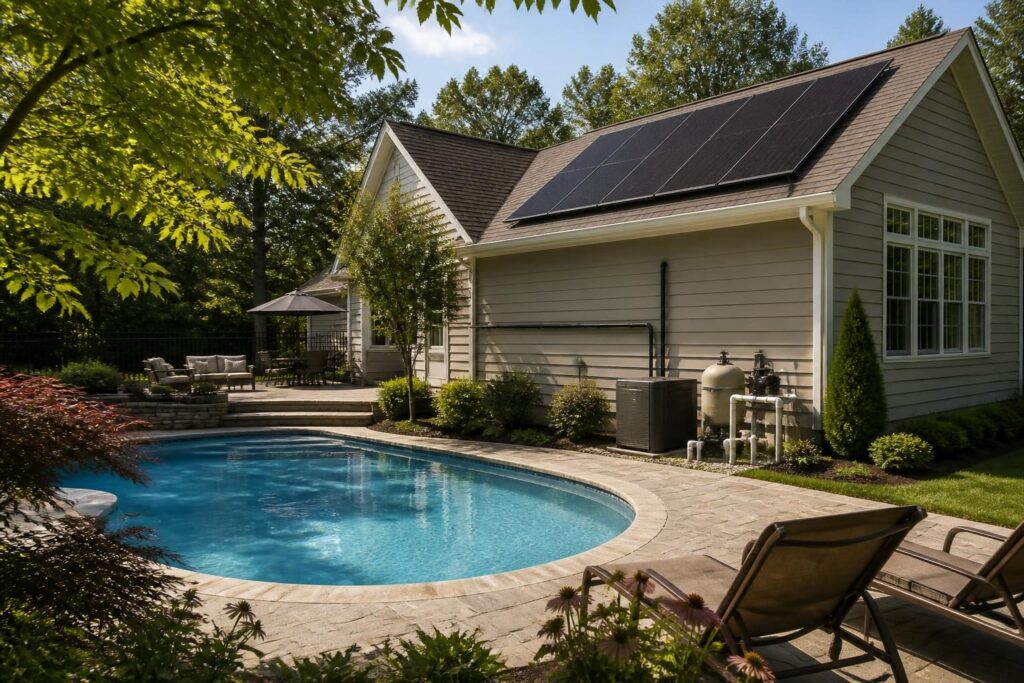
Solar pool heating planning North Carolina homeowners can do early may reveal whether a solar-assisted system fits the site, swimming goals, and equipment plan. Solar heating uses collectors that absorb sunlight and transfer heat to pool water. The system may reduce reliance on conventional heating, but it does not create heat on demand like a gas heater or heat pump.

A useful decision starts with the property rather than a product brochure. Roof angle, shade, collector location, plumbing distance, controls, weather, and desired water temperature all affect the result. Ask the pool contractor to show these items on a plan and explain which assumptions still need professional review.
Start solar pool heating planning with the site
Solar collectors need useful sunlight during the part of the day when your pool system can circulate water. A roof may provide a large, clear surface, while a ground mount may offer easier access and a shorter route to the equipment pad. Neither option is automatically better for every North Carolina property. Good solar pool heating planning North Carolina homeowners can review early should also account for future shade and yard changes.
Review the proposed collector area from several viewpoints. Trees, chimneys, dormers, neighboring homes, privacy screens, and future landscaping can cast shadows. Shade may change across the year, so a bright winter observation does not prove that summer conditions will be adequate.
- Which roof surfaces or ground areas are you considering?
- What shade is expected during the planned swimming hours?
- Will roof structure, surface condition, or access require review?
- Could future trees, fences, or additions reduce sunlight?
- Will the collectors remain visible from important rooms or outdoor spaces?
Orientation also deserves a clear explanation. The best direction and tilt depend on the site, collector design, shading, roof geometry, and installation method. Ask the designer to explain the expected tradeoff if the collectors cannot face the preferred direction. A qualified professional should evaluate roof loading, attachment details, weather exposure, and any structural questions.
Compare roof and ground-mount locations
A roof-mounted system can use space that would otherwise remain unused. It may also keep collectors away from children, pets, lawn equipment, and routine yard traffic. However, roof work introduces questions about attachment, flashing, access, future reroofing, and service safety.
Ground-mounted collectors may make inspection and servicing more convenient. They can also simplify some plumbing routes. The tradeoffs may include lost yard space, visual impact, possible damage from landscaping work, and the need to protect the array from accidental contact.
| Question | Roof mount | Ground mount |
|---|---|---|
| Available area | Uses elevated space, subject to roof geometry | Uses usable yard area |
| Access | May require roof access procedures | Often easier to reach, subject to site layout |
| Future changes | Coordinate with reroofing or additions | Coordinate with landscaping, fencing, and drainage |
| Appearance | Visible from some elevations | May affect views and yard use |
For either location, request a drawing that shows collector dimensions, support or attachment points, access space, pipe paths, shutoff locations, and protection from routine yard work. If the project involves structural, drainage, electrical, or building-code questions, use the appropriate licensed professional or local authority.
Plan solar pool heating plumbing routes before construction
Solar pool heating planning North Carolina projects should include the water path, not just the collector location. In a typical arrangement, pool water flows through a filter and then travels through solar collectors before returning to the pool. The exact arrangement varies by system and equipment.
Long pipe runs can affect layout, appearance, access, and installation complexity. Buried lines may cross areas affected by future planting, drainage work, irrigation, or other utilities. Exposed lines may be easier to inspect but more visible and vulnerable to accidental damage.
Questions about the water circuit
- Where will the solar supply and return lines run?
- Will the route cross a deck, retaining feature, planting bed, or access path?
- How will the lines receive support, insulation, protection, or identification?
- Where will isolation valves and service access remain available?
- How will the system drain or receive cold-weather protection?
- What happens if solar circulation becomes unavailable?
Ask for the final pipe sizes, valve arrangement, equipment connection points, and any buried-line record. Do not rely on a verbal description. A clear as-built drawing can help future service providers understand what the original installer intended.
Underground work also requires broader site coordination. Confirm utility-marking steps through North Carolina 811 before excavation. If the route approaches septic components, obtain property-specific guidance from the local health department or a qualified septic professional.
Understand controls and backup heating
Solar heating works best when the controls can respond to sunlight and water temperature. A controller may use sensors to determine when the collectors can add useful heat. A motorized valve may send water through the collectors when conditions are favorable, then bypass them when they are not.
Ask whether the proposed control system works with the pool pump, filtration schedule, conventional heater, cover, and remote-access platform. Compatibility matters more than a long feature list. The installer should explain what the system does automatically and what you must still adjust.
- Where are the water and collector temperature sensors?
- What temperature settings can the homeowner change?
- Can solar heating and a gas heater or heat pump operate together?
- What is the priority if the pool needs heat but sunlight is limited?
- What alerts appear when a valve, sensor, or circulation path fails?
- Can the homeowner operate the system manually during service?
A conventional heater supplies heat from fuel or electricity when its operating conditions are met. Solar collectors depend on available sunlight and circulating water. Solar may lower operating demand during suitable conditions, but a backup heater can provide more predictable recovery when the weather is cloudy or the desired temperature is high.
For a broader comparison of heat pumps, gas systems, covers, and solar-assisted choices, see pool heater energy efficiency considerations. The right comparison includes installation, controls, maintenance, fuel or electricity, and the comfort level you expect.
Set realistic seasonal expectations
Solar pool heating planning North Carolina discussions should separate “warmer water” from “anytime heating.” Solar collectors can add heat during sunny periods, but performance changes with cloud cover, air temperature, wind, nighttime losses, water exposure, and the pool’s surface area.
North Carolina has varied conditions from the mountains to the coast. A site in one region may have different wind, temperature, shade, and shoulder-season conditions than a site elsewhere. Even nearby properties can perform differently because of roof orientation and tree cover.
Ask the contractor to describe expected use by season without promising a specific water temperature or swimming period. Request the assumptions behind any performance estimate, including pool size, cover use, collector area, target temperature, operating hours, and backup heating.
Questions to ask about the forecast
- Which months are included in the estimate?
- Does the estimate assume a cover when the pool is not in use?
- How do cloudy days and cool nights affect the estimate?
- What temperature increase is expected under typical conditions?
- How long might recovery take after rain or an extended cool period?
- What result should prompt a service call?
A cover can reduce heat loss when the pool is not in use, but it does not make solar energy constant. Discuss safe cover selection, storage, and daily use with the pool professional. Keep expectations tied to the system’s design conditions rather than a single favorable day.
Review cost, maintenance, and handover details
Solar heating is not simply a collector purchase. The complete proposal may include supports, valves, sensors, controls, pipework, electrical connections, roof work, ground preparation, permits, and coordination with existing equipment. Ask which items the proposal includes and which depend on site findings.
Use a written comparison that records the proposed collector location, system type, control strategy, backup equipment, installation assumptions, exclusions, and owner responsibilities. Avoid comparing only the equipment labels. Two proposals may use similar components but require different plumbing routes or structural work.
- Save the equipment model and installation manuals.
- Record valve locations, sensor locations, and controller settings.
- Request operating and shutdown instructions in plain language.
- Keep permits, inspection records, invoices, and approved revisions.
- Ask who services the solar components and connected heating equipment.
- Confirm how roof or ground-mount work affects future repairs.
For seasonal operating changes, connect the solar controller settings with the wider equipment plan. The guide on North Carolina seasonal pool equipment schedules can help organize questions about circulation, heating, and changing weather.
A practical decision checklist
Before approving a solar heating design, confirm that you can answer these questions:
- Where will collectors go, and how will shade change throughout the year?
- Why is the proposed roof or ground orientation suitable for this property?
- What plumbing route connects the collectors to the equipment?
- How will valves, sensors, controls, and service access work?
- What seasonal results are realistic without a backup heater?
- How will a cover affect heat retention and operating expectations?
- What site, structural, electrical, drainage, or permitting reviews does the project require?
- Which drawings and records will the contractor deliver at handover?
Build a Pool in North Carolina encourages homeowners to treat solar heating as a coordinated site and equipment decision. Consult the local inspections department about current permit and inspection requirements. Use a licensed pool contractor for system design, a qualified electrician for electrical work, and an engineer, surveyor, roofing professional, or septic specialist when site conditions call for one.