
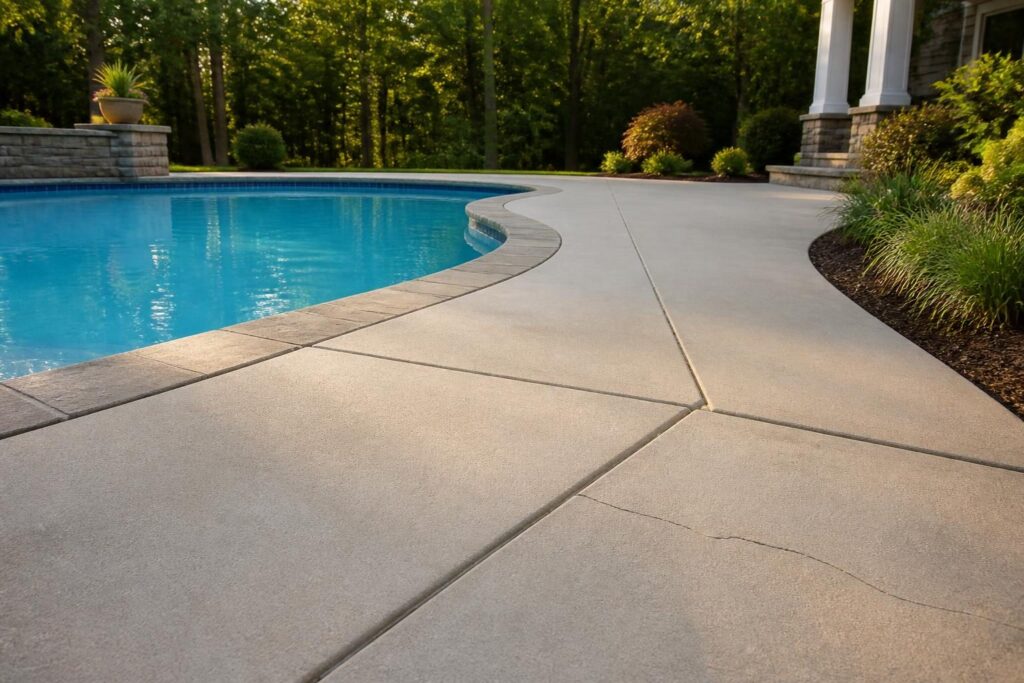
Pool deck expansion joints and cracks North Carolina homeowners observe can reflect several different conditions. Temperature changes, moisture, soil movement, drainage, construction details, and ordinary material aging may all play a part. A crack is not automatically a structural emergency, but a new or changing crack deserves a clear record and sensible follow-up.

This guide focuses on observation. It does not diagnose concrete, soil, structural, drainage, or code issues. Your maintenance record can help a qualified pool contractor, concrete professional, engineer, or other specialist understand what changed and when.
Why pool deck joints and cracks change over time
Concrete expands when it warms and contracts when it cools. North Carolina pool decks may experience hot sun, heavy rain, humid conditions, and occasional freezing weather. These cycles can place stress on large slabs and on the materials beside the pool coping, steps, walls, or other hard surfaces.
An expansion joint is a planned separation that allows adjacent materials to move independently. A control joint, sometimes called a contraction joint, creates a preferred location for a crack as concrete shrinks during curing or drying. The joint may contain a flexible filler or sealant. Its appearance can change without meaning the entire deck has failed.
Settlement is different. It occurs when soil or supporting fill moves downward or changes shape. Water can soften or wash out supporting material. Poorly directed roof runoff may erode soil near the deck. Changes to nearby landscaping, irrigation, downspouts, or drainage paths can also alter moisture conditions.
Homeowners should avoid assigning a cause from appearance alone. A local professional may need to evaluate the slab, base, surrounding grade, drainage, pool structure, and site history together. Soil conditions can add uncertainty, so homeowners may also review questions about soil testing before pool construction.
What to look for during a routine inspection
Walk the deck when the surface is dry and safe. Look across the whole area instead of focusing only on the most visible line. Note whether the change is in the concrete, joint filler, coping, grout, sealant, or another material.
- New cracks that did not appear in earlier photographs.
- Cracks that appear longer, wider, deeper, or more numerous.
- One side of a crack that appears higher than the other.
- Edges that chip, crumble, or expose coarse aggregate.
- Gaps between the deck and coping, steps, pool wall, house, or walkway.
- Joint filler that has pulled away, split, hardened, or fallen out.
- Low spots where water remains after nearby surfaces dry.
- Soil loss, mulch movement, exposed roots, or washout beside the slab.
- Water flowing toward the pool, house, equipment, or another unwanted area.
Do not use a sharp tool to probe a crack. Avoid applying patch material, sealant, or paint before documenting the condition. An unplanned repair can hide movement and make later evaluation harder.
How weather and water can affect the deck
Seasonal temperature and moisture changes
Sun exposure can heat one part of a deck more than another. Shade, wet areas, and different materials can create uneven movement. After a cold period, inspect joints and sealants for separation. After intense heat or rain, look for changes in open joints, surface scaling, or standing water.
Weather does not prove that it caused a particular crack. Record the conditions instead. A useful note might include the date, recent rainfall, unusual heat, freezing conditions, and whether the area felt wet or dry during inspection.
Runoff and erosion
Water should not collect beside the deck or repeatedly discharge onto one edge. Downspouts, roof valleys, pool overflow, irrigation, and sloped ground can all affect the surrounding soil. Erosion may remove support beneath an edge, while saturated soil may behave differently from dry soil.
For a broader review of slopes, drains, runoff paths, and settlement observations, see pool deck drainage maintenance guidance. During construction or major grading, North Carolina stormwater and erosion requirements may also apply. The NC DEQ Construction Stormwater Program explains that applicability and requirements depend on the project and site.
How to distinguish a maintenance observation from an urgent concern
Some changes belong on a routine monitoring list. For example, a stable, narrow line that follows an existing joint may need periodic photographs and professional review during scheduled maintenance. That description does not diagnose the condition. It simply identifies a condition to watch.
Contact a qualified professional promptly when you see movement, a trip hazard, sudden changes, or damage near the pool edge. Also seek advice when water repeatedly undermines the deck, the slab appears to tilt, or a gap develops beside the pool structure or house.
Use extra caution if cracks affect walking surfaces. Keep people away from sharp edges, unstable pieces, exposed reinforcement, or areas that may conceal a void. Do not assume a deck issue is only cosmetic when it occurs with drainage changes, soil loss, pool movement, or damage to nearby structures.
The appropriate specialist depends on the observation. A pool contractor may assess the relationship between the deck and pool shell. A concrete professional may review slab and joint conditions. An engineer may help evaluate suspected structural movement or complex settlement. A drainage professional, surveyor, or soil specialist may help when grades, runoff, or supporting soil affect the issue.
What to include in a pool deck maintenance record
A good record turns a vague concern into a useful timeline. Use the same photo locations and, when practical, similar lighting. Include a wide view for context and close views that show the crack or joint clearly.
- Date and location: Identify the deck section, nearby pool feature, and direction of view.
- Condition: Describe the line, gap, joint, surface damage, low spot, or exposed soil.
- Change: State whether it appears new, unchanged, longer, wider, displaced, or uncertain.
- Weather: Note recent rain, heat, freezing conditions, or prolonged wetness.
- Water movement: Record ponding, runoff direction, downspout discharge, irrigation, and erosion.
- Safety impact: Note a raised edge, loose material, sharp surface, slippery area, or blocked drain.
- Related conditions: Mention coping, tile, steps, walls, walkways, landscaping, or soil changes.
- Action taken: Record who you contacted, your request, and any documents you received.
Use neutral language. “A gap is visible between the deck and coping in the south corner” is more useful than “the deck is failing.” Save original photographs, not only edited or compressed copies.
Questions to ask before repair work
Before approving a repair, ask what condition the work addresses and what remains uncertain. A surface patch may improve appearance without correcting movement, water, or soil support. The proposed work should match the observed problem and the materials involved.
- What is the likely area of concern, and what evidence supports that view?
- Does the joint allow movement, or does it need a different treatment?
- Could drainage, erosion, settlement, or nearby construction be contributing?
- How will the repair affect pool coping, waterproofing, drainage, or access?
- What preparation does the work need before sealant, patching, lifting, or replacement?
- How will the homeowner monitor the repaired area afterward?
- What written scope, product information, exclusions, and care instructions apply?
Ask the professional to place observations and recommendations in writing. Keep sketches, photographs, invoices, product information, and maintenance notes with your pool records. Build a Pool in North Carolina can help homeowners organize practical questions, but site-specific conclusions belong to qualified professionals.
A simple seasonal monitoring routine
Inspect the deck at the start of the swimming season, after major storms, after nearby grading or landscaping, and before winter maintenance. Look at joints, edges, drains, coping, and runoff paths. Compare current photographs with earlier images rather than relying on memory.
A dated photo helps track pool deck expansion joints and cracks North Carolina homeowners may notice after each season. Keep vegetation, soil, and stored items from hiding the deck edge. Confirm that downspouts and irrigation are not concentrating water beside the slab.
Pool deck expansion joints and cracks North Carolina homeowners monitor deserve the same dated notes after each inspection. For homeowners maintaining a changing deck, pool deck expansion joints and cracks North Carolina observations can provide useful context for a qualified professional. Do not change grading or drainage without considering where the water will go and whether local requirements or professional design review apply. When observations show movement, repeated water problems, unsafe surfaces, or damage near the pool structure, pause do-it-yourself repairs.
Consult the local inspections department when permits, inspections, or adopted requirements may apply. For site-specific conditions, ask a licensed pool contractor, concrete professional, electrician, engineer, surveyor, drainage specialist, or septic professional as appropriate.