
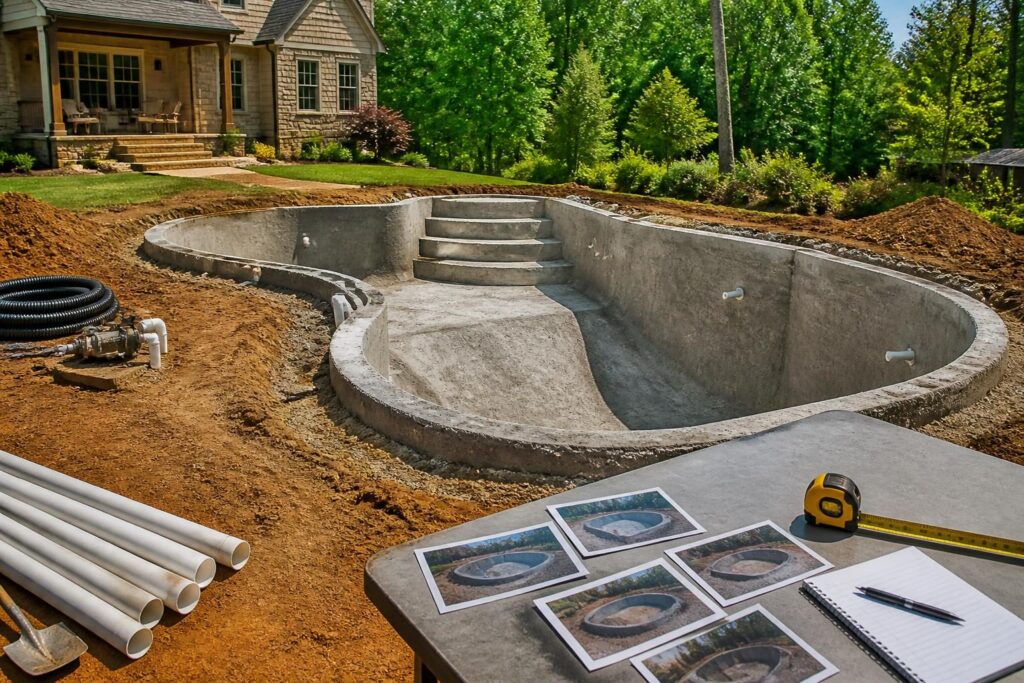
A pool shell inspection before backfill gives you a final opportunity to review visible work before soil hides much of the structure and its connections. The goal is not to replace a licensed inspection or professional evaluation. It is to compare observable conditions with the approved design, written scope, and project records.

Backfill is the material placed around the outside of the pool shell. After the contractor installs it, access becomes limited. A careful review now can help identify unanswered questions about dimensions, openings, fittings, surfaces, drainage, and future service access. Build a Pool in North Carolina encourages homeowners to treat this stage as a documentation point, not a search for defects.
Why review the exposed pool shell?
The shell is the pool’s structural body. Its form may be concrete, fiberglass, or another specified system. At this stage, some items remain easy to see: walls, floor contours, steps, benches, lights, return fittings, drains, skimmer openings, and plumbing penetrations.
Once backfill begins, measurements may be harder to confirm. Photos may no longer show the relationship between buried plumbing and the shell. Future deck, coping, drainage, and equipment work can also depend on what the crew conceals below grade.
A homeowner review should therefore answer three practical questions:
- Does the visible work appear consistent with the current plan and written scope?
- Are the locations and finishes documented well enough for future reference?
- Which questions need an answer from the pool contractor, designer, engineer, inspector, or another qualified professional?
Do not enter an excavation unless the contractor confirms that access is safe. Open excavations can have unstable edges, standing water, hidden utilities, and fall hazards. North Carolina requirements can vary by jurisdiction, adopted code, property conditions, and project scope.
Pool shell inspection before backfill: compare the shape and dimensions
Begin with the approved drawing or current written revision. Use the latest version, and keep older versions marked as superseded. A drawing comparison is more useful than relying on memory or a sales sketch.
Ask the contractor to identify the reference points used for measurements. Those points might relate to the house, property features, coping, or finished grades. Homeowners should not assume that an informal tape measurement proves compliance with a plan or code requirement.
Dimensions and elevations to discuss
- Overall length and width at the locations shown on the plan.
- Intended shallow-end and deep-end areas.
- Water depths and any transitions between levels.
- Step, bench, tanning ledge, or seat locations.
- Corner shapes, radiuses, and unusual curves.
- Distances to nearby walls, decks, structures, and planned drainage features.
- Top-of-shell elevations in relation to the proposed coping and deck.
Record who supplied each measurement and whether it is approximate. If a dimension differs from the plan, pause the review and request clarification before concealment. A change may be intentional, but the project record should reflect it if the design or scope changed.
For broader stage planning, see the residential pool construction phases checklist. It can help place this review within excavation, structural work, utilities, finishes, and handover.
Review penetrations, fittings, and visible connections
A penetration is an opening through the shell for plumbing, lighting, drainage, or another component. Fittings are the visible parts that connect water movement or equipment systems to the pool. Their exact placement should match the approved design and the specified equipment plan.
Walk the perimeter with the contractor and create a location list. Photograph each item from a wide view and a close view. Include a reference object or tape measure when safe and practical, but avoid placing tools on unfinished surfaces.
Items to identify and record
- Skimmer openings and their orientation toward the planned deck.
- Return fittings, suction outlets, cleaner lines, and water features.
- Pool lights, niches, conduits, and junction locations visible at the shell.
- Drain openings and covers, if already installed and safe to view.
- Autofill, overflow, hydrostatic, or other specified openings.
- Waterline tile locations, raised features, spillways, and vanishing-edge details.
- Plumbing lines that leave the shell and their general direction.
Do not loosen fittings, remove covers, test electrical parts, or handle open wiring. Ask the appropriate licensed professional to explain work that involves electrical bonding, grounding, conduit, pressure testing, or other technical systems.
For visible drain-cover questions after installation, use the residential pool drain-cover safety checklist. It addresses a later homeowner review and does not replace professional verification of the installation.
Look at surfaces without treating appearance as a diagnosis
Surface review depends on the pool type and the construction stage. A concrete shell may show trowel marks, texture changes, construction joints, small surface variations, or areas that will receive a separate finish. A fiberglass shell may show molded features, seams, fittings, and shipping or handling marks. Other systems have their own accepted installation characteristics.
Ask which visible conditions are temporary and which will remain part of the finished system. Request the manufacturer’s or contractor’s written preparation requirements when applicable. Do not scrape, patch, grind, fill, or chemically treat a surface yourself unless the responsible professional directs you to do so.
Questions about surface condition
- Which areas will receive plaster, pebble, tile, liner, coating, or another finish?
- Have the shell and substrate been cleaned or prepared for that finish?
- Are visible cracks, voids, honeycombing, chips, stains, or uneven areas documented?
- Does the contractor recommend repair, monitoring, or no action before the next phase?
- What product or method will be used, and who is responsible for the work?
Descriptions should remain factual. Write “linear mark visible on the east wall” instead of assigning a cause. A qualified pool professional, engineer, or other specialist can evaluate whether a condition matters for the specific shell and finish system.
Use photos and measurements as a concealed-work record
A useful photo record shows context. Take images from each corner, along each wall, across the floor, and toward every visible penetration. Capture the shell before water, soil, decking, coping, or landscaping changes the view.
Keep the original files. Avoid editing out objects or conditions. Phone metadata can help, but it should not be your only record. Add a simple written index with the date, location, direction, and subject of each image.
Consider recording:
- Plan version and revision date used for the review.
- Approximate measurements and the reference point for each one.
- Depth readings supplied by the contractor or survey professional.
- Fitting names, locations, and intended functions.
- Visible surface conditions and the contractor’s response.
- Plumbing routes, sleeves, conduits, and other items that the crew will cover.
- Open questions, responsible party, and target decision date.
Use a consistent file name, such as date-area-view. Store a backup outside your phone. The article Document Pool Construction offers additional ideas for organizing photos, measurements, approvals, and construction records.
Clarify decisions before backfill starts
A review is most useful when it ends with clear next steps. Ask the contractor to identify which items are ready for concealment and which remain open. If the project has an inspection hold point, confirm who schedules it and what records the contractor will provide.
Keep these questions together:
- Is the shell ready for the planned next phase?
- Have all approved penetrations and fittings been installed?
- Were any locations, dimensions, materials, or methods changed?
- Are changes reflected in a revised drawing, change order, or daily record?
- What testing or inspection occurred, and what documentation will you receive?
- Will backfill affect access to plumbing, drainage, cleanouts, or future repairs?
- What must remain visible until a local inspection or professional review is complete?
Do not approve concealment solely because the schedule is moving. At the same time, do not stop construction based on a visual concern alone. Put the question in writing and ask the responsible professional for a specific response. A pool shell inspection before backfill can help organize that response around observable facts.
For records connected to approvals, consult the North Carolina pool permit inspection records guide. Current requirements and inspection practices must be confirmed with the local inspections department.
Understand what this homeowner review cannot confirm
Photos and tape measurements cannot establish structural adequacy, reinforcement placement, water-tightness, electrical safety, soil support, code compliance, or proper pressure-test results. Some critical work may be concealed before a homeowner can see it.
Do not rely on a visual shell review to approve technical work. North Carolina homeowners should verify current requirements with the local inspections department and the professionals responsible for the design and installation. The North Carolina Office of State Fire Marshal documents can help readers locate state code materials and interpretations, but local application still requires confirmation.
If excavation, underground utilities, or site access remains active, use the official North Carolina 811 resource for utility-notification information. Follow the directions of the responsible contractor and utility professionals.
A calm final review before concealment
Complete the pool shell inspection before backfill with the current plan, a written checklist, a camera, and enough time for questions. Focus on what you can observe: shape, dimensions, openings, fittings, surfaces, routes, and records. Then separate visible facts from technical conclusions.
Use a pool shell inspection before backfill as a recordkeeping checkpoint, not as a substitute for required inspections or technical approval. Consult the local inspections department, licensed pool contractor, electrician, engineer, surveyor, septic professional, or another qualified specialist when the question involves permits, structure, electrical systems, drainage, septic conditions, elevations, or code requirements. Good records support those conversations and preserve useful information for future maintenance.