
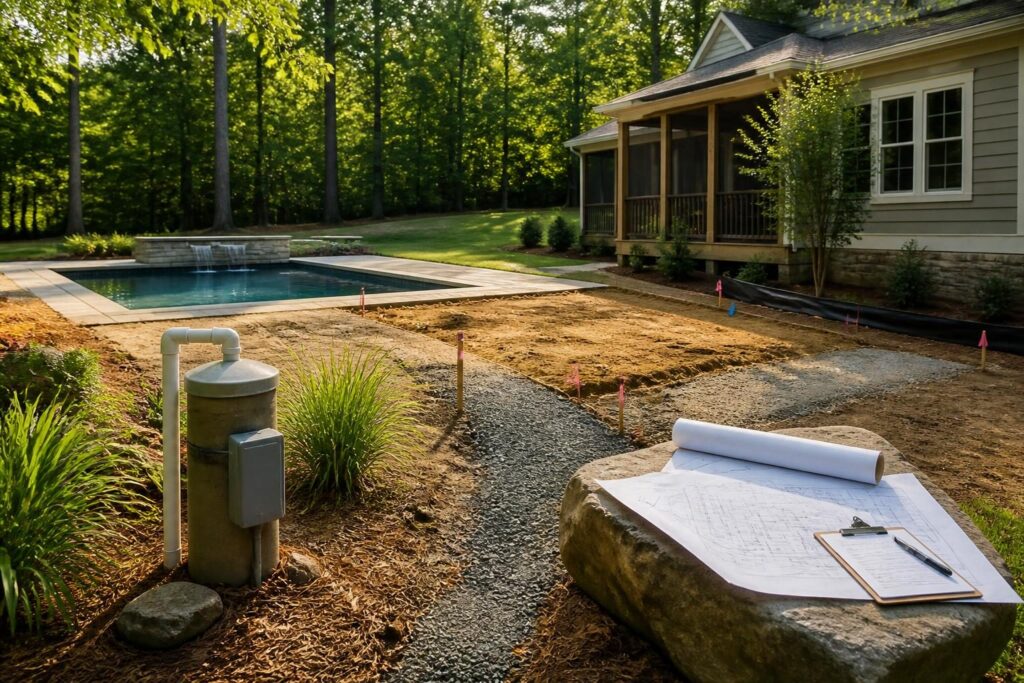
Pool construction near private well water supply access questions deserve attention before a design is finalized. A private well can affect pool location, equipment access, construction traffic, water testing, filling plans, and future service. The right questions depend on the property, local jurisdiction, well records, adopted requirements, and the project scope.

This guide helps North Carolina homeowners organize those questions. It does not establish a universal well setback or replace advice from the local health department, inspections department, licensed pool contractor, well professional, surveyor, engineer, or other qualified specialist.
Start with well location records and visible evidence
A well may be easy to see, but its records can provide details that the yard cannot. Look for original closing documents, well construction records, permits, water-quality reports, pump information, and prior service notes. Records may identify the well location, depth, casing, pump type, or other useful information.
Do not assume a visible pipe marks every part of the well system. Buried lines may run from the well toward the house, pressure tank, treatment equipment, irrigation system, or other connections. A surveyor or qualified well professional can help identify what should be located and documented.
Build a property record folder
- Copy of available well construction or installation records.
- Recent water-quality reports, if available.
- Wellhead photographs from several directions.
- Pressure-tank and treatment-equipment locations.
- Known water lines, electrical feeds, and control equipment.
- Survey, site plan, and proposed pool layout.
- Names and contact details for the local review offices.
North Carolina Environmental Health provides state resources for private wells and environmental-health topics. Use the North Carolina Environmental Health resources as a starting point, then confirm property-specific questions with the appropriate local office.
Resolve equipment access before choosing the pool location
Well equipment needs more than a one-time inspection. Pumps, pressure tanks, filters, treatment systems, electrical controls, and piping may need service or replacement later. A pool, deck, fence, retaining wall, or planting bed should not make that work impractical.
Ask the pool designer to show the wellhead and related equipment on the working site plan. Request a separate note that identifies the route for service access. This is more useful than a general promise to keep the well accessible.
Consider how access changes during each construction stage. A compact machine may fit during excavation but not during future pump replacement. A gate may admit workers but not the equipment needed for a larger repair. The pool plan should account for those possibilities without treating an unverified access route as adequate.
Questions about access and protection
- Where is the wellhead in relation to the pool shell, deck, fence, and equipment pad?
- Can a well professional reach the system without crossing finished pool surfaces?
- Will construction vehicles pass over buried water or electrical lines?
- How will the wellhead stay protected from soil, concrete washout, fuel, and debris?
- Will grading or drainage direct runoff toward the wellhead?
- Could a future fence or gate block service access?
- Which access responsibilities belong to the homeowner, pool contractor, or well professional?
Put the answers in the plan or written project scope. If the design changes, update the access drawing rather than relying on a field conversation.
Separate pool water supply from well capacity assumptions
Pool construction near private well water supply access questions often begin with one practical issue: Can the well provide the water needed for construction and filling? The answer should not be guessed from household pressure or from a hose connection.
Resolving pool construction near private well water supply access questions early can help the project team separate household use, construction use, and the pool’s initial fill.
A pool may require water for initial filling, concrete work, cleanup, testing, or later maintenance. The well professional can discuss the system’s known production, storage, pump operation, and recovery characteristics. Those factors do not automatically establish how much water the pool should use.
Ask for a written filling plan. It may involve a staged fill, stored water, a permitted delivery source, or another approach selected by the project team. The plan should address where delivery vehicles can stop, how hoses will reach the pool, and how traffic will avoid the wellhead and buried lines.
For related planning questions, review private-well pool planning questions and initial pool water delivery planning. These topics should be coordinated with the current site plan rather than handled separately.
Decide how to document water use
Record the planned source, expected sequence, responsible party, and any limitations. Keep notes about unusual pressure changes, loss of flow, cloudy water, sediment, or changes in household water service during construction. Stop and seek professional help if construction activity appears to affect the well system.
Plan water testing before and after construction
Water testing can answer different questions, so define the purpose before collecting a sample. A homeowner may want to understand baseline household water quality, assess water intended for a pool fill, or investigate a change after excavation. One test may not answer all three questions.
Use consistent sampling instructions from the selected laboratory or qualified professional. Keep the date, sample location, laboratory, test panel, and results together. A baseline sample taken before construction may help compare later results, but it does not prove that a later change came from pool work.
Pool construction near private well water supply access questions also include the water’s intended use. Pool water needs separate treatment and testing after filling. The CDC explains residential pool water treatment and testing, including chlorine and pH considerations, in its home pool water testing guidance. Follow product instructions and obtain qualified help when results are unclear.
Useful testing questions
- What is the purpose of each test?
- Should the sample represent household water, source water, or filled pool water?
- Should testing occur before excavation, after construction, or both?
- Which changes require prompt contact with a well professional?
- Who will document the pool’s fill source and startup results?
Discuss construction impacts before excavation
Excavation introduces heavy equipment, vibration, soil movement, dust, fuels, concrete materials, and changing drainage patterns. These conditions can affect the area around a well even when the pool does not directly overlap the wellhead.
Ask the contractor and well professional to discuss the proposed excavation limits, machine travel paths, spoil storage, temporary drainage, and material staging. Mark the wellhead and known utility routes clearly. Keep protective measures visible to every worker who enters the site.
Do not allow construction decisions to rely on an uncertain buried-line location. The project team may need locating services, updated drawings, or professional review before excavation continues. North Carolina requirements for land disturbance and runoff can vary by project and location. Review the NC DEQ Construction Stormwater Program and confirm applicability with the responsible authority.
Document conditions that matter
- Photograph the wellhead, access route, exposed lines, and nearby grades.
- Mark temporary barriers and no-storage areas on the site plan.
- Record who will respond if a line, casing, or control suffers damage.
- Note how rainwater will be managed while the excavation remains open.
- Update the plan if the pool location or equipment route changes.
Homeowners should not enter an excavation or inspect electrical equipment during active work. Ask the responsible professionals to explain safe observation points and reporting procedures.
Verify separation requirements locally
There is no single spacing answer that fits every North Carolina property. Separation requirements may depend on the well type, pool design, property conditions, local health review, adopted code, septic features, easements, flood conditions, and other site constraints.
Ask the local health department or other responsible authority which current requirements apply. Provide the well records, proposed pool plan, septic information when relevant, survey, grading details, and equipment locations. Request confirmation of any required review, documentation, or revisions.
Coordinate that review with the local inspections department. Building, electrical, barrier, grading, and other permit questions may involve different offices. The North Carolina Office of State Fire Marshal provides code documents and interpretations, but homeowners should confirm the currently adopted code and local interpretation before relying on general information.
Keep written confirmations with the project records. If an authority or qualified professional gives a property-specific direction, ask where it belongs on the plan and who will verify it during construction.
Use a preconstruction decision checklist
Before approving the final layout, confirm that the following questions have clear owners and written answers:
- Does a record, field evidence, or professional locating support the well location?
- Do the drawings show the wellhead, pump equipment, pressure tank, treatment units, and buried lines?
- Does future service access remain practical after the pool, deck, fence, and landscaping are complete?
- Has the team selected the water source for construction and initial filling?
- Are delivery access, hose routes, and vehicle parking documented?
- Is baseline water testing appropriate for the stated purpose?
- Will the team document excavation, runoff, fuel, concrete, and soil protection?
- Can the local authority confirm applicable separation and permit questions?
- Are changes recorded in the plan, contract scope, and homeowner file?
A useful record includes the dated site plan, well documents, test results, written decisions, photographs, professional contacts, and approvals. Build a Pool in North Carolina can help homeowners frame practical planning questions, but property-specific decisions belong with the responsible professionals.
When questions remain, consult the local inspections department, local health department, licensed pool contractor, well professional, electrician, engineer, surveyor, septic professional, or other qualified specialist. Verify current requirements before excavation, water-system changes, filling, or construction near the well.