
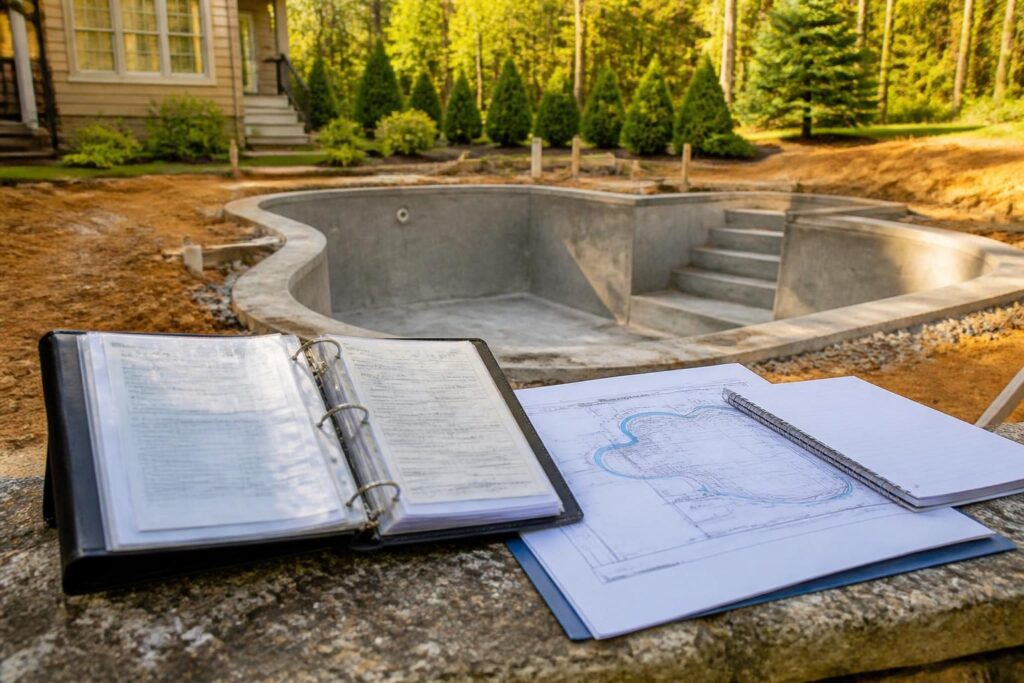
When a pool shell uses shotcrete, gunite, or another concrete placement method, pool construction concrete testing records can help connect what the crew placed with where it went. These records do not replace a qualified professional’s evaluation. They give homeowners a clearer file for questions, maintenance planning, warranty discussions, and future work.

Concrete documentation often comes from several parties. The concrete supplier may issue delivery information. The placement crew may keep production notes. An independent testing firm may prepare test reports when someone requests or requires testing. Your contract, project specifications, local requirements, and construction method determine which records exist.
Why concrete records matter after the pool is covered
Much of a pool shell becomes difficult to inspect once plumbing, backfill, coping, decking, and finishes cover it. A well-organized record preserves information that homeowners may otherwise struggle to reconstruct later.
These records can help answer practical questions. Which load or batch served the pool walls? When did placement occur? Did anyone note weather or site conditions? Did anyone perform field tests? Which test sample relates to the deep end, steps, bench, or another section?
The file may also support a future conversation with a pool contractor, engineer, testing laboratory, or other qualified specialist. A report helps only when you understand its scope and limits. A passing result, where one exists, does not automatically prove that the crew constructed every part of the pool correctly.
- Keep records with the contract, approved changes, drawings, and material information.
- Use the pool plan or a marked site sketch to identify relevant sections.
- Note whether a document is original, revised, incomplete, or supplied later.
- Do not alter technical reports or summarize them as conclusions you cannot verify.
Pool construction concrete testing records to request
Start with a written request that asks for records created during the concrete phase. Use neutral wording. You are asking for project documentation, not assuming that testing occurred or that a deficiency exists.
Delivery and batch information
Ask whether delivery tickets or batch records exist for the concrete used in the pool shell. Depending on the supplier and project, a ticket may identify the delivery date, time, truck, mix designation, quantity, and other production details. It may also show additions that someone documented at the plant or on site.
Do not assume every ticket contains the same fields. Ask for complete copies rather than relying on a summary spreadsheet. If a document uses a mix code, request the related specification or product description so a qualified reviewer can understand what the code means.
Placement and site notes
Placement notes can connect delivery information with the work performed. Request the placement date, approximate start and finish times, equipment used, crew or subcontractor identification if the project file includes it, and any recorded interruptions.
Useful notes may also describe weather, surface preparation, water additions, admixtures, nozzle or hose changes, curing measures, or areas placed in separate operations. These details vary by construction method. A homeowner should not treat missing notes as proof that a particular step was skipped.
Testing reports when testing occurred
Ask for copies of all concrete or shotcrete testing reports that relate to the pool. Depending on the project, testing could involve fresh-concrete observations, slump, temperature, air content, sample identification, or later strength testing. Shotcrete work may use different procedures from conventional ready-mix placement.
Request the full report, not only a result described as “good” or “passed.” Look for the test date, sample date, specimen identification, test method, laboratory or technician information, result, stated acceptance criteria, and any limitations or comments. The person who interprets a technical report should have the appropriate qualifications.
Connect each record to the relevant pool section
The most valuable part of pool construction concrete testing records is often the location link. A delivery ticket by itself may show that concrete arrived. It may not show whether the crew placed the load into the deep end, walls, steps, bench, bond beam, or another feature.
Ask for any available placement map, pour sequence, daily report, or marked-up plan. If no formal map exists, request a simple project sketch that identifies the areas placed on each date. The sketch should use recognizable features and the approved pool plan as references.
For example, a record might identify “east wall and steps” rather than only “pool shell.” Keep the section label consistent across the delivery ticket, placement note, testing report, and project photographs. Consistency reduces confusion when several loads or placement days are involved.
Location-linked pool construction concrete testing records also help a future reviewer compare test samples with the pool’s actual features. Keep that connection visible in the folder rather than relying on memory.
- Pool section or feature: wall, floor, steps, bench, ledge, beam, or other area.
- Placement date and approximate time window.
- Delivery ticket or batch number.
- Test sample or specimen number, if applicable.
- Related photographs, inspection notes, or daily report.
- Any stated uncertainty about the location or sequence.
Homeowners may also find it useful to compare these records with the project’s reinforcement and placement documentation. The guide on reinforcement steel inspection questions explains why records from before concrete placement should remain connected to later construction documents.
Questions to include in your written request
A focused request makes it easier for the project team to identify what exists. Ask for records in their existing form. Do not request a professional certification unless the contract or applicable requirement calls for one.
- Which concrete placement dates appear in the project file?
- Can you provide delivery tickets for each placement date?
- What mix designation or specification connects to each ticket?
- Do placement maps, daily reports, or batch-to-location notes exist?
- Did anyone perform concrete testing, and if so, who performed it?
- Which sample number connects to which pool section or placement date?
- Do reports exist for rejected loads, retesting, repairs, or unusual conditions?
- What curing or protection instructions did the project team provide after placement?
- Which documents does the contract require for closeout, warranty, or handover?
- Are any records unavailable, and can the project team identify the gap?
Keep the request separate from a complaint or payment dispute. A simple records request creates a cleaner paper trail and helps the parties focus on locating documents. For broader organization, see this homeowner record guide for construction material submittals.
Review the documents without overreading them
When the records arrive, check whether names, dates, batch numbers, and locations agree. Compare them with your approved plan and construction photographs. Save the original files, then create a separate working copy for notes.
Several gaps deserve a follow-up question. One test report may lack a clear pool location. Another ticket may list a mix code without the related specification. A placement note may refer to a feature using a different name from the plan. Ask for clarification before drawing conclusions.
Concrete test results also require context. The meaning of a result depends on the test method, sample, timing, material, and stated acceptance criteria. A homeowner should not use a generic online value to judge a project. If a report raises concern, ask a qualified pool professional or engineer to review the complete record.
Keep the records alongside related documents, including the pool plan, approved revisions, reinforcement observations, plumbing photographs, inspection paperwork, and payment records. The article on plumbing fittings before backfill documentation covers another example of linking hidden work to location-specific evidence.
Build a usable concrete record folder
A simple folder structure can make future service conversations more efficient. Use filenames that begin with the date, followed by the document type and pool section. Retain original email attachments and note who supplied each file.
Keep pool construction concrete testing records in the same project folder as delivery tickets, plans, and location sketches. This arrangement makes the connection easier to review during future work.
- 01 Plans: approved pool plan, details, and revisions.
- 02 Delivery: tickets, batch information, and mix specifications.
- 03 Placement: daily notes, pour sequence, and curing instructions.
- 04 Testing: laboratory reports, field reports, and sample references.
- 05 Location links: marked plans, sketches, and labeled photographs.
- 06 Follow-up: neutral questions, responses, and professional reviews.
Record the date you received each document. If the file is incomplete, write down what remains outstanding and whether the project team said no record exists. This distinction is more useful than silently treating an absent document as proof of a construction problem.
North Carolina questions that may need local verification
North Carolina pool projects can involve different local authorities, adopted codes, permits, inspections, site conditions, and contract requirements. Concrete testing may appear in the design professional’s specifications, the contract, an insurer’s requirements, or another project document. Do not assume that one statewide checklist applies to every residential pool.
For code and inspection questions, review current official information from the North Carolina Office of State Fire Marshal and confirm the applicable interpretation with the local inspections department. The state’s construction stormwater program may also matter when land disturbance and runoff controls are part of the project; requirements should be checked for the specific site.
Build a Pool in North Carolina encourages homeowners to keep technical records as part of the project handover file. Request the documents early, before the people or companies who created them become difficult to reach or the work becomes harder to identify.
Consult the local inspections department for permit or inspection questions. Ask a licensed pool contractor about construction records and handover materials. An engineer, surveyor, testing laboratory, electrician, or other qualified specialist may be appropriate for technical questions outside a homeowner’s role. Professional review matters especially when a record appears incomplete, inconsistent, or concerning.