
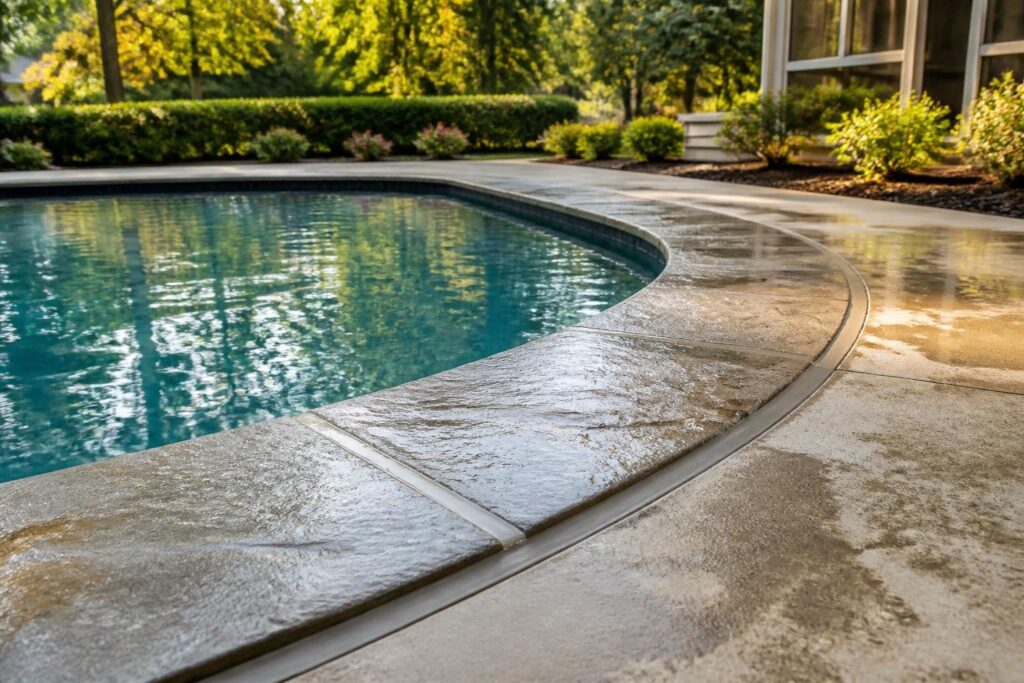
Regular pool coping seasonal movement checks North Carolina homeowners can perform help create a useful record of changes around the pool edge. Coping is the material installed along the pool perimeter. It may be concrete, stone, brick, pavers, or another finish. The coping meets the pool structure, joint sealants, and surrounding deck, so several materials can move differently as temperature and moisture change.

This routine is not a substitute for a qualified inspection. It gives you dated observations that may help a pool contractor, mason, concrete professional, engineer, or other specialist understand when a change appeared. Focus on repeatable photographs rather than trying to diagnose the cause yourself.
Why seasonal movement deserves a record
North Carolina weather can shift from cool, wet conditions to hot, humid periods. Freeze events may occur in some areas, while heavy rain can affect soil and surfaces throughout the state. Concrete, stone, sealants, and adjacent decking respond to these conditions in different ways.
Temperature may change a narrow joint opening. Sealant may become harder, softer, separated, or discolored. After a storm, a deck transition may collect water. None of these observations alone proves a structural problem or installation defect. They show where a professional may need to look more closely.
Start with a baseline when the pool area is clean and easy to see. Save wide views and close-ups. Use the same locations, camera direction, and approximate distance each time. A simple file name can include the date, location, and condition, such as 2026-09-15-north-coping-joint-dry.
Choose repeatable observation points
- Mark each side of the pool with a simple name, such as north, east, south, and west.
- Include corners, steps, curves, raised sections, and areas where materials change.
- Photograph coping near doors, drains, planters, retaining features, or slopes.
- Keep the original files instead of relying only on edited or compressed images.
For broader deck observations, see this guide to photographing changes around a North Carolina pool deck. It can complement a coping-focused record without replacing professional evaluation.
What to photograph around coping joints
A coping joint is a planned or visible separation between adjacent pieces or materials. Some joints are intentional. Others may reflect movement, wear, or damage. Photograph the joint in context before taking a close-up.
Capture the full coping piece, the neighboring pieces, and the nearby deck. Then take a closer image that shows the joint clearly. Include a ruler only if you can place it safely without entering the water or disturbing the area. A coin may provide visual scale, but do not treat it as a precise measurement.
- Joint width and shape: Note whether the opening appears even, tapered, stepped, or irregular.
- Edges: Look for chipped corners, flaking, exposed aggregate, or fresh-looking breaks.
- Vertical change: Photograph whether one piece appears higher than the next. Do not press, pry, or attempt to level it.
- Surface staining: Record dirt lines, rust-colored marks, algae-like growth, or water tracks.
- Location: Identify the side, corner, coping material, and nearby feature.
Repeat the same image after a dry period and after notable weather changes. Record whether the surface was wet, shaded, recently cleaned, or covered by leaves. These details help prevent misleading comparisons.
Check sealants without disturbing them
Installers may use flexible sealant at selected joints or transitions. Sealant is a material that fills a gap while allowing limited movement. Its condition can change with age, sunlight, water exposure, cleaning, and temperature.
Photograph the sealant from above and from the side when safe. Look for separation from one edge, splits across the bead, recessed sections, bubbling, hardening, or missing areas. Also record whether debris or standing water collects beside the joint.
Do not cut, pull, scrape, paint, or apply replacement sealant during a monitoring check. Different products and joint details may require different preparation. An attempted repair can hide the original condition or introduce water into an unintended location.
Use a simple sealant note
- Location and joint type, if known
- Date and recent weather conditions
- Whether the sealant looks continuous
- Any visible separation, cracking, soft spots, or missing sections
- Whether the change appears new, larger, or unchanged compared with the prior image
If a joint opens quickly, exposes a gap, allows water to collect, or sits beside a visibly displaced coping piece, contact a qualified pool professional. Avoid assuming that adding caulk will solve the issue.
Photograph transitions between coping and deck
The transition between coping and the adjacent deck deserves special attention. The deck may be concrete, pavers, tile, stone, or another surface. Each material may have different joints, support conditions, and drainage behavior.
Take a wide photograph that shows the transition and a close-up that shows its edges. Photograph the same area when dry and after rain if water remains long enough to observe safely. Record whether the deck appears to slope differently, whether a low spot has formed, or whether water is moving toward the house or another sensitive area.
Watch for changes such as a growing gap, cracked grout or mortar, lifted pavers, a chipped coping edge, or a deck crack that reaches toward the pool. A crack does not identify its own cause. Soil movement, temperature changes, drainage, material behavior, and construction details may all require consideration.
For planning context, review this guide to pool deck joint layout and movement areas. It explains why planned joints and transitions should be documented before maintenance questions arise.
Compare seasonal conditions consistently
Useful pool coping seasonal movement checks North Carolina homeowners perform should compare similar conditions. A wet photograph may make a joint look darker or wider. Strong sunlight can create shadows that exaggerate edges. Leaves, furniture, covers, and dirt can hide important details.
Consider taking a routine set during several different conditions:
- After cleaning, when the surfaces are visible
- During a warm, dry period
- After a significant rain event, if access remains safe
- Before and after the season when the pool receives less use
- After nearby landscaping, drainage, or deck work
Do not climb onto unstable coping or enter the pool to reach a photograph. Keep children away from the area during inspection. If the deck is slippery, cracked, or uneven, wait for safer conditions and ask a qualified professional to assess difficult locations.
Keep observations separate from conclusions
Write what you can see rather than what you think caused it. “Sealant appears separated along the east-side transition” is more useful than “the pool shell is failing.” Avoid labeling a change as settlement, structural movement, or code noncompliance without appropriate professional review.
A practical note can include:
- Exact location and photo number
- Surface condition and recent weather
- What changed since the last image
- Whether water, debris, or staining was present
- Questions for the pool contractor or specialist
When to request a professional review
Some patterns deserve prompt attention. These include a coping piece that rocks, a visible height difference that increases, a sharp or newly exposed edge, a joint that changes rapidly, or water entering an unexpected gap. Also note deck movement near doors, foundations, retaining features, or drainage paths.
These signs do not establish a cause. They indicate that a qualified person should review the location and surrounding conditions. Ask the reviewer to explain what they observed, what additional information they need, and whether temporary precautions are appropriate.
Bring your photo record, construction documents, material information, prior repair records, and notes about weather or nearby work. If the coping is under warranty, follow the written notice and documentation process without altering the area first.
North Carolina requirements and professional responsibilities can vary by jurisdiction, property conditions, adopted codes, utilities, drainage, and project scope. For current code or inspection information, consult the North Carolina Office of State Fire Marshal document resources and confirm details with the local inspections department.
Build a repeatable coping check routine
Consistent pool coping seasonal movement checks North Carolina homeowners make are most valuable when they remain simple. Choose a recurring reminder, use the same photo points, and save notes with the images. You do not need specialized equipment to create a useful history.
- Walk the perimeter only when surfaces are safe.
- Take wide images before close-ups.
- Photograph joints, sealants, corners, and material transitions.
- Record weather, surface moisture, cleaning, and nearby work.
- Compare the new images with the baseline.
- Ask a qualified professional about changes you cannot explain or safely evaluate.
Build a Pool in North Carolina encourages homeowners to treat photographs as maintenance records, not as proof of a diagnosis. A calm, dated record can make conversations clearer and help separate normal seasonal appearance changes from conditions that need further review.
For related maintenance observations, you can also review irrigation and overspray questions and pool deck drainage around doors and walkways. Consult the local inspections department, a licensed pool contractor, mason, engineer, surveyor, drainage professional, or other qualified specialist when the change involves safety, movement, water flow, or repairs. Keep your pool coping seasonal movement checks North Carolina record available for that review.