
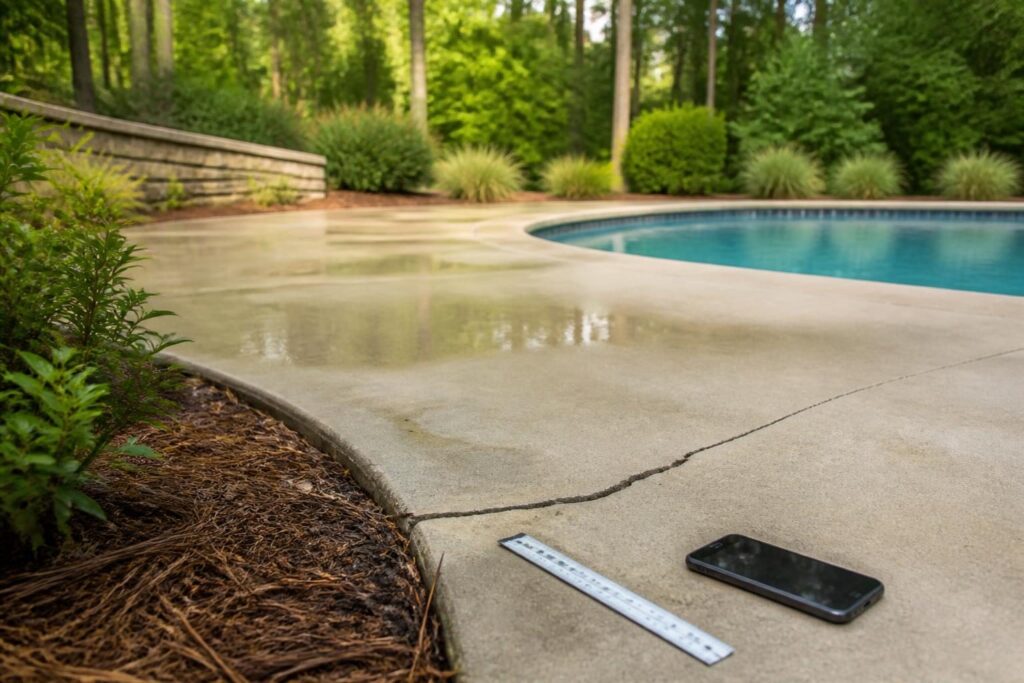
Pool deck settlement monitoring North Carolina homeowners can manage starts with a clear baseline. A deck may show small cracks, uneven areas, or changing drainage without revealing the cause. Consistent photographs and notes help you see whether a condition is stable, seasonal, or changing.

This record does not replace an inspection by a qualified professional. Concrete can move because of soil conditions, water, drainage, nearby construction, tree roots, temperature changes, or other site factors. Your goal is to document what changed, where it changed, and when you noticed it.
Why a baseline matters before you track movement
A baseline is a dated record of the deck’s condition at a known point in time. Create one after the deck is complete, after a repair, or as soon as you begin monitoring an older surface. Include the pool edge, coping, steps, doors, walkways, drains, landscaping, retaining features, and nearby structures. Pool deck settlement monitoring North Carolina records become more useful when the baseline includes these surrounding reference points.
Use the same routes and camera positions during later visits. A wide photograph shows location and context. A closer image shows the condition. Together, these views make later comparisons more useful than a single close-up taken from an unknown angle.
Capture a repeatable photo set
- Take wide images from each corner of the deck.
- Photograph each side of the pool and every transition to another surface.
- Include doors, steps, drains, downspouts, retaining walls, and walkways.
- Take close images of existing cracks, joints, stains, low spots, and lifted edges.
- Place a ruler or another familiar reference beside a feature when appropriate.
- Keep the camera level and avoid changing the viewing angle between visits.
Do not alter a crack or lift an edge to make the image clearer. Avoid entering an unstable area or moving heavy covers, furniture, or equipment. A safe photograph is more valuable than a risky measurement.
What changes to photograph on the pool deck
Photograph the same features each time, then add new images when you notice a change. Record the feature’s location with a simple label, such as “east walkway beside the equipment pad” or “deep end, outside coping.” Avoid relying on memory alone.
Cracks and joints
Record whether a crack is in the concrete field, follows a joint, reaches the pool coping, or crosses a transition. Photograph its full path, not only the widest section. Note branching, widening, offset edges, darkened areas, or water collecting along it.
A joint is an intentional separation or movement area in a hard surface. It may look different from an unexpected crack. Even so, homeowners should avoid diagnosing the cause from appearance alone. The useful record shows whether the line has changed and whether nearby surfaces moved with it.
For more background on weather, settlement, drainage, and deck movement, see pool deck cracks and expansion joints.
Low spots and uneven surfaces
Low spots often become visible after rain. Photograph standing water while it is present, then take another image after the area dries. Include nearby drains, slopes, doors, coping, and pool edges so the location is clear.
Write down how long water remains only if you can observe it safely and consistently. Do not assume that every puddle proves settlement. Surface texture, blocked drainage, changing landscaping, heavy rainfall, or altered runoff can also affect water movement.
Lifted edges and vertical changes
Photograph edges that appear higher or lower than adjacent concrete. Pay attention to transitions at coping, steps, doors, walkways, drains, and equipment pads. A wide image shows the relationship between surfaces. A close image shows the lip, gap, or shadow line.
Use a straightedge or level only if you know how to use it safely and without disturbing the surface. Home measurements are useful for comparison, but they do not establish structural significance or code compliance.
Track drainage and runoff, not just concrete
Water movement can change how a deck looks and how surrounding soil behaves. During or after rain, photograph flow paths, ponding, soil washout, exposed aggregate, muddy edges, and water moving toward the house. Capture downspouts, splash areas, channels, and landscape borders.
Compare drainage photographs taken after similar weather when possible. A heavy storm and a light shower may produce very different results. Record recent changes, such as new mulch, irrigation work, grading, a replaced downspout, or nearby construction.
North Carolina projects can involve local drainage, erosion, stormwater, and land-disturbance considerations. The NC DEQ erosion and sediment control guidance provides background for construction-related erosion and sedimentation. It does not determine what applies to every residential property.
If drainage changes affect doors or walkways, review pool deck drainage around doors and walkways for related planning questions.
Separate seasonal movement from continuing change
Concrete and surrounding soil may respond to wet and dry conditions, heat, cold, and freeze events. North Carolina properties can also experience different soil and drainage conditions across the state. A single photograph cannot show whether a condition is seasonal.
Create a schedule that balances consistency with safety. Monthly photographs may be useful for an active concern. A less frequent record may suit a stable surface. Add an entry after unusually heavy rain, a long dry period, frost, nearby excavation, landscaping, or a repair. Pool deck settlement monitoring North Carolina homeowners perform over several seasons can reveal patterns that one visit cannot.
Use the same observation points. Record the date, recent weather, water conditions, and any work near the deck. If a feature looks different in one season and returns later, note that pattern rather than treating one image as a final conclusion.
A simple monitoring log
- Date and time: Include the visit date and approximate time.
- Weather context: Note recent rain, drought, freezing conditions, or unusual heat.
- Location: Use a consistent label and a wide reference image.
- Condition: Describe the visible crack, low spot, lift, gap, stain, or drainage path.
- Comparison: State whether it appears unchanged, new, wider, longer, lower, higher, or uncertain.
- Related activity: Record irrigation, planting, grading, repairs, excavation, or heavy equipment nearby.
- Action: Note whether you continued monitoring or requested professional review.
Look for patterns before requesting a review
Some observations deserve prompt attention. These can include a rapidly changing crack, a growing vertical offset, a new gap at the pool edge, repeated ponding toward the house, soil loss beneath an edge, or movement near a retaining feature. Photographs help a qualified professional understand the concern before arriving.
Do not wait for a dramatic appearance before documenting it. A small change with a clear date and location can be more useful than a large change with no baseline. Avoid labeling a condition as structural, unsafe, or code-compliant based only on photographs.
Pause use of an area if it presents an immediate trip hazard, unstable ground, exposed sharp material, or another obvious safety concern. Keep children and guests away from the affected area until a suitable professional can evaluate it. For broader pool safety principles, consult Pool Safely’s safety tips.
Organize photos so the record remains useful
Use a folder for each year, then a subfolder for each monitoring date. Keep original files when possible because they preserve date and image information. Give files descriptive names, such as “2026-08-14-east-walkway-wide” and “2026-08-14-east-walkway-crack-close.”
Do not edit out stains, shadows, cracks, or surrounding features. Cropping a duplicate image for emphasis is acceptable if you retain the original. Add a short note that explains the image. Back up the folder with your other pool project and maintenance records.
Questions to prepare for a qualified reviewer
- When did the feature first appear?
- What changed compared with the baseline?
- Does it vary after rain, drought, or colder weather?
- Has water begun moving toward a structure or collecting in a new location?
- What repairs, landscaping, irrigation, excavation, or drainage work occurred nearby?
- Are there approved plans, site drawings, repair invoices, or earlier photographs?
Know when monitoring is no longer enough
Monitoring is appropriate for documenting a condition, not for deciding whether a deck or nearby structure is safe. Contact a licensed pool contractor, concrete professional, engineer, surveyor, drainage specialist, or other qualified person when changes continue or their significance is unclear.
Ask the reviewer what observations support the recommended next step. Keep written findings, photographs, repair descriptions, and any follow-up instructions. Local permitting or inspection questions may require confirmation from the local inspections department. Requirements can vary by jurisdiction, adopted code, property conditions, flood zones, utilities, septic systems, and project scope.
A calm record gives you better information without turning normal seasonal movement into an automatic emergency. Pool deck settlement monitoring North Carolina homeowners maintain over time can support a clearer conversation with the appropriate specialist. Build a Pool in North Carolina encourages homeowners to compare dated images, note drainage conditions, and seek qualified review when the pattern is uncertain or worsening.