
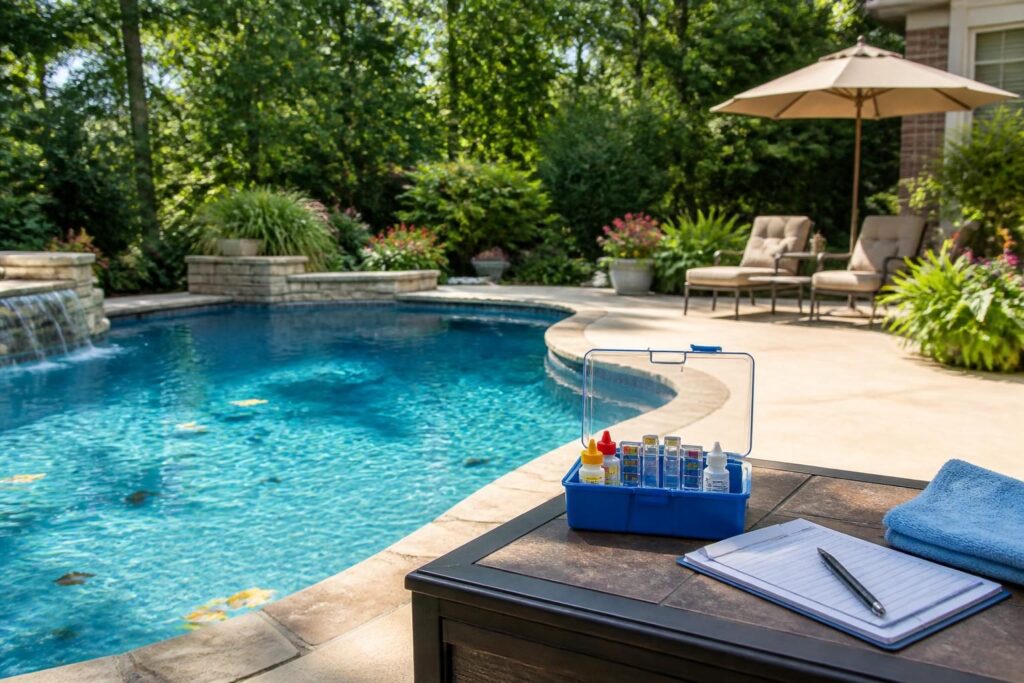
Pool water chemistry after heavy use North Carolina homeowners manage can change quickly during a busy weekend. More swimmers add contaminants. Heat speeds chemical reactions and water loss. Rain can dilute or introduce debris, while evaporation leaves some dissolved materials behind.

The right response is not to add chemicals by guesswork. Test first, record what changed, and make measured adjustments according to your product instructions or a qualified pool professional’s guidance. North Carolina conditions vary across the coast, Piedmont, and mountains, so your water-care routine should reflect your pool, equipment, weather, and use.
Why heavy use changes pool water
Swimmers bring sweat, body oils, cosmetics, sunscreen, hair, and other organic material into the water. Sanitizer is used as it reacts with these contaminants. A crowded pool may therefore show a lower sanitizer reading after use, even when the system worked normally.
Heavy use can also affect water clarity and comfort. Combined chlorine compounds may contribute to odor or irritation. Those signs do not identify a single cause, however. Testing and professional interpretation are safer than trying several products at once.
Heat, sunlight, and evaporation
Warm water can increase the rate of chemical activity. Sunlight can also reduce unstabilized chlorine. Evaporation removes water, not the same proportion of every dissolved substance. As the water level falls, certain minerals and salts may become more concentrated.
Top-offs then change the balance again. Municipal water, well water, and delivered water can have different mineral content. If you regularly add large amounts of water, ask a pool professional whether source-water testing would help explain recurring adjustments.
Test before making an adjustment
Use a reliable test method and follow its instructions. At minimum, homeowners commonly track sanitizer, pH, and total alkalinity. Depending on the pool and treatment system, you may also need to monitor stabilizer, calcium hardness, salt, or other values.
The CDC guidance on home pool water treatment and testing explains the role of testing, chlorine, and pH. Treat that information as general health guidance, not as a substitute for your product label, local conditions, or professional advice.
- Test at a consistent location and time when practical.
- Record the date, weather, water temperature if available, and recent swimmer load.
- Note rain, visible debris, water additions, filter cleaning, and equipment changes.
- Write down the product name, measured amount, and time of each adjustment.
- Retest after the product’s stated circulation or waiting period.
A test result is only useful when the sample represents the pool. Avoid sampling directly beside a return jet, skimmer, chemical feeder, or recently added product. Follow the test-kit directions for sample depth and handling.
Adjusting water after a busy swim period
Start with the pool’s current readings and your normal target ranges. Product labels often provide dosage tables based on pool volume and test results. Confirm the actual pool volume before relying on a dosage calculation, especially after a design change or uncertain measurement.
Make one planned adjustment at a time when possible. Circulate the water as directed, then retest. Several simultaneous changes make it harder to identify what helped or caused a new imbalance.
Sanitizer and pH decisions
If sanitizer is below your usual operating range, do not assume that adding more is always the answer. Check whether the reading reflects recent heavy use, rain, sunlight, a feeder setting, a salt-system output, or a testing problem. Follow the treatment system’s instructions and seek help if the reading remains abnormal.
pH affects swimmer comfort, sanitizer performance, and surfaces. Adjusting pH without checking related values can create a repeating cycle. Ask a qualified pool professional to review persistent instability, unusual demand, or suspected testing errors.
Cloudy water and strong odor
Cloudiness may follow heavy use, poor circulation, fine debris, filter loading, or chemical imbalance. A strong odor does not prove that the water contains too much sanitizer. It can reflect reaction products and inadequate water management.
Pause swimming when the water is unclear enough to limit visibility or when test results fall outside the product’s safe operating guidance. Keep children and pets away from recently treated water until the label and your professional guidance indicate that use can resume.
Rain, debris, and North Carolina weather
Summer storms can add fresh water, organic material, pollen, soil, and contaminants. Rain may dilute some readings, while runoff can introduce material that increases sanitizer demand. Wind can also fill the skimmer and filter with leaves or fine debris.
After a significant storm or busy gathering, inspect the water before making chemical changes. Remove debris using equipment suited to your pool. The guide on removing pool debris safely in North Carolina covers ways to reduce avoidable strain on circulation equipment.
Check the water level as well. Heavy rain can raise it, while heat and swimming can lower it. For water-level observations after storms, see how to manage pool water levels after heavy rain. Do not discharge water where it can damage structures, enter a septic area, or create unsafe runoff. Verify local requirements when drainage is uncertain.
Use your filter and circulation records
Filtration removes suspended material, but a filter cannot correct every chemical imbalance. Heavy use may load the filter sooner than usual. A rising pressure reading, weaker return flow, or slower cleaning performance can signal that the filter needs attention.
Compare current readings with the clean-filter baseline recorded for your system. The appropriate cleaning method depends on filter type and manufacturer instructions. This article on when to clean a residential pool filter explains how pressure, clarity, flow, and weather can inform that decision.
Keep service records separate from chemical records. Note pump schedules, filter pressure, cleaning dates, unusual noises, water additions, and changes in sanitizer demand. Those details help a technician see patterns that a single test cannot show.
Build a repeatable post-use routine
A short routine can prevent a busy weekend from becoming a larger water-care problem. Adapt the sequence to your equipment and the instructions for your treatment system.
- Remove visible debris and check that skimmer baskets are not blocked.
- Inspect water clarity and confirm that circulation appears normal.
- Test sanitizer, pH, and the other values your system requires.
- Compare results with your documented operating range.
- Make only the planned adjustment supported by the test and product instructions.
- Circulate and retest at the stated interval.
- Record the result, action, and any weather or use factor that may explain it.
For frequent gatherings, consider testing before the event and again afterward. A cover can reduce evaporation and debris when used correctly, but it does not replace testing or safe supervision. Never treat a cover as a barrier unless it is specifically designed and approved for that safety purpose.
When repeated adjustments signal a deeper issue
Recurring sanitizer loss, persistent cloudiness, unstable pH, scale, staining, or unusual water demand deserves a broader review. Possible factors include inaccurate pool volume, source-water chemistry, inadequate circulation, filter problems, leaks, organic contamination, or a treatment system that needs service.
Do not keep escalating doses without understanding the cause. Bring your test log, product labels, equipment model information, and recent weather notes to a qualified pool professional. A professional may recommend testing beyond a basic home kit.
Also review whether evaporation is being mistaken for a leak. The article on pool water evaporation versus a possible leak describes safe observations homeowners can document before requesting specialized testing.
Keep a clear adjustment record
Your log should answer three questions: what changed, what did you do, and what happened next? Include the pool’s approximate volume, test method, readings, products, amounts, circulation time, weather, swimmer count or general use level, and follow-up readings.
Store chemical labels and equipment instructions where you can find them, but keep chemicals in their original containers and follow storage directions. Never mix products unless the manufacturer specifically directs that practice. If a spill, exposure, or strong reaction occurs, follow the product label and contact the appropriate emergency resource.
Know when to ask for qualified help
Pool water chemistry after heavy use North Carolina homeowners manage is affected by several moving parts. Testing and records can improve decisions, but they cannot replace professional evaluation when results remain outside guidance or the water may be unsafe.
A documented approach makes pool water chemistry after heavy use North Carolina homeowners face easier to manage.
For a clear record, note that pool water chemistry after heavy use North Carolina conditions can reflect swimmer load, weather, water source, and equipment together.
Consult a licensed pool professional for persistent chemistry problems, an equipment technician for circulation concerns, or a water-treatment specialist for difficult source-water issues. Contact the local inspections department for questions about any required work or property-specific rules. Build a Pool in North Carolina provides homeowner education; confirm current requirements and safe operating decisions with the appropriate qualified professional.