
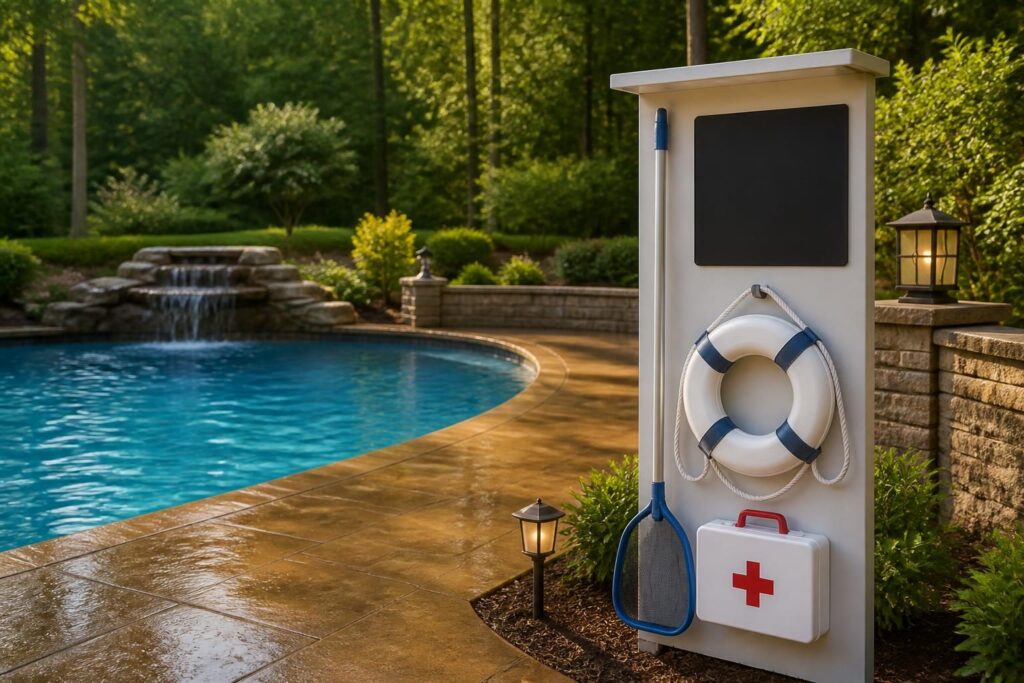
A residential pool safety signage emergency equipment checklist helps your household respond faster when something goes wrong. Signs cannot replace supervision, barriers, swimming skills, or emergency training. They can, however, make important information visible when a family member, guest, or caregiver needs it quickly.

Use this residential pool safety signage emergency equipment checklist to review practical readiness around a residential pool in North Carolina. Requirements may vary by city or county, property conditions, adopted codes, and project scope. Treat placement suggestions as planning guidance, then confirm applicable rules with your local inspections department and qualified safety professionals.
Start with a visible pool emergency information point
Choose one location where adults can find emergency information without searching. The spot should be near the pool area but outside the wet walking path. A covered cabinet, weather-resistant board, or clearly labeled household safety station may work.
Keep the information readable in daylight and easy to reach. Do not place it behind locked storage, dense planting, furniture, or pool equipment. If the pool area has more than one common entry, consider a second copy near the other access point.
Information to post
- Local emergency service instructions, including the correct emergency number for your location.
- The property’s full street address and any helpful entry directions.
- Nearby contact information for parents, guardians, or responsible adults.
- The location of the first-aid kit, rescue equipment, phone, and main pool shutoff if appropriate.
- A short reminder to call for help, remove a person from danger only when safe, and begin trained response steps.
Use large, high-contrast lettering. Avoid relying on a handwritten note that fades or becomes unreadable. Review the sheet after phone numbers, addresses, access arrangements, or household responsibilities change.
The CPSC Pool Safely guidance describes layers of protection, including supervision, barriers, alarms, and emergency preparation. Use it as general consumer-safety information, not as a substitute for local requirements or professional instruction.
Place signs where decisions happen
Effective pool signs support a specific decision. A sign at the gate can remind visitors to close and latch it. Near the phone, another sign can show the address. Beside rescue equipment, a third sign can explain what belongs there.
Avoid covering the area with so many messages that people stop reading them. Use a small number of durable signs with direct wording. Replace signs when weather, chemicals, sunlight, or cleaning makes them hard to read.
Useful locations to review
- Pool entry: Post a reminder about adult supervision, gate closure, and keeping unauthorized swimmers out.
- House access: Identify any safety rule that applies to doors leading toward the pool.
- Emergency contact station: Display the address and contact information at eye level.
- Rescue equipment: Label the storage point so guests can find it without asking.
- Lighting controls: Identify the switch or control location without placing labels inside wet areas.
Signs do not establish compliance with North Carolina or local pool-barrier rules. Local interpretations can differ. For current code documents and local verification steps, consult your inspections department and review the North Carolina Office of State Fire Marshal documents.
Keep reaching and rescue equipment ready
Emergency equipment should be visible, accessible, and easy for an unfamiliar adult to recognize. Store it beside the pool, but not where a person must enter the water or cross a slippery area to retrieve it.
Include this residential pool safety signage emergency equipment checklist in the equipment station review. A reaching tool, such as a suitable pole, can help someone assist from the deck. A properly selected flotation device may provide support in some situations. These tools have limits. They do not replace a trained rescuer, supervision, or a call for emergency help.
Inspect the equipment station
- Check that the reaching tool is present and not cracked, bent, loose, or difficult to use.
- Confirm that flotation equipment remains clean, intact, and suitable for its intended purpose.
- Keep equipment above standing water and away from chemical containers.
- Make sure furniture, toys, covers, and landscaping do not block access.
- Use labels or a simple outline so missing equipment is noticed quickly.
- Ask an instructor or qualified safety professional how household members should use each item.
Do not test rescue equipment by creating a dangerous scenario. Instead, include equipment checks in a routine walk-around. Remove damaged items from service and replace them with products selected for the pool setting.
Visible drain covers also deserve attention, although they are not rescue tools. A damaged, loose, or missing cover needs qualified evaluation. You can use this residential pool drain-cover inspection guide to organize a nontechnical review.
Build a practical first-aid supply
Keep first-aid supplies close enough for quick access but protected from pool water, weather, children, and chemicals. A household kit may include clean dressings, gloves, bandages, antiseptic supplies, a cold pack, scissors, and other items recommended by a qualified health professional.
Check expiration dates and packaging during the same routine used for rescue equipment. Replace wet, opened, contaminated, or missing supplies. Store instructions with the kit, but do not delay emergency help while searching for a particular item.
Separate first-aid supplies from chlorine, acids, and other pool chemicals. Chemical storage needs its own safe arrangement. The kit should also include a flashlight if the pool may be used after dark, provided the flashlight stays dry and ready.
Make the kit easy to identify
- Use a recognizable first-aid label.
- Tell babysitters and regular guests where it is stored.
- Record the date of each inspection.
- Keep emergency contacts nearby, not inside a box that may be locked.
- Ask healthcare or emergency-training professionals what supplies fit your household.
Review pool-area lighting and visibility
Lighting helps adults see gates, steps, deck edges, equipment, signs, and people. It should reduce dark spots without producing glare that hides the water surface. Walk the area after sunset and note where an adult would struggle to see.
Keep switches and controls accessible from a dry, safe location. Do not alter pool electrical components yourself. Water and electricity create serious hazards, so a licensed electrician should evaluate installation, repairs, controls, and protective devices.
Check lighting after storms, landscaping work, bulb failures, or changes to furniture and planting. Trim growth that blocks signs or fixtures. Use qualified service for wiring, underwater lights, junctions, and equipment connections.
For related documentation, see these nontechnical electrical review questions. They can help you prepare a discussion with the appropriate licensed professional.
Practice household procedures before an emergency
Written instructions work best when household members have practiced them. Set expectations before guests arrive. Adults should know who watches the water, who calls for help, and who brings the equipment.
Use age-appropriate instruction. Children should not supervise other children. Caregivers need clear rules about phone access, distractions, entry doors, gates, and when swimming ends.
A simple readiness discussion
- Show every adult the emergency address and the fastest way to reach the pool.
- Point out the phone, rescue tools, first-aid kit, lights, and access gates.
- Agree that an adult remains within active supervision range whenever children swim.
- Discuss how to call emergency services and provide the property address.
- Arrange age-appropriate CPR and first-aid training through a recognized provider.
- Review what changes during parties, evening swimming, storms, or reduced visibility.
Keep a short emergency plan with your household records. Record training dates, equipment checks, and unresolved questions. A maintenance log can help connect readiness checks with routine pool care; this residential pool maintenance log template offers a useful record-keeping structure.
Use a recurring readiness checklist
Walk the pool area weekly during the swimming season and after major weather. Choose a frequency that fits your household and site conditions. The goal is to notice missing, blocked, damaged, or unreadable items before they matter.
Use the residential pool safety signage emergency equipment checklist during each walk-around:
- Are emergency contacts and the property address current?
- Can an unfamiliar adult find the phone and rescue tools quickly?
- Are signs clean, firmly mounted, and readable?
- Are reaching and flotation tools intact and accessible?
- Is the first-aid kit dry, stocked, and within reach?
- Do lights work, and are walkways and equipment visible after dark?
- Are gates, doors, alarms, and barriers operating as intended?
- Have household adults reviewed supervision and emergency procedures?
- Did recent storms, construction, or landscaping change access or visibility?
Record the date and any correction. Photographing a damaged sign or blocked equipment station can help you track a repair, but photos do not replace professional evaluation when safety is uncertain.
Keep the readiness file with pool records
Store sign layouts, equipment instructions, purchase records, training information, inspection questions, and maintenance notes together. Include the location of shutoffs and controls only when the information is accurate and safe to share.
At handover, ask the pool contractor to identify emergency equipment locations, lighting controls, barriers, and routine checks. Do not assume a generic equipment folder covers household safety procedures. A dedicated page can list what must remain accessible and who checks it.
Build a Pool in North Carolina encourages homeowners to treat readiness as an ongoing household practice. A pool is safer when people, equipment, information, and site conditions work together.
Consult your local inspections department about current barrier, signage, and permit questions. Ask a licensed pool contractor about suitable rescue equipment and placement. Use a licensed electrician for pool lighting and electrical work, and seek qualified medical or emergency-training guidance for first aid and CPR. Property-specific drainage, access, or structural concerns may require a surveyor, engineer, or other qualified specialist.