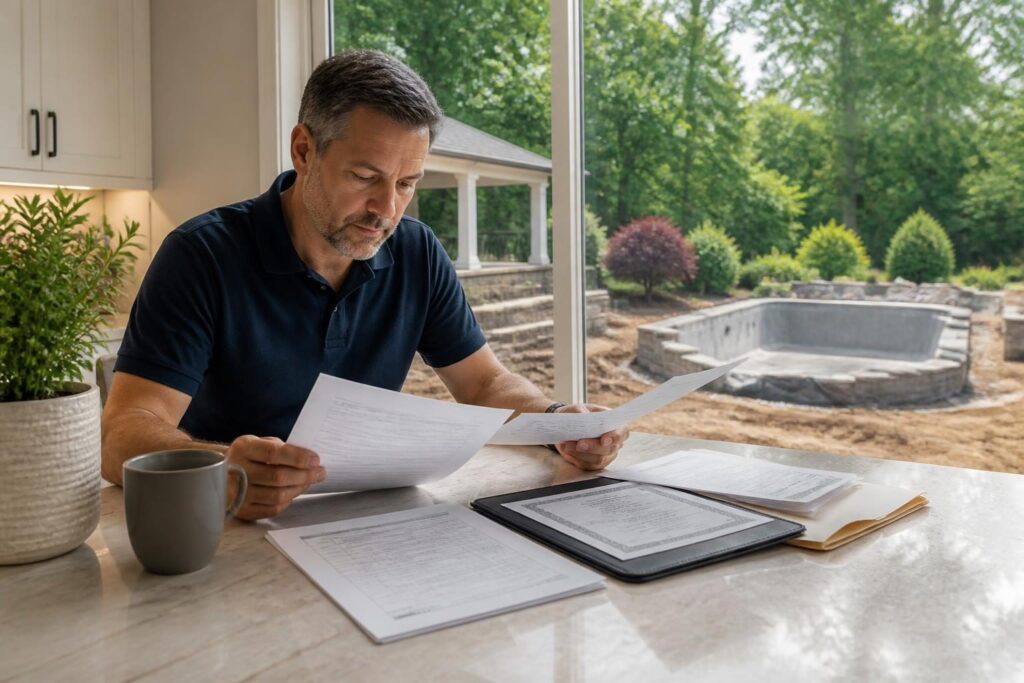
Before you sign a pool agreement, take time to verify North Carolina pool contractor license information and compare it with the documents in front of you. A company name on a proposal may not match the legal license entity. The person who discusses your project may also differ from the license qualifier, or the individual responsible for the licensed work.
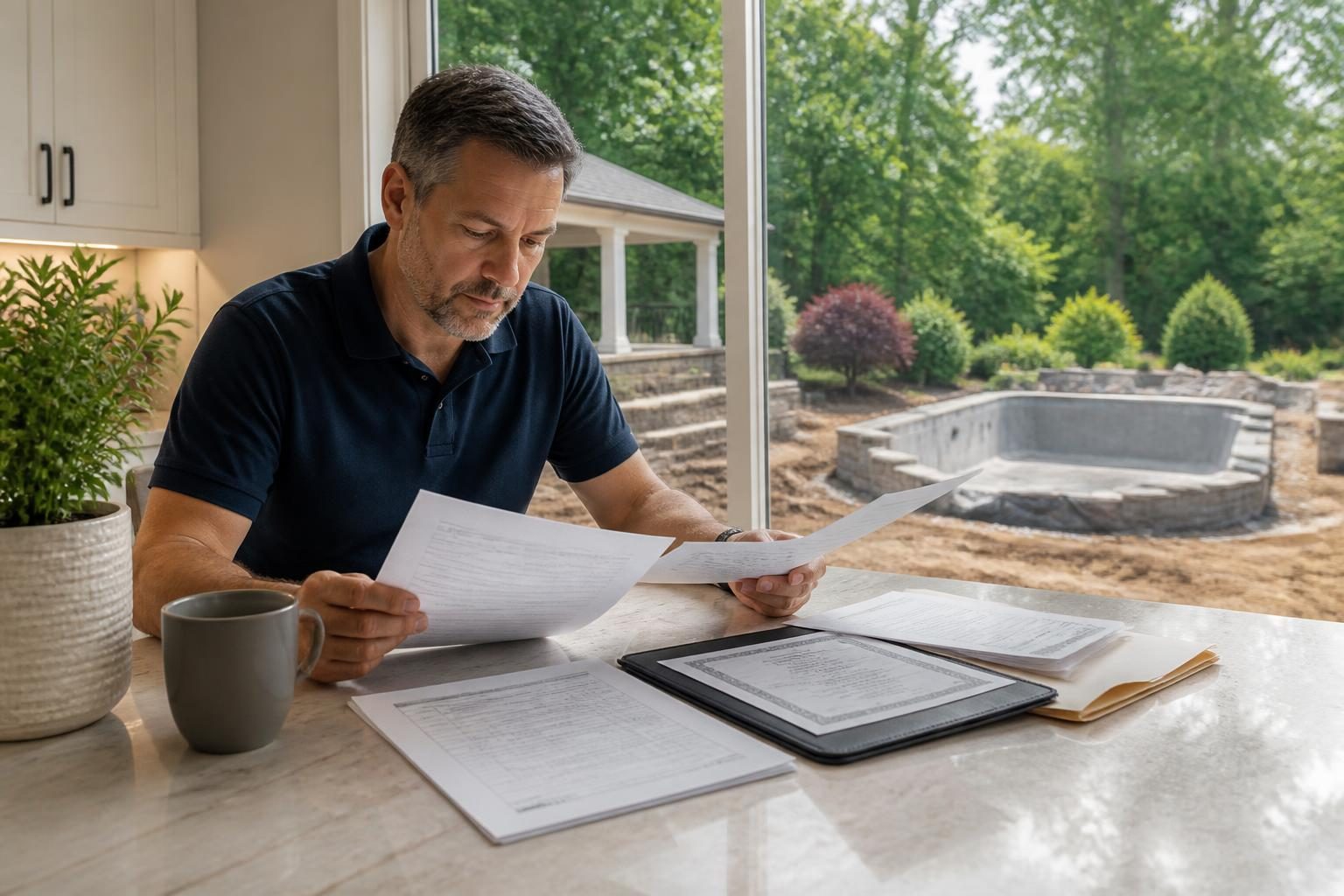
This review does not judge any named contractor. It offers a practical document check for homeowners. North Carolina requirements can vary by jurisdiction, project scope, property conditions, and the work included. Use the state licensing board, your local inspections department, and qualified professionals to confirm details for your property.
Start with the legal business name
Ask for the contractor’s complete legal business name before searching. Request the license number, if one exists, along with any trade name used in advertising. A business may use a short brand name while its formal records show a different entity.
Compare the same name across the proposal, contract, invoice, insurance certificate, license search, and payment instructions. Do not assume that similar names refer to the same business. Small differences can matter, such as “Inc.,” “LLC,” punctuation, or a different spelling.
Record the details you find
- Legal license entity and any stated trade name
- License number and license classification shown in the state record
- Current status displayed by the licensing board
- Qualifier’s name and relationship to the entity
- Date you checked the record and a saved copy or screenshot
The North Carolina Licensing Board’s public license search provides the appropriate starting point for a state record check. Read the record itself rather than relying only on a salesperson’s description.
How to verify North Carolina pool contractor license records
Search the state portal with the information available to you. A license number may provide the clearest starting point. If you do not have one, try the legal entity name and review similar results carefully.
Then compare the record with your project documents. The entity shown in the state search should make sense alongside the name signing your contract. If the names differ, ask for a written explanation before moving forward. Keep the question neutral and specific: “Which licensed entity will contract for this work, and how does it relate to this proposal?”
A search result helps, but it does not answer every construction question. It may not confirm your site design, subcontractor arrangements, insurance limits, workmanship, schedule, or the exact work included in your agreement. Treat the license check as one part of due diligence.
Check the qualifier, not only the company
The qualifier is the person associated with the licensed entity for the licensed work. Ask who the qualifier is and what role that person will have in your project. The qualifier may not be the salesperson or the crew member who visits your property.
Ask how the business manages supervision, permits, subcontractors, and changes in personnel. Your goal is to verify North Carolina pool contractor license details and understand who connects to the license and how that connection fits the proposed work.
If the state record, contract, and explanation do not align, pause the process. Contact the licensing board or a qualified professional for help interpreting the record. The board’s consumer overview of contractor licensing provides official background for homeowners researching a construction investment.
Match North Carolina pool contractor license details to project scope
Write down the status shown when you check the record. Status information can change, so an earlier record may not answer a later question. Recheck close to contract signing if the project faces delays or the documents change.
Next, identify the work the contractor will perform. Pool projects can involve excavation, concrete or other structural work, plumbing, electrical connections, drainage, grading, fencing, and equipment installation. One contractor may coordinate several trades, while another may limit its scope.
Ask these questions in writing:
- Which entity will sign the contract?
- Which entity will apply for or coordinate permits?
- What work does the quoted scope include?
- Which tasks will licensed subcontractors perform?
- Who will schedule required inspections?
- How will added work receive written approval?
Do not treat a license search as proof that every part of a pool project has coverage. Confirm current requirements with the local inspections department. Electrical work, septic concerns, drainage, grading, and structural questions may require separate qualified professionals or local review.
Review the contract name and payment documents
The contract should identify the parties clearly. Look for the legal entity, business address, contact information, project address, scope of work, payment terms, allowances, exclusions, change-order process, and completion or handover responsibilities.
Compare the contract name with the state license record. Also compare it with the name receiving deposits or progress payments. If payment instructions identify another entity, ask why and request documentation before paying.
For additional contract-planning questions, review the official North Carolina home-improvement contract guidance. It can help you organize questions about references, payments, and changes. It does not replace review by an attorney or other qualified adviser when you need project-specific advice.
Keep a simple verification file
Create one digital folder before signing. Save the proposal, contract drafts, license-search result, insurance documents, references, emails, and notes from calls. Use clear file names with dates.
A short verification log can include:
- Checked item
- Source used
- Name or number searched
- Record result
- Open follow-up question
- Responder and date
This file helps you compare documents. It also reduces confusion when several people or subcontractors become involved.
Request insurance documentation carefully
Ask for current certificates or other insurance documentation relevant to the work. A certificate may summarize coverage, but it may not answer every question about exclusions, limits, additional insured status, or claims handling.
Ask whether the document remains current for the planned work and whether the named insured matches the contracting entity. You can also ask how subcontractors carry insurance and who carries responsibility for their work.
Do not interpret coverage as a guarantee that a loss will receive payment. For questions about insurance language, contact the carrier, an insurance professional, or another qualified adviser. Keep the documents with your contract file and note their effective dates.
Check references without treating them as proof
Request references for comparable residential pool projects. Ask whether the projects had similar site conditions, features, access limits, or equipment. A reference is most useful when it helps you understand the contractor’s process, not when it provides a simple positive or negative label.
Ask permission before contacting a reference. Keep questions factual and respectful:
- What work did the agreement include?
- Did the written scope match the work discussed?
- How did the parties document changes?
- Who handled permits and inspection coordination?
- How did the contractor communicate during construction?
- What records did the homeowner receive at handover?
- What would the homeowner clarify before starting again?
References cannot confirm current license status, insurance, or your property’s suitability. Use them alongside documents and official records. You can also compare your preparation list with questions to ask before hiring a pool builder, while keeping your own project’s facts separate.
Know when to pause and ask for help
Pause before signing when a business name changes between documents, the qualifier remains unclear, the status cannot be confirmed, insurance information remains incomplete, or references do not describe comparable work. A pause gives you time to resolve a documentation question. It is not a conclusion about the contractor.
Ask for written clarification and keep the response with your records. If the answer involves licensing, contact the North Carolina Licensing Board. For permits and local interpretations, contact the local inspections department. For electrical work, use a qualified electrician. Site grading, retaining conditions, drainage, septic systems, wells, and excavation may require a surveyor, engineer, septic professional, or other specialist.
Homeowners can also review the broader planning topics in this North Carolina pool planning guide. Build a Pool in North Carolina encourages a document-first approach because clear records support better questions.
A practical final checklist
- Search the exact legal entity in the state license portal.
- Record the license number, status, entity, and qualifier.
- Match the license entity to the contract and payment recipient.
- Ask which work the scope includes and which trades are subcontracted.
- Request current insurance documentation and review named entities.
- Contact comparable references with factual questions.
- Save dated copies of every record and clarification.
- Confirm local permit, barrier, electrical, drainage, septic, and excavation requirements.
Before signing, verify North Carolina pool contractor license information as an important first step, not a complete evaluation of a pool project. Verify the current record locally, read the contract carefully, and ask qualified professionals to address technical or property-specific issues before work begins.