
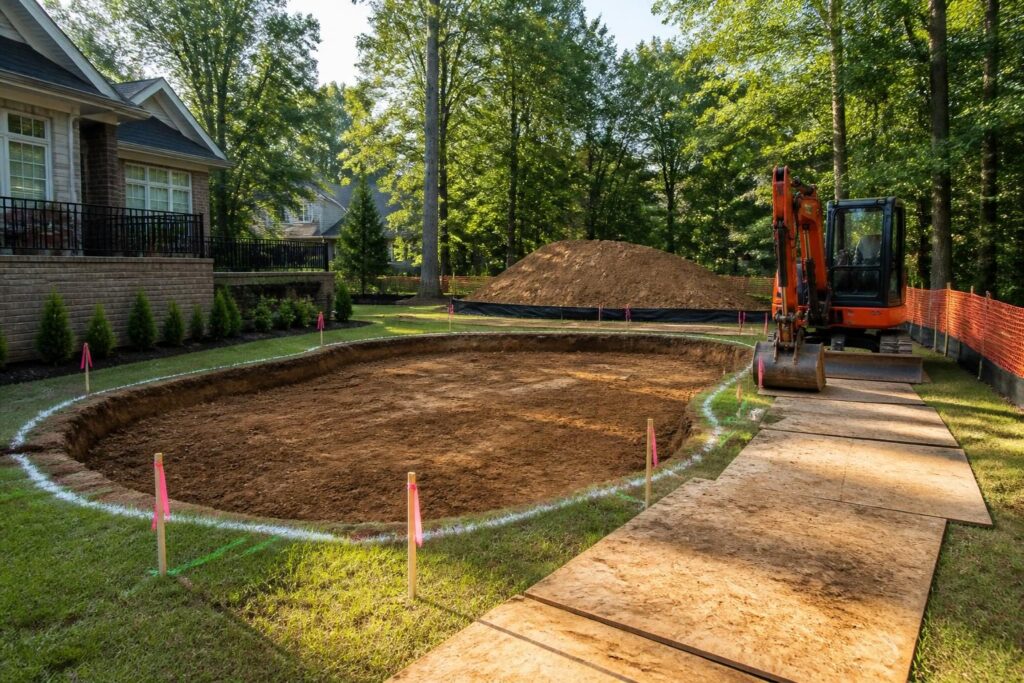
Before a machine breaks ground, pool excavation shoring questions North Carolina homeowners ask can reveal risks that a simple pool layout does not show. Shoring provides temporary support that helps keep excavation sides stable. It may not suit every site, while other lots need a professional plan for sloped, deep, wet, or confined work areas.

This article gives you a practical discussion guide. It does not determine whether a specific excavation is safe. Soil behavior, depth, weather, groundwater, nearby foundations, utilities, and local requirements all need review by qualified professionals and the appropriate authority.
Why open excavation stability deserves early attention
An open excavation is a hole or trench that remains exposed during construction. Its sides can change as soil dries, becomes saturated, vibrates, or loses support. A bank that looks firm on one morning may behave differently after rain or nearby equipment movement.
Pool work also creates changing conditions. Crews may excavate in stages, remove spoil, install forms, place steel, route plumbing, or pump water. Each activity can affect access and the space available around the excavation. The project team should explain how they will manage those transitions.
- Identify the site observations that will trigger a stability review.
- Confirm who selects, designs, installs, and removes temporary support.
- Discuss how workers will enter, leave, and work beside the excavation.
- Clarify how rain, standing water, seepage, or a forecast storm changes the plan.
- Review how spoil piles, machines, trucks, and stored materials stay away from open edges.
Do not treat a verbal statement such as “the soil is hard” as a complete evaluation. Soil can vary across a single yard. Cut faces can also expose fill, loose layers, roots, rock, or wet material that was not visible at the surface.
Pool excavation shoring questions North Carolina homeowners can ask
The right questions focus on the actual lot rather than a generic construction sequence. Request clear explanations, drawings when appropriate, and updates when field conditions differ from the planned work. These pool excavation shoring questions North Carolina homeowners use can also clarify who makes site decisions.
Questions about the excavation shape
- What are the planned excavation depths and side slopes?
- Which areas will remain open at the same time?
- Will the crew use sloped sides, benching, shields, shoring, or another approach?
- What professional reviews must the team complete before work begins?
- How will the plan change if the excavation becomes deeper, wider, or wetter than expected?
Questions about changing site conditions
- What signs of movement, cracking, sloughing, or water will cause work to stop?
- Who communicates a field change to the homeowner?
- How will the team protect the excavation overnight and during nonworking periods?
- What temporary measures keep people, pets, and vehicles away from the open area?
A homeowner should not enter an open excavation to inspect it. Photos can help document progress, but take them only from a safe location that the project team approves.
Nearby homes, walls, paving, and other structures
Excavation can affect more than the pool footprint. Nearby foundations, crawl spaces, basements, garages, patios, driveways, retaining walls, fences, decks, and buried features may need consideration. The closer the cut is to a structure, the more important a site-specific review becomes.
Have the team identify structures within the possible influence of the excavation. The answer may depend on depth, soil, slope, foundation type, drainage, and the proposed method. A pool contractor may need input from an engineer, surveyor, geotechnical professional, or other qualified specialist.
- Which nearby structures appear on the current site information?
- Has the team confirmed foundation locations where they matter to the work?
- Could excavation alter support, surface drainage, or water movement near a structure?
- Will vibration from equipment or breaking rock require special precautions?
- What observations will the team record before, during, and after excavation?
For a pool near the house, compare these questions with the more focused guidance in questions about excavation near a house foundation. That review should supplement, not replace, professional advice for your property.
Tight access can change the excavation approach
Many residential lots leave little room between the proposed pool and a house, fence, neighboring property, or slope. Limited access can affect machine size, spoil handling, emergency routes, temporary support, and the order of work.
Request a simple access plan before excavation. It should show how equipment enters, where soil goes, where it turns, and how the crew keeps a safe separation from the open cut. A plan that fits the pool on paper may not fit the machine needed to build it.
- What is the widest equipment expected on the property?
- Will gates, fences, landscaping, paving, or overhead obstacles limit access?
- Where will excavated soil be placed or hauled?
- How will trucks and machines avoid undermining the excavation edge?
- What happens if the planned access route becomes unusable after rain?
- Which surface protections and restoration responsibilities appear in writing?
Review the layout marking before work begins. The pool layout stakeout checklist can help you discuss dimensions, elevations, structures, access, and drainage while changes remain easier.
Utilities, drainage, and water management
Utility locations matter before excavation, even when the pool appears far from the street. North Carolina homeowners should use the official North Carolina 811 resource and confirm the project team’s process for locating underground lines. A utility notification does not answer every private-line question, so discuss how the team will address private electrical, irrigation, lighting, drainage, and other lines.
Water can change both access and stability. Rainfall, groundwater, leaking lines, surface runoff, and seepage may soften soil or fill the excavation. Confirm who watches conditions, where pumped water goes, and whether discharge could affect a neighbor, foundation, crawl space, septic area, or erosion-control measure.
- What drainage paths exist before construction?
- How will runoff stay out of the excavation?
- What pumping or water-control method may the team use if needed?
- Where can water leave the site without causing damage or violating applicable requirements?
- Who decides whether conditions support continued work?
For related questions about water pressure and wet excavations, see groundwater and hydrostatic pressure during pool work. Requirements can vary by jurisdiction and property conditions.
Records to request when shoring or site conditions change
Good records help everyone understand what the team planned and what changed. They also make later conversations more precise. Keep the approved design, site plan, excavation notes, photos, written instructions, professional recommendations, and change documents together.
Ask the project team which records they will provide. Depending on the work, these may include updated drawings, field measurements, photographs, written change orders, water-management notes, or confirmation from a qualified professional. Do not assume every document applies to every project.
- Record the date and general location of notable site changes.
- Save messages about changed soil, water, access, structures, or support methods.
- Ask whether a change affects cost, schedule, drainage, restoration, or later construction.
- Confirm who approves changes and how approval reaches the project record.
- Keep copies of local permit and inspection communications.
North Carolina requirements can vary with the local jurisdiction, adopted code, property conditions, flood exposure, utilities, septic systems, and project scope. The state Office of State Fire Marshal provides building-code documents and interpretations, but your local inspections department remains the place to confirm current, property-specific requirements.
A homeowner’s pre-excavation discussion checklist
Before approving excavation, ask the team to walk the site with you. Focus on decisions that affect safety, access, structures, water, and documentation.
- Where will the excavation remain open, and how will the team protect it?
- What conditions could require sloping, benching, shoring, or a different sequence?
- Who has authority to stop work when conditions change?
- How will nearby structures and hardscape be observed and protected?
- Where will equipment, spoil, materials, and workers travel?
- How will utilities and private lines be located?
- How will rainwater, seepage, and pumped water be managed?
- Which changes require written approval before the work continues?
- What local permits, inspections, or professional reviews must be confirmed?
Write down the answers. If an answer depends on soil, depth, distance, weather, or field conditions, ask how that decision will be made on site.
When to pause and seek qualified input
Pause the discussion if the proposed work is close to a foundation, retaining wall, property line, steep slope, buried utility, septic feature, or other sensitive area. Also seek qualified review when the excavation shows unexpected water, cracking, movement, loose fill, buried debris, or unstable edges.
A licensed pool contractor can explain construction sequencing and project responsibilities. An engineer or other qualified specialist may need to evaluate site-specific stability or nearby structures. Surveyors, septic professionals, electricians, and local officials may have separate roles.
Build a Pool in North Carolina encourages homeowners to make these questions part of the written project record. Confirm current requirements with your local inspections department, licensed pool contractor, electrician, engineer, surveyor, septic professional, or another qualified specialist before work begins. These pool excavation shoring questions North Carolina homeowners ask cannot replace a site-specific professional review.