
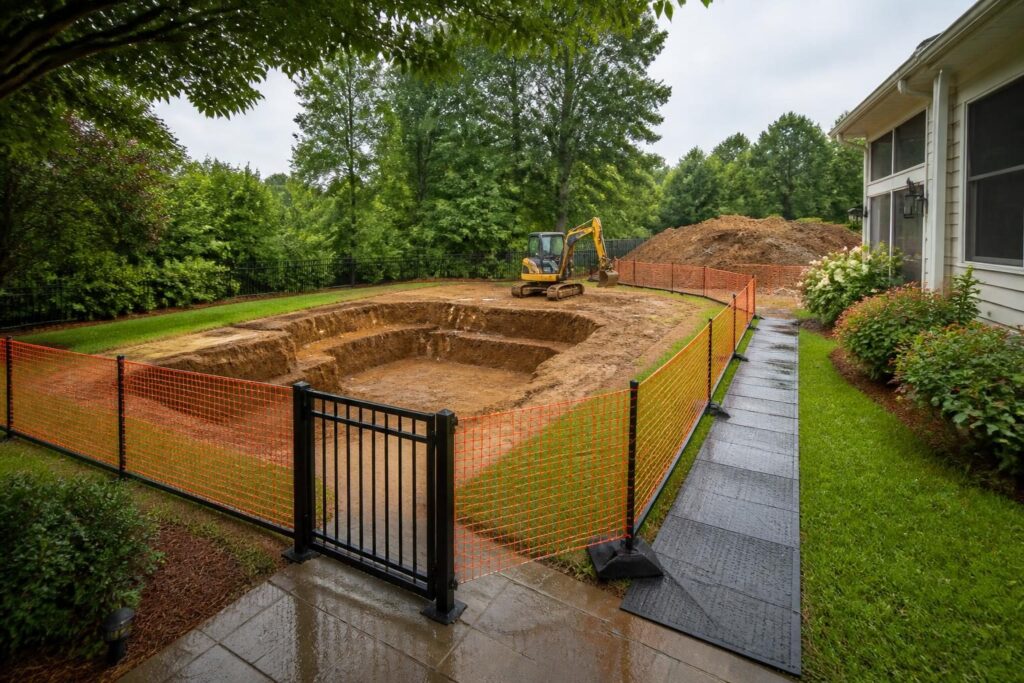
A pool excavation safety planning homeowner checklist helps you manage the period when your yard contains an open, changing work area. Before digging begins, plan for children, pets, visitors, workers, weather, equipment, spoil piles, and daily communication.

An excavation is not a finished pool. It may have uneven edges, loose soil, steep sides, standing water, temporary equipment, and limited visibility. Treat the entire work zone as restricted space until the contractor confirms that it is safe to enter.
Start with a written pool excavation safety plan
Ask the pool contractor to explain how the site team will secure the area at the end of each workday. The answer should cover access points, temporary barriers, equipment parking, loose materials, lighting, weather response, and who receives updates.
Keep the pool excavation safety planning homeowner checklist with your project records. A short written note can reduce confusion when work crews change or conditions shift. It can also help household members follow the same rules.
Use the same pool excavation safety planning homeowner checklist during each open-work-area review. Consistent checks help you spot changes without entering the excavation.
- Mark the work zone on a simple yard sketch or site plan.
- List every expected access route, including driveways, side yards, gates, and doors.
- Identify who may enter the area and who may not.
- Record the contractor’s preferred contact method for urgent site questions.
- Confirm who checks barriers, gates, and the excavation after work stops.
- Ask how the crew will respond to rain, high winds, lightning, or standing water.
Do not rely on construction tape alone. Tape can warn people, but it may not stop a child, pet, or visitor from entering. The contractor and local authority should determine what protective measures the project requires.
Keep children, pets, and visitors away from open excavation areas
Children may see an excavation as a place to play. Pets may follow familiar paths or investigate machinery and piles of soil. Visitors may not understand the boundaries, especially after dark or during a gathering.
Use a layered approach. A temporary physical barrier should support locked access points, household rules, supervision, and clear communication. The Pool Safely safety guidance describes barriers and other protection layers for residential pool areas. Its guidance is useful context, but local requirements still control.
Household rules to establish before digging
- Children do not enter the work zone, even when workers are absent.
- Pets remain indoors or in a separate secure area during active work.
- Guests use a designated route that avoids the excavation and equipment.
- No one climbs, crosses, sits on, or moves a temporary barrier.
- Only authorized adults speak with operators or enter for a specific reason.
Tell neighbors if equipment or access routes could affect a shared boundary. Do not provide them access to the excavation. If a child or pet enters the area, keep others back and contact the responsible site supervisor rather than attempting a risky rescue.
Plan temporary barriers and controlled access
Temporary barriers should surround the actual hazard, not just the future pool outline. Include soil piles, trenches, exposed utilities, machinery, ramps, and areas where equipment swings or reverses.
Discuss how the barrier will remain stable on uneven ground. Check whether gates close securely, whether the route can be locked, and whether the arrangement will change as excavation progresses. A barrier that worked on day one may not protect the site after the pit expands.
- Confirm the barrier location at the start of each excavation stage.
- Keep gates closed whenever authorized workers are not moving through them.
- Keep ladders, boards, toys, and other climbable items away from the boundary.
- Provide a safe, separate route for household access when possible.
- Use lighting that helps identify the boundary without creating glare for equipment operators.
Do not assume a temporary setup meets a permanent pool-barrier rule. North Carolina requirements can vary by jurisdiction, adopted code, property conditions, and project scope. Confirm current barrier and inspection requirements with the local inspections department and qualified professionals.
Control site access, vehicles, and underground hazards
Excavation often requires heavy equipment to cross a driveway, lawn, or narrow side yard. Establish the route before work begins. Discuss where trucks will turn, where materials will sit, and how pedestrians will stay separate from moving equipment.
Use the contractor’s site access plan as a daily reference. The related pool construction site access protection guide covers temporary fencing, driveway protection, staging, and restoration records.
Utility notification is a separate responsibility from general site access. North Carolina homeowners should review current excavation-notification information through North Carolina 811. Ask the contractor who will make the notification, when it will occur, and how private lines will be handled. Public utility marking may not identify every privately installed line.
Keep people away from operating machinery. Never stand behind equipment, between a machine and a fixed object, or within a rotating arm’s path. Do not enter the site to take photographs while equipment operates unless the site supervisor has authorized a safe location.
Manage spoil piles, loose soil, and water
Spoil is soil removed from the excavation. The crew may place it temporarily on the property or load it for removal. Ask where it will go, how long it may remain, and how the crew will keep it away from structures, drainage paths, driveways, and the excavation edge.
Loose soil can shift after rain. Soil piled near an open edge may add weight to the ground beside the excavation. Homeowners should not decide whether a pile is safe based on appearance alone. Ask the contractor or qualified site professional to evaluate placement.
- Find out how rainwater will flow away from the open area.
- Confirm who removes standing water and what equipment they use.
- Keep children and pets away from muddy areas and soft ground.
- Record visible changes, such as slumping soil, cracks, washouts, or new ponding.
- Report concerns promptly rather than walking closer to investigate.
North Carolina land-disturbing work may involve erosion and sediment controls that depend on the site and project scope. The North Carolina erosion and sediment control manual provides official planning information. Verify property-specific obligations with the appropriate authority.
Prepare for rain, wind, heat, and changing conditions
Weather can change an excavation from a controlled work area into a difficult site. Rain may create slippery surfaces, standing water, runoff, and soft ground. Wind can move lightweight barriers, covers, dust, and loose materials.
Ask the contractor what conditions pause work and who checks the site afterward. A responsible plan should address the excavation, barriers, equipment, spoil piles, nearby drains, and access routes.
- Do not enter an excavation to inspect water, soil, or damage.
- Keep household members away until the site supervisor confirms that the crew has controlled the area.
- Report moved barriers, washouts, blocked drainage, or damaged fencing immediately.
- Ask whether temporary pumps, hoses, or electrical equipment need special protection.
- Keep outdoor furniture and loose yard items away from the work zone.
Weather records can help explain interruptions and site changes. Note the date, general condition, visible concern, person contacted, and response. Photographs should come from a safe location and should not delay urgent reporting.
Build a simple communication routine
Excavation creates many small decisions. A consistent update routine helps the household understand what changed and prevents assumptions about access.
Questions for the contractor or site supervisor
- What work is planned today, and which areas will workers restrict?
- Will equipment, trucks, or soil piles change the normal walking route?
- Are any utilities, drainage features, septic components, or private lines exposed?
- What should the homeowner do after rain or an unexpected site change?
- When will the crew secure the excavation at the end of the day?
- Who should receive photographs or questions about a safety concern?
Use one shared project log instead of scattered text messages. Record the date, work stage, access changes, weather, open questions, and agreed next step. The construction decision-tracking checklist can help organize approvals, site conditions, weather interruptions, and unresolved questions.
Know when to stop and seek qualified help
Pause household access and contact the site supervisor if a barrier is missing, soil has shifted, water is entering rapidly, equipment is unattended in an unsafe position, or an unknown utility or structure appears.
Do not move soil, operate pumps, repair barriers, enter the excavation, or inspect electrical components unless the responsible qualified professional directs and performs that work. Keep children, pets, and visitors away while the qualified professional evaluates the concern.
Use this pool excavation safety planning homeowner checklist as a communication tool, not as a substitute for site-specific judgment. North Carolina rules can differ among local jurisdictions. Confirm permits, barriers, excavation practices, erosion controls, utilities, septic concerns, and inspections with the local inspections department, licensed pool contractor, electrician, engineer, surveyor, septic professional, or other qualified specialist as applicable. Build a Pool in North Carolina offers homeowner education, not a substitute for project-specific professional advice.