
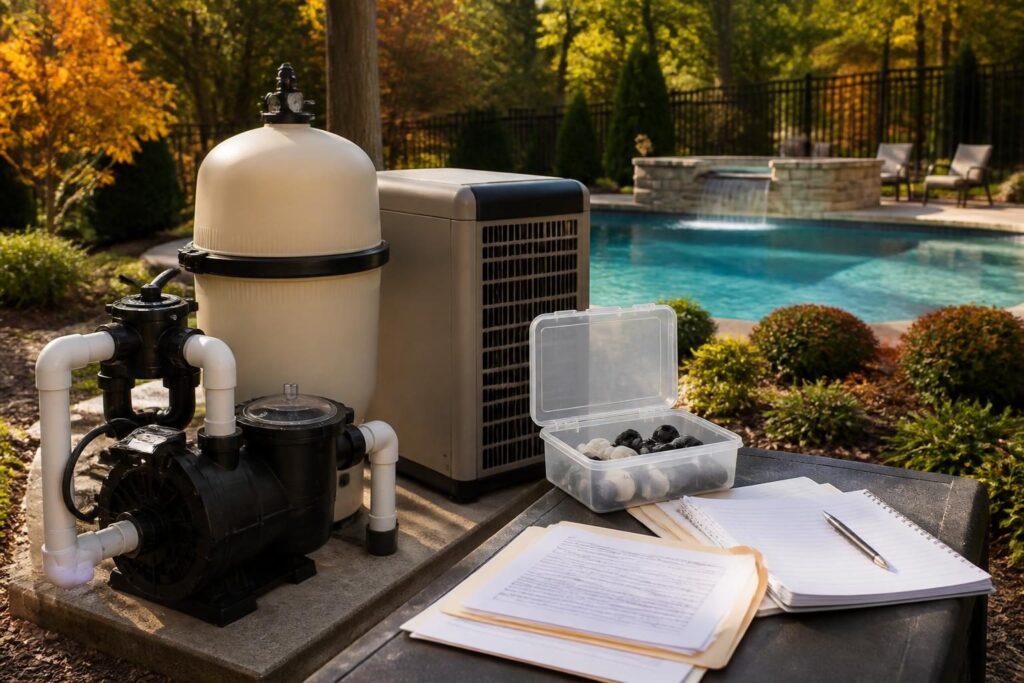
Good pool equipment winter drain down records do more than confirm that someone visited the equipment pad. They show which components received service, where water left the system, which plugs went into storage, and what the next technician should verify before restarting the system.

North Carolina winters vary by region and weather pattern. A mild season can still bring a damaging freeze, while a sudden cold front may arrive after you place a pool in seasonal service. Follow the equipment manufacturer’s instructions, system design, and service provider’s procedures. This guide helps you preserve useful information without replacing those instructions.
Why equipment-specific records matter
“Winterized” does not provide enough detail. A pool system may include a circulation pump, filter, heater, salt cell, chemical feeder, automation panel, booster pump, heat pump, water features, and separate lines. Each component may have different drain points, caps, plugs, valves, and storage needs.
A note such as “system drained” leaves important questions unanswered. For the filter, was water removed from the tank? The heater connections may require the manufacturer’s directions. Someone may also need to remove the salt cell. Water-feature lines may need separate service. Clear notes reduce guesswork months later.
Keep the winter service record with your equipment manuals and labels. The related pool equipment manuals and labels homeowner file can provide a useful home for these documents, photos, and diagrams.
Build a drain-point record for every component
Start with a simple equipment inventory. List each item by manufacturer, model, location, and system function. If you do not know an item’s function, ask a pool service professional to identify it before seasonal work begins.
For each component, record:
- Equipment name and model number.
- Normal valve positions before seasonal service.
- Drain plugs, unions, petcocks, caps, or other water-release points.
- Whether the technician drained, blew out, bypassed, removed, or left the item in service.
- Where the technician stored each loose plug, cap, gasket, or fitting.
- Any component that needs a special reopening step.
- The person or company that performed the service, if you choose to record it.
- Date, weather conditions, and any unresolved question.
Do not assume that two similar pumps or filters drain the same way. Record the actual model and follow that equipment’s manual. If a label looks faded or missing, photograph the equipment and ask for help identifying it.
Circulation pump and filter
For a pump, document the drain-plug locations, lid condition, basket condition, and any instructions about trapped water. State whether the service provider disconnected, protected, or left the pump installed. Do not energize a dry pump merely to test it.
For a filter, note the filter type and the location of its drain fitting or valve. Sand, cartridge, and diatomaceous earth filters can have different service needs. Record whether the technician removed, cleaned, dried, and stored cartridges, or left the filter assembled. Also identify any pressure-gauge or sight-glass issue that needs attention at reopening.
Heater, heat pump, and chemical equipment
Heaters and heat pumps need equipment-specific instructions. Save notes about water connections, isolation valves, drain points, power status, and manufacturer-required protection. Do not infer a procedure from a different model. Fuel-fired equipment also involves combustion and fuel-supply concerns that belong with qualified service personnel.
Chemical feeders, salt systems, and dosing equipment deserve separate entries. Record whether the technician emptied, flushed, isolated, or left each feeder connected. For a salt cell, note its condition, connector protection, controller setting, and storage location if someone removed it. Keep chemical containers closed, labeled, and stored as directed. Avoid mixing products or handling residues without appropriate guidance.
Document plugs, caps, unions, and stored parts
Loose parts can disappear during a long off-season. Create a parts list before the service visit ends. Give each item a plain-language description, such as “pump drain plug” or “heater union gasket.” Include a part number when one appears on the component.
Use a labeled container for small parts. Record the container’s location and photograph its contents. Keep rubber seals and gaskets clean, dry, and protected from unnecessary heat or sunlight. Do not substitute a generic plug, cap, or gasket because it appears to fit.
Your pool equipment winter drain down records should also identify parts that remain installed. That detail matters because a reopening technician needs to know whether someone intentionally left a component in place or simply overlooked it.
Ask the service provider whether a stored part needs inspection before installation. Some components may need replacement after damage, distortion, cracking, or wear. Capture the question in the record rather than promising that a part remains serviceable.
Photograph the equipment pad before and after service
Photos make written notes easier to understand. Take wide images that show the equipment layout, then closer images of valves, drain points, plugs, unions, labels, and control panels. Photograph the equipment before work begins if you want a reference for normal operating positions.
After service, photograph:
- Open or closed drain points, where visible and safe to document.
- Removed parts in their labeled storage container.
- Valve handles and tags.
- Controller displays or settings, if the equipment is powered and the service professional confirms that the display is safe to record.
- Disconnected wiring, protected connectors, or covers.
- Leaks, cracks, corrosion, or other items requiring follow-up.
Use consistent file names. A format such as “2026-11-15-filter-drain-point” makes later searches easier. Keep the original files, not only compressed text-message copies. Do not open electrical enclosures or remove covers simply to obtain a photograph.
A valve map can complement these photos. The guide to a pool plumbing valve labeling plan explains how normal positions and flow-path notes can reduce confusion during seasonal service.
Record power, controls, and settings separately
Drain-down records do not prove that electrical work occurred. Instead, document what the service provider says about equipment power status, disconnects, automation schedules, freeze protection, and stored settings. Electrical disconnects, wiring, bonding, and equipment controls may require a licensed professional.
Ask for a written note covering these points:
- Which equipment is off, disconnected, bypassed, or still powered.
- Whether someone changed automation schedules.
- Whether freeze protection remains active.
- Which settings should return in spring.
- Whether a battery backup, clock, or network connection needs attention.
- Whether an alarm, error code, or service light appeared.
Do not change a setting merely because it looks unusual. Save a screenshot or photo when appropriate, then ask the qualified service person what it means. If the system has remote controls, confirm who can access them during the off-season and whether someone should disable remote operation.
Prepare a reopening record before the next cold season
The best seasonal file serves both directions. Along with winter service details, include a reopening checklist written for your specific equipment. Identify the inspection order, replacement parts, valve positions, power-restoration steps, water-level checks, and startup observations.
Use questions rather than assumptions:
- Which plugs and caps must return before water reaches the equipment?
- Which valves return to normal operating positions?
- Should someone clean or replace a filter cartridge before startup?
- Does the heater or heat pump require a qualified inspection?
- When should the salt cell or chemical feeder return to service?
- Which leaks, noises, pressure readings, or error codes require the system to remain off?
- What water-testing steps should occur before normal operation?
Record answers from the equipment manual or service professional. A reopening note does not authorize anyone to bypass safety devices or operate equipment outside its instructions.
Keep a copy of the completed service invoice, but do not rely on the invoice alone. It may not list every drain point or stored part. Add your own photos, notes, and unresolved questions to the file. These pool equipment winter drain down records can then guide the next seasonal visit.
Use a seasonal service handoff checklist
Before the technician leaves, compare the work against your pool equipment winter drain down records. Confirm that the file names each serviced component and explains exceptions. If someone did not drain a part because the manual required another method, record that reason.
Check that the handoff includes:
- Equipment inventory and model numbers.
- Drain-point list and component-specific instructions.
- Plug, cap, gasket, and loose-part storage notes.
- Photos before and after service.
- Power and automation status.
- Open service questions and recommended follow-up.
- Reopening steps and required professional checks.
- Date of service and contact information for the service record.
Save the file in two places, such as a labeled paper binder and a secure digital folder. Include current manuals and warranty information. Do not edit an old record to hide changes. Add a dated correction or new note so the service history remains understandable.
For related maintenance tracking, see this residential pool maintenance log template. It can help connect winter service notes with water tests, repairs, cleanings, and spring observations.
Know when to pause and ask for qualified help
Stop and seek professional guidance if you find cracked housings, damaged drain plugs, frozen water, unusual wiring, fuel concerns, chemical residue, unclear valve positions, or missing manufacturer instructions. Never restore power to equipment that may hold trapped water or show visible damage.
North Carolina requirements and safe procedures can vary with local jurisdiction, adopted code, equipment type, property conditions, and project scope. Verify electrical, fuel, barrier, drainage, and inspection questions with the local authority or an appropriately licensed professional. For general safety information about barriers, gates, alarms, covers, and layers of protection, review Pool Safely’s safety tips.
Build a Pool in North Carolina encourages homeowners to keep seasonal records that give the next service visit clear, equipment-specific information. Consult a licensed pool contractor, electrician, heater technician, or other qualified specialist whenever the equipment, connection, or condition exceeds a safe visual review.