
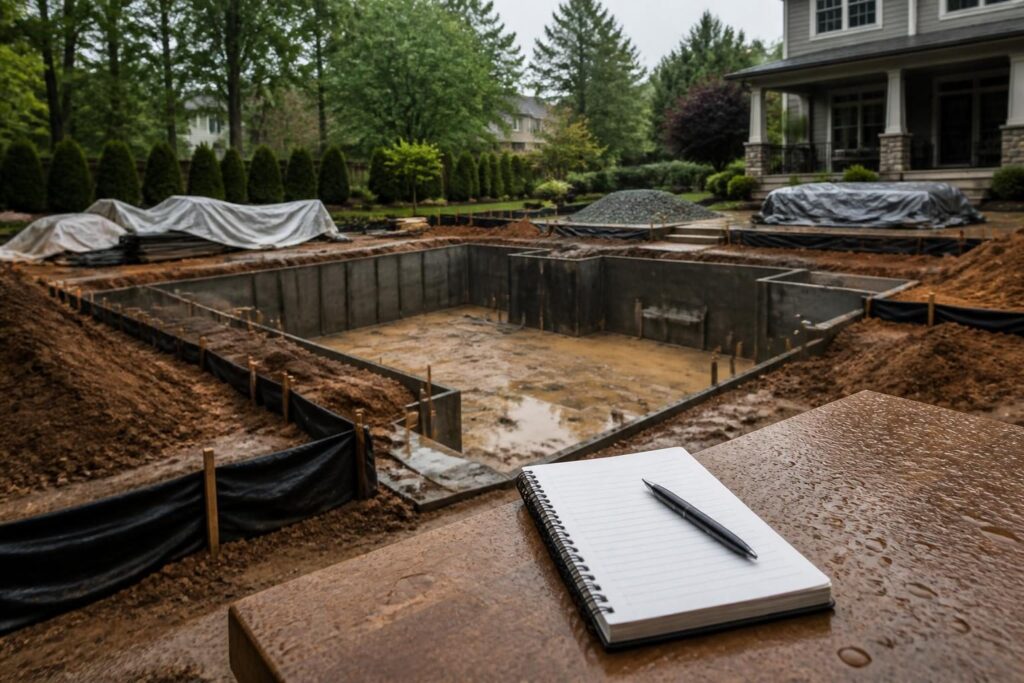
Pool construction rain delay documentation North Carolina homeowners create can clarify what happened during wet weather without turning a changing project into a promise of a fixed completion date. Rain affects access, excavation, soil, concrete work, drainage, material protection, and other decisions. A simple record helps you understand those impacts and keep project conversations organized.

This record is not a substitute for the contract, a site professional’s judgment, or local requirements. It also does not prove that every delay is excused or that work should stop. Instead, it gives you a dated history of weather, visible conditions, protection steps, decisions, and open questions.
Why weather records matter during pool construction
Rain can affect a pool project in several different ways. A work area may become unsafe to enter, too soft for equipment, or unsuitable for placing materials. Water can also collect in the excavation or move soil toward a driveway, drainage feature, neighboring property, or stormwater inlet.
The effect depends on more than the amount of rain. Soil type, slope, groundwater, access conditions, current construction stage, site protection, and the planned work all matter. A short shower may have little effect on one task but create a significant issue for another.
Good records separate observation from interpretation. “Standing water visible at the deep end” is an observation. “Rain caused a structural problem” is a conclusion that may require a qualified professional. Keep those categories separate in your notes.
- Record what you saw, when you saw it, and where it occurred.
- Save messages and written schedule updates with the same date.
- Ask which task the condition affected and what must happen before work resumes.
- Note protection measures without assuming they guarantee a result.
- Track decisions and approvals separately from weather observations.
Build a pool construction weather log
A spreadsheet, notebook, or project-management app can work. Use one row or entry for each weather event, site visit, or schedule decision. Consistency matters more than the software.
For pool construction rain delay documentation North Carolina homeowners can use, include enough detail to connect weather, site conditions, and project decisions:
- Date and time: Include when rain began or ended if known, plus when you visited the site.
- Weather description: Use plain language such as steady rain, intermittent showers, saturated ground, or dry conditions after rainfall.
- Work stage: Identify whether the site involved layout, excavation, structure, plumbing, electrical work, decking, grading, or another stage.
- Visible conditions: Describe mud, rutting, standing water, soil movement, exposed materials, blocked access, or changes in drainage.
- Work status: Note whether work continued, paused, changed, or was not scheduled.
- Protection measures: Record visible covers, pumps, temporary drainage, stabilized access, erosion controls, or other measures reported by the project team.
- Next decision: State what remains open, such as waiting for safer access or confirmation that a surface is ready for the next task.
Avoid presenting a weather app as a complete site record. Forecasts can support your notes, but they do not show actual soil strength, excavation stability, water movement, or suitability for a specific construction task. If you save weather information, keep the source and date with it.
Photograph site conditions consistently
Photos can make a written log easier to understand. Take them from repeatable locations when it is safe and permitted. A wide view can show access and drainage, while closer images can show rutting, pooled water, soil movement, or protected materials.
Do not enter an open excavation, climb equipment, move covers, operate pumps, or cross a soft work area to get a better image. Ask the contractor how homeowners should access the site during active construction. Safety and site control come first.
Useful photo habits include:
- Keep original files when possible, rather than relying only on edited images.
- Use filenames that include the date, area, and subject.
- Take a matching wider image when a close-up may lack context.
- Photograph fixed reference points, such as a fence corner or house wall, without implying a survey measurement.
- Do not use photos to diagnose structural, soil, drainage, or electrical conditions.
For example, a useful caption might say: “March 12, 8:30 a.m.—water visible along the east side of the excavation; photo taken from the driveway.” That wording describes what the image shows without assigning a cause.
Track protection measures and drainage observations
Wet weather makes temporary site protection especially important. Depending on the property and project stage, the construction team may use measures intended to limit runoff, protect access, control sediment, or keep water away from unfinished work. The correct approach depends on the site and applicable requirements.
North Carolina’s construction stormwater program may apply to certain land-disturbing activities. The NC DEQ Construction Stormwater Program provides official information about applicability and program requirements. Homeowners should also confirm property-specific questions with the appropriate local authority or qualified professional.
Your record can list what was visible without declaring that a measure was adequate. Note whether access mats, temporary covers, pumps, silt controls, check areas, or other protections were present. If you see water moving toward a home, neighboring property, road, or drainage structure, photograph the condition from a safe location and raise it promptly.
Ask focused questions:
- Which unfinished areas need protection before the next rain?
- Where is collected water expected to go?
- What condition will allow equipment or workers to return safely?
- Could the next task disturb soil or materials that are currently protected?
- Does the local authority require a response, inspection, or additional control?
Record schedule decisions without promising a completion date
Rain documentation should explain decisions, not create a replacement calendar. A wet site may require drying, stabilization, testing, inspection, redesign, material replacement, or a different work sequence. The time required can depend on conditions that are not visible to a homeowner.
For pool construction rain delay documentation North Carolina, record schedule decisions in neutral terms rather than predicting a final date:
- Original task under discussion.
- Observed condition or reported concern.
- Decision made for the next step.
- Person or role who provided the update.
- Information still needed.
- Next review point, if one was stated.
“Deck placement postponed while the work area remains saturated; contractor to reassess conditions before rescheduling” is more useful than “rain delayed the deck by three days.” The first statement records a decision and a condition. The second may imply a certainty that the project cannot support.
Keep a separate change and decision list. Link each entry to the relevant email, text message, drawing, photo, or meeting note. This approach complements the pool schedule decision tracking checklist, especially when several weather interruptions overlap with selections or inspections. For a broader stage-by-stage record, review the residential pool construction phases checklist.
Ask for clear updates from the project team
Homeowners do not need to direct construction methods. They do need enough information to understand the current status and their own responsibilities. Written updates can reduce confusion when weather affects access, materials, or sequencing.
Consider asking:
- Before the rain: What work did the team complete before the event?
- For paused work: Why does the current condition matter to that task?
- About protection: What measures are currently in place?
- Before resuming: Which site condition will the team check?
- Are any homeowner decisions, access arrangements, or approvals now time-sensitive?
- Has the weather affected materials, inspections, subcontractor coordination, or the work sequence?
- What remains uncertain, and when will the team review it?
Save the response in the project file. If someone gives an update by phone, write a short summary and invite correction if you misunderstood it. Avoid editing messages to make them sound more definite than they were.
Organize a rain-delay documentation file
Create one folder for weather and site records. Use subfolders for photos, messages, daily logs, reports, approvals, and invoices if those records relate to the event. A consistent naming format can help you find entries later.
weather-log-2026-09-14.pdfexcavation-east-side-2026-09-14-0830.jpgschedule-update-2026-09-15.pdf
Back up the folder in a secure location. Keep the contract and any written schedule provisions nearby, but do not assume a log changes those terms. Your records should help you compare what was planned, what occurred, and which decisions followed.
It can also help to maintain an open-questions list. Include the date raised, the person or role contacted, the response, and whether the question remains unresolved. This is more practical than relying on memory after several wet-weather events.
Know when to request specialist input
Some observations require more than homeowner documentation. Contact the appropriate professional when you need an evaluation of excavation stability, groundwater, soil movement, drainage design, erosion control, structural work, electrical conditions, septic impacts, or property-specific requirements.
North Carolina requirements can vary by jurisdiction, adopted code, utilities, septic systems, flood zones, property conditions, and project scope. Verify current permitting, stormwater, inspection, and site-control questions with the local inspections department or other responsible authority. A licensed pool contractor can explain construction sequencing, while an engineer, surveyor, electrician, septic professional, or drainage specialist may be appropriate for a narrower issue.
Use pool construction rain delay documentation North Carolina as a communication and recordkeeping practice, not as a promise that weather will produce a particular schedule result. Clear dates, careful observations, safe photos, and written decisions give you a more dependable project history while qualified professionals make the technical judgments.
Build a Pool in North Carolina encourages homeowners to keep records that support calm, informed project conversations. Good documentation cannot control the weather, but it can make changing conditions easier to understand.