
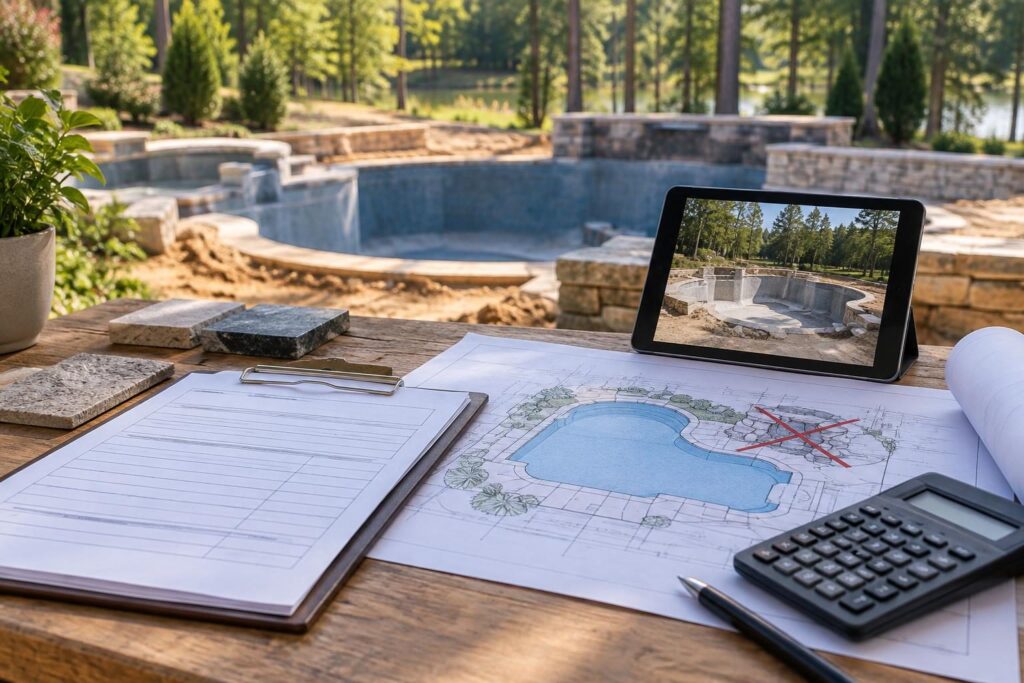
A pool change order credit for omitted work needs more than a conversation about removing a feature. Perhaps you no longer want a waterfall, a heater, or part of the planned decking. Before approving the revised scope, document what disappears, what remains, and how the price changes.
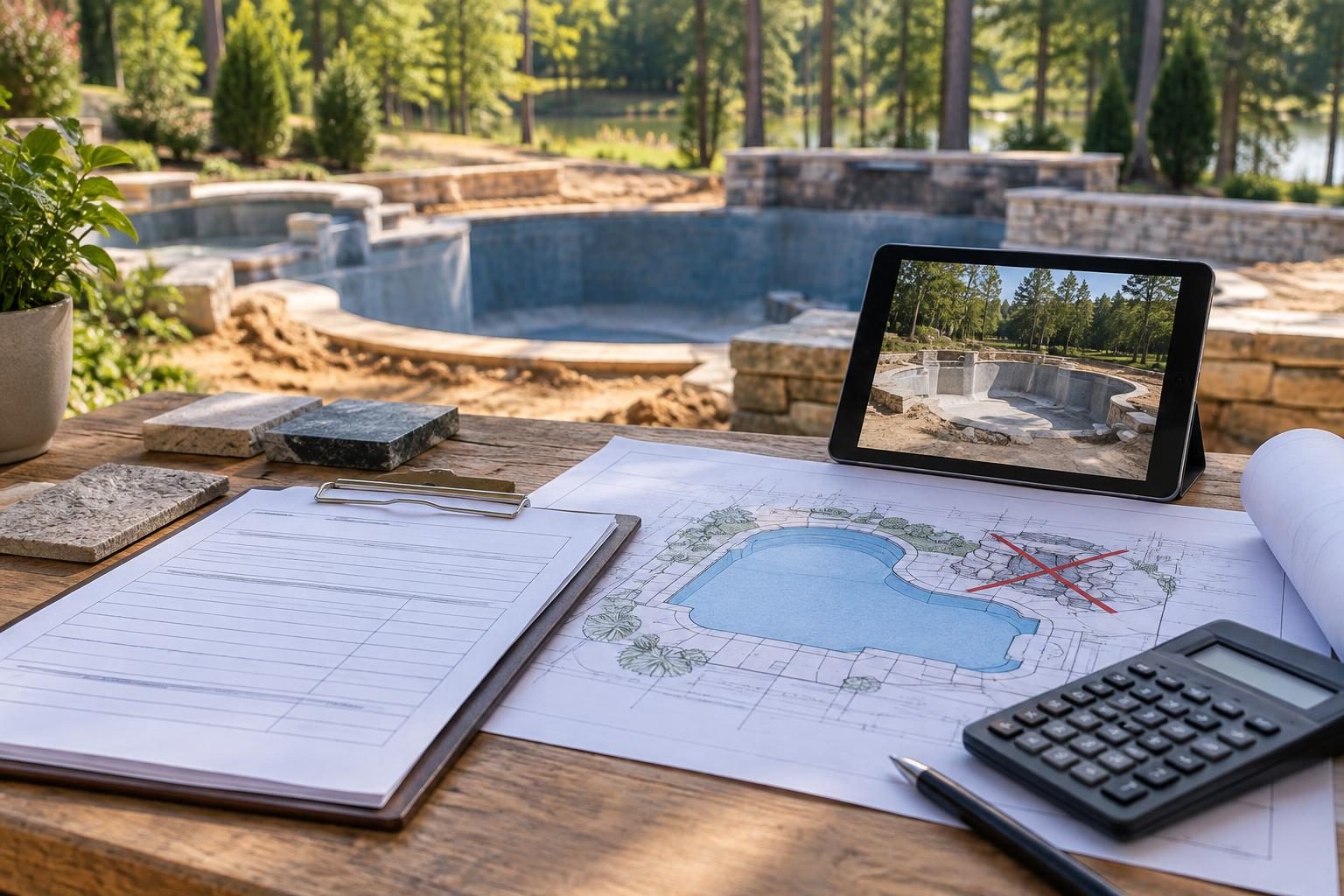
A change order is a written amendment to the construction agreement. A deductive change order reduces the agreed price. However, removing a feature does not automatically establish the deduction. Completed work, purchasing commitments, and necessary revisions may affect the proposed credit.
The goal is a shared written record—not an assumed refund based on a remembered sales conversation.
Identify exactly which pool work will be omitted
Start with the signed contract, approved drawings, specifications, and earlier amendments. Find every reference to the feature you want to remove. A single feature may appear in several documents.
For example, deleting a water feature could affect plumbing, controls, electrical work, masonry, and surface finishes. Ask the contractor to identify each affected item rather than writing only “remove waterfall.”
- Name the feature and its location.
- Identify applicable drawing numbers, revision dates, and specification items.
- State whether you plan to remove the feature entirely or reduce it.
- List related work that remains in the contract.
- Describe the finished appearance after the omission.
For reduced decking, identify the revised boundaries and agreed quantity. Our guide to checking change-order quantities explains how to connect measurements with supporting records.
Record the work already performed before discussing the credit
Ask for a dated status summary before the affected work advances. Separate design, purchasing, delivery, installation, and testing. These stages involve different commitments; ask the contractor to describe each rather than grouping them under “already started.”
Photograph accessible work from safe locations. Keep the original files and label them with the date and location. Request photographs of concealed work from the contractor; never enter an excavation or open electrical equipment to document it.
- What feature-specific work has the contractor completed?
- Which installed components will remain useful?
- What requires removal, revision, or restoration?
- Which work has not begun?
Request relevant installation records, delivery tickets, or subcontractor descriptions. These records help explain the proposal, but they do not independently determine the contractual credit. Resolve that amount through the agreement and written negotiations.
Separate ordered materials from installed materials
A statement about ordered materials leaves several questions unanswered. Ask which materials the contractor ordered, when the supplier accepted the order, and whether the supplier can cancel or accept a return.
Request relevant order confirmations and written cancellation or return terms. A contractor may provide redacted records when unrelated purchasing information needs protection. The supporting information should still identify the materials and explain the proposed charge.
- Have the materials shipped or arrived?
- Are they custom-made or potentially returnable?
- What documented freight, storage, or restocking charges apply?
- Who will receive any supplier refund?
- Who will own, collect, or dispose of retained materials?
Do not assume that paying a retained-material charge establishes ownership or delivery rights. Put that arrangement in writing. Review custom material cancellation terms before accepting a proposed deduction for purchasing commitments.
Ask how the proposed omission credit was calculated
A pool change order credit for omitted work should show the agreed deduction and explain its basis. Ask the contractor to distinguish avoided work from costs already incurred or retained under the agreement.
A bundled feature price may include shared labor, equipment, overhead, or other components. Removing one element may not eliminate every associated cost. Conversely, a general statement about committed costs does not explain which charges remain.
Request separate entries for:
- The proposed deduction for omitted scope.
- Any retained charges for completed work or materials.
- New charges for redesign, removal, restoration, or revised installation.
- The resulting net credit or additional charge.
Ask whether the stated deduction already accounts for retained costs. Otherwise, the proposal could count the same cost twice. Supporting cost information helps you evaluate the proposal; it does not automatically create a particular refund entitlement.
Check what replaces the removed feature
An omission can leave unfinished conditions. Removing a raised feature might require a revised pool edge. Deleting equipment could leave unused pipes, wiring provisions, or control settings.
Ask qualified trades to describe the safe, finished condition. Do not accept an unexplained instruction to leave unused components concealed. Request updated drawings showing remaining components and photographs before crews cover them.
Confirm whether the change affects circulation, drainage, deck elevations, equipment compatibility, or maintenance access. Do not treat required safety measures as optional decorative features.
North Carolina requirements can vary by jurisdiction, adopted code, property conditions, utilities, septic systems, flood zones, and project scope. Ask the local inspections department whether the change requires revised plans or additional review. Have licensed professionals address electrical, structural, drainage, or other technical consequences.
Reconcile the revised contract total and payment schedule
The change order should connect the credit to the whole contract. A note promising to “adjust the final invoice” leaves the amount and timing unresolved.
Request a written reconciliation showing the original contract amount, previously approved additions and deductions, and the current agreed total. Then show the new net change and revised contract total.
Keep payments separate from contract-price adjustments. Record payments already made, any refund agreed upon, and the remaining scheduled payments. A credit may reduce a future payment rather than produce an immediate refund; specify the arrangement.
Also revise payment milestones tied to deleted work. A milestone should not remain ambiguous because it still names a feature the contractor will no longer install. Use the payment documentation checklist to match later invoices with the amended agreement.
Agree in writing before authorizing the revised scope
Before approving a pool change order credit for omitted work, review the scope and financial terms together. Approval of a drawing alone should not leave the price adjustment unresolved.
Use this approval checklist:
- Identify the contract, property, change-order number, and date.
- Attach the revised scope, drawings, and material disposition details.
- State the net credit and revised contract total.
- Document payment changes and any agreed refund timing.
- Record schedule effects, including unresolved dependencies.
- Assign permit revisions, restoration, testing, and record updates.
- Obtain approval from the people authorized under the agreement.
If affected work should pause while both parties review terms, agree on that pause in writing. Identify what may continue and who will protect unfinished areas. For general consumer guidance, consult the North Carolina Licensing Board’s home-improvement contract guidance.
Resolve unclear explanations without assuming wrongdoing
A vague credit, changing explanation, or request for approval before pricing deserves follow-up. None of these facts alone proves misconduct.
Ask a focused question: “Which completed work or purchasing commitment accounts for this retained charge?” Request the supporting record and identify the answer still needed. Preserve emails, proposal versions, and meeting notes.
If explanations remain inconsistent, request a reconciled proposal before authorizing the revision. Follow the contract’s notice and dispute procedures. Seek legal advice about disputed payment obligations rather than assuming you can withhold an unrelated payment.
If material cancellation involves deadlines, request prompt written confirmation of available options. Do not assume your request to remove the feature also canceled a supplier order.
Carry the omission through final project records
Keep the signed change order with the contract, updated drawings, purchasing records, and payment reconciliation. At walkthrough, confirm that the omitted feature is absent and the agreed replacement condition is complete.
Document unfinished restoration on the punch list—the written list of remaining corrections. Obtain applicable inspection and correction records, updated equipment information, and warranty documents for the work that remains. Check that closeout paperwork no longer promises the deleted feature.
A well-documented pool change order credit for omitted work connects the decision, deduction, finished condition, and final balance.
Consult the local inspections department about permit implications. Use a licensed pool contractor, electrician, engineer, surveyor, or septic professional when the revision affects their area of expertise. Obtain legal advice when contract interpretation or payment rights remain disputed.