
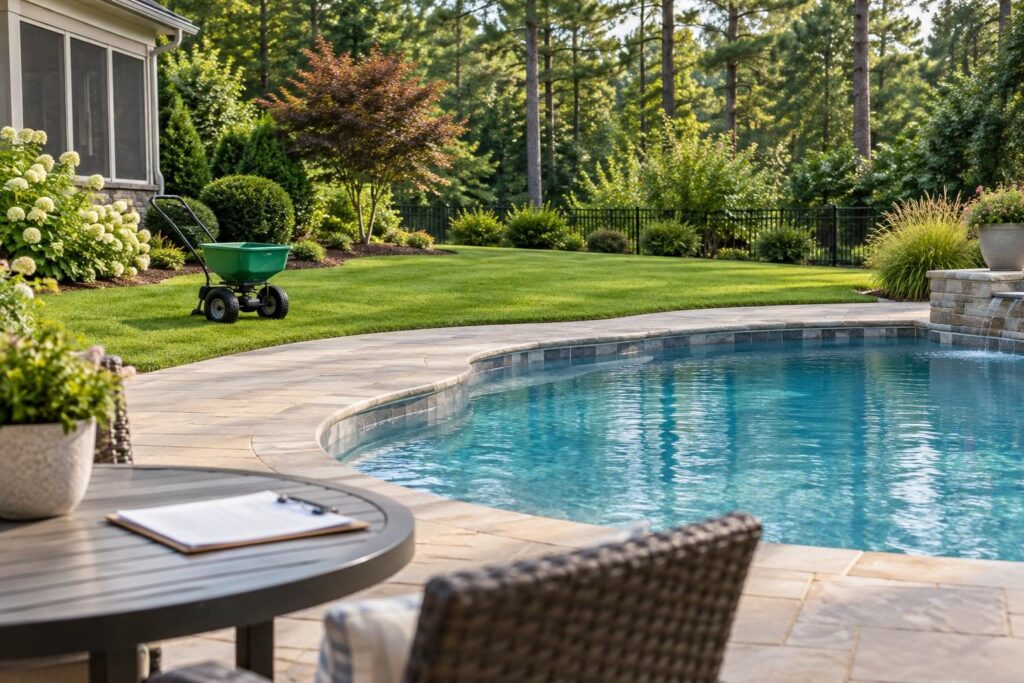
To keep lawn fertilizer out of swimming pool water, coordinate the lawn treatment before anyone opens a bag or starts spraying. Scattered granules, windblown material, irrigation, and rain can carry lawn products toward the pool. Prevention starts with knowing the product, reviewing the application area, and assigning cleanup responsibility.
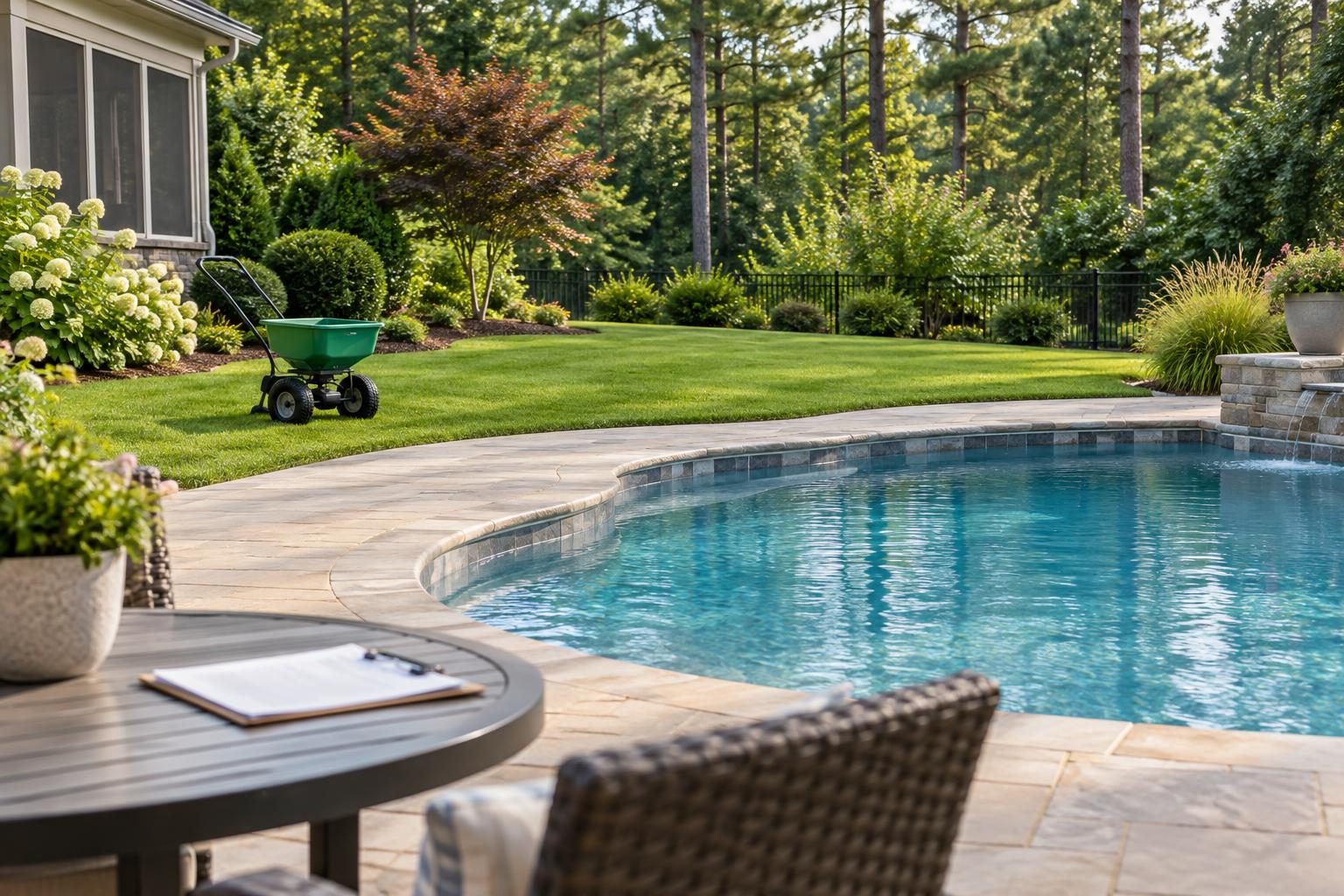
If material enters the water, avoid guessing at a chemical fix. Identify the product, document what happened, and seek product-specific guidance. A clear-looking pool or an ordinary chlorine reading cannot establish that an unfamiliar lawn treatment has been addressed.
Identify the lawn product before approving treatment
“Lawn treatment” is not a complete product description. Plain fertilizer differs from a combination product containing a weed killer or insect-control ingredient. Liquid applications also require different handling from dry granules.
Ask the applicator for the exact product name and a readable label before the visit. For a combination product, identify each active ingredient—the substance intended to control a pest or weed. Keep the original label or a complete digital copy.
- What product and formulation will be applied?
- Does it contain only fertilizer, or other treatment ingredients?
- What application, weather, watering, and access instructions apply?
- What precautions address nearby water, paved surfaces, spills, and disposal?
- Who can answer product-specific questions if material reaches the pool?
Follow the actual label rather than a general lawn-care schedule. If instructions seem unclear or conflict with the proposed work, pause and request clarification from the manufacturer or a qualified applicator.
Put pool protection in the lawn-service instructions
A short written plan helps a lawn crew and pool service avoid working at cross-purposes. Send it before treatment, not after finding granules on the coping—the finished edge around the pool.
Mark the pool, deck, equipment area, gates, and any slopes draining toward the water. Ask the applicator to identify untreated areas and explain how they will control placement near the deck. Do not invent a universal separation distance; the product, equipment, label, and site all matter.
- Confirm the treatment date and who authorizes weather-related postponement.
- Assign responsibility for checking the deck and pool afterward.
- Require notice of spills, overspray, or changed products.
- Identify who coordinates any follow-up with the pool service.
- Record any extra cleanup scope and cost approval in writing.
A vague assurance that everything will be fine is not a protection plan. Ask for specific steps. Reluctance to document them calls for clarification, but does not by itself establish wrongdoing.
A written plan helps keep lawn fertilizer out of swimming pool water while making cleanup responsibilities clear.
Plan fertilizer application around wind, rain, and irrigation
To keep lawn fertilizer out of swimming pool areas, review both direct application and later water movement. Material can miss the pool initially, then arrive with irrigation or runoff.
Check the forecast and actual conditions with the applicator. Ask how the product label addresses wind, rain, watering, and application conditions. Do not assume every fertilizer should be watered immediately, or that every product should remain dry.
Review sprinkler coverage before treatment. Heads that spray the deck or coping can move material toward the water. Schedule adjustments with the lawn provider so watering follows product instructions without creating avoidable runoff.
Postponement may be the better decision when the crew cannot control placement or follow label directions. Record the revised plan rather than accepting an undocumented substitution.
Keep swimmers, pets, toys, and pool-cleaning tools away from the application work. Follow product-specific access restrictions, and maintain normal pool barriers throughout the visit.
Keep granules off the deck without washing them into water
Before treatment, remove loose pool accessories from nearby work areas. Give the crew a clear route that does not require dragging equipment through the pool enclosure unnecessarily.
Ask how the applicator will control dry granules near hard surfaces. A spreader’s directional shield or a more controlled application method may help, depending on the equipment and label. Leave equipment selection and calibration to the qualified operator.
Afterward, inspect accessible deck edges, joints, steps, and the equipment area. Do not hose stray material toward the pool, a drain, or a neighboring property. Avoid using a leaf blower that could scatter it into the water.
Have the applicator handle recovery according to the label and product guidance. Do not return collected material to its original container unless the manufacturer’s instructions permit it.
A pool cover is not a substitute for careful application. Material can collect on top and enter during removal. Ask the cover manufacturer about compatibility and cleaning before using it as treatment protection.
Check runoff routes before the next watering cycle
Walk the yard from the treated lawn toward the pool. Look for low spots, bare soil, clogged deck drains, and places where turf sits above the deck. These observations help identify routes that could carry lawn products.
Watch normal watering or rain from a safe location. Do not create a test flow that could wash fresh treatment into the pool. Photograph visible flow paths and note whether water reaches the coping.
Recent sod or planting work deserves attention. Our guide to checking pool drainage after sod installation explains useful observations to record.
Ask the landscape contractor to review recurring runoff before the next treatment. Request a written correction proposal rather than accepting an improvised trench or soil ridge.
North Carolina requirements vary with jurisdiction, property conditions, utilities, septic systems, flood zones, and project scope. Verify drainage changes with the appropriate local authority or qualified professional. Keep any required approvals and photograph authorized work before it is covered.
If fertilizer enters the pool, document before cleanup
Stop the application and keep people and pets out of the pool while seeking guidance. Prevent additional material from entering when that can be done safely. Do not enter the water to retrieve granules or approach operating application equipment.
Photograph the scene promptly without delaying urgent safety measures. Build an incident record containing:
- The product container, full label, and available safety data sheet.
- The application date, discovery time, and weather conditions.
- Where material was observed: deck, cover, water surface, or pool floor.
- The estimated amount, clearly marked as an estimate or unknown.
- Whether irrigation, circulation, or cleaning equipment was operating.
- Recent water-test results and any visible changes.
- Steps already taken and the people contacted.
Separate observations from conclusions. “Granules visible beside the return fitting” is more useful than an unsupported claim about damage. Ask the applicator for their service record, product identification, and account of events in writing.
Get product-specific cleanup guidance, not a generic chemical fix
Contact the lawn-product manufacturer and a qualified pool professional with the incident record. Ask who can assess the specific ingredients and recommend appropriate testing, removal, disposal, and swimming restrictions. Suspected exposure or illness requires prompt medical or poison-control guidance.
Do not automatically add chlorine, phosphate remover, stain treatment, or another product. Likewise, avoid starting a vacuum, draining the pool, or changing equipment operation without advice suited to the incident. Ask whether the recommended method could affect the finish, filter, plumbing, or disposal route.
The CDC’s home pool treatment and testing guidance supports routine water care. Routine chlorine and pH tests do not identify every possible contaminant or establish product-specific clearance.
If cloudiness develops, our cloudy-water troubleshooting guide explains general observations. It does not replace assessment of the lawn product involved.
Close the incident with records and a revised plan
Before approving paid cleanup, request a written scope. It should identify the proposed work, responsible provider, testing, disposal arrangements, and conditions for follow-up. Ask who will advise when swimming can resume and what that advice relies on.
Retain invoices, recommendations, test results, photographs, and correction records. Document unresolved observations without assuming their cause. If someone claims warranty coverage is affected, request the applicable terms and explanation. Our guide to pool warranty maintenance obligations can help organize those questions.
The lasting way to keep lawn fertilizer out of swimming pool water is to revise the next service plan. Record product restrictions, application boundaries, notification steps, and the person responsible for inspection afterward.
Consult a qualified lawn applicator and pool professional for product-specific prevention and cleanup. For recurring runoff or proposed site changes, involve a drainage specialist or engineer. Ask local inspections or environmental-health staff about applicable requirements, especially near septic systems, wells, or regulated drainage areas.