
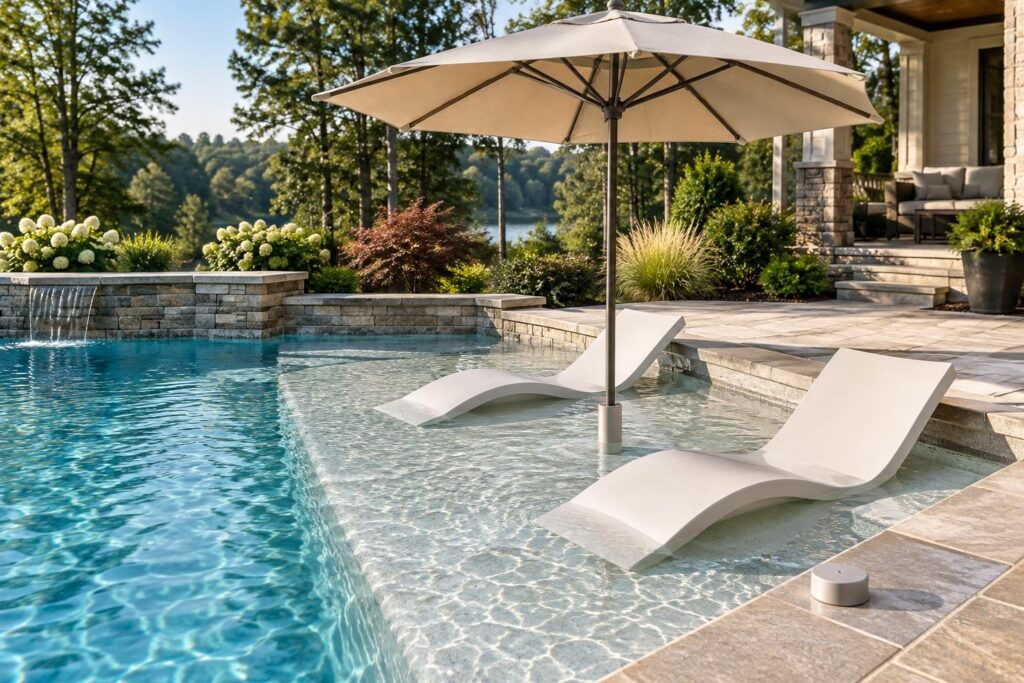
Good pool tanning ledge umbrella sleeve planning starts before you buy the umbrella or approve the ledge drawing. A sleeve is the socket that receives an umbrella pole. Its presence does not mean every umbrella will fit, tolerate pool water, or remain secure in wind.
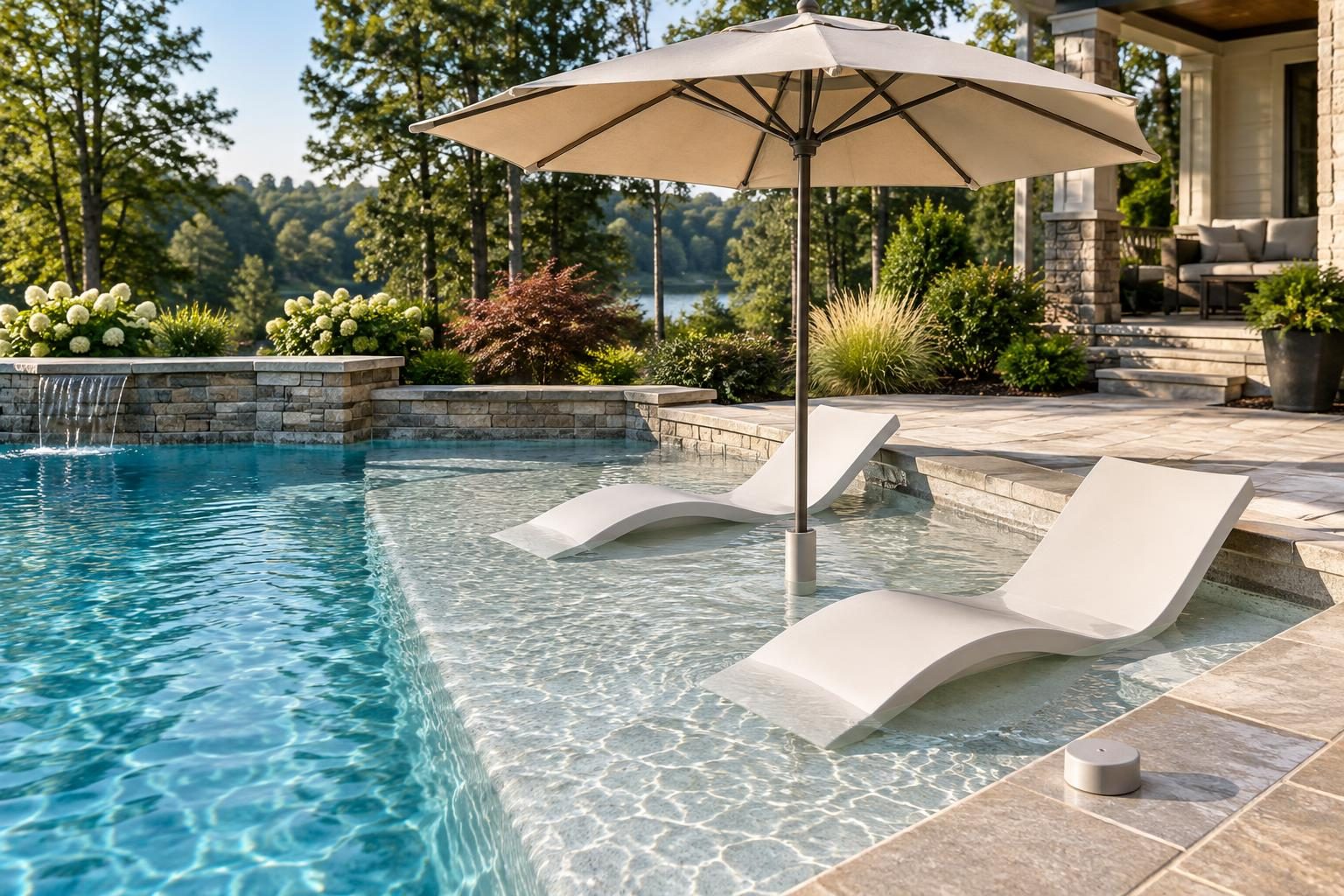
For North Carolina homeowners, the decision also involves summer thunderstorms, seasonal storage, and access for removal. Compare the umbrella, sleeve, mounting hardware, and finished ledge as one system. Written product details matter more than a rendering showing attractive shade.
Choose the umbrella and sleeve as a matched system
Start with the exact umbrella model, not just its canopy color or advertised size. Confirm that the manufacturer permits installation in a submerged pool sleeve. An umbrella intended for a deck base may not be suitable for that use.
Ask the seller and installer to identify the compatible sleeve, pole, adapter, and retention hardware. Retention hardware means the parts intended to hold the pole in place. A close fit alone does not establish secure installation.
- What are the umbrella and sleeve model numbers?
- What pole diameter and shape does the sleeve accept?
- How far must the pole enter the sleeve?
- Does the approved assembly require an adapter, collar, or locking part?
- Are all submerged components suitable for the intended pool-water exposure?
- Can you purchase replacement parts separately?
Keep the current installation instructions and written compatibility confirmation. Independently compare those documents with the proposal. A product description that says “poolside” does not answer whether the manufacturer approves submerged installation.
Treat pool tanning ledge umbrella sleeve planning as a compatibility check, not simply an accessory purchase.
Match sleeve placement to finished ledge depth
A tanning ledge is a shallow platform inside the pool. Review its finished water depth, not merely the unfinished shell measurement. The final surface and normal operating water level affect that depth.
Ask the designer to show the sleeve location and finished elevation on the drawing. Elevation means height relative to a stated reference point. Confirm how much pole remains above water after the required insertion.
Check the resulting canopy height, opening mechanism, and clearance around loungers. Make sure users can enter, exit, and move without encountering the pole or canopy hardware. Shade location also changes as the sun moves.
Use a scaled layout or safe dry-land mock-up to evaluate reach and circulation. Our guide to mapping pool sunlight and shade can help establish where shade is useful.
Do not move the sleeve casually during construction. Ask whether a proposed relocation affects the shell, finish, nearby fittings, or umbrella clearances. Record the approved location before installation.
Ask how the umbrella sleeve handles water
Sleeve drainage and pool drainage are different questions. A submerged socket may contain pool water by design. A socket exposed during seasonal lowering may also collect rainwater. Ask how the specific assembly handles each condition.
Request the manufacturer’s detail rather than assuming every sleeve needs the same drain arrangement. The installer should explain whether the system retains water, drains, or requires an approved seasonal procedure.
- Is the socket closed-bottom, open-bottom, or connected to a specified drainage path?
- Where does any drainage go?
- How does the installation protect the pool shell against unintended leakage?
- How can debris be removed without damaging the sleeve or finish?
- What happens when water remains inside during freezing weather?
Do not request an improvised hole through the shell or connect the sleeve to nearby plumbing. Those changes require qualified review and product-specific instructions.
If a proposed detail discharges outside the pool, review the destination with the responsible professional. Our drainage outlet planning guide explains broader site-water questions. It does not establish a suitable sleeve detail.
Specify caps, collars, and safe removal access
Include the sleeve cap in the purchase decision. Ask how it fits when the umbrella is absent and whether it is intended for submerged use. Check whether it sits flush with the finished ledge or creates a raised edge.
Confirm how to remove, retain, clean, and replace the cap. Ask whether a missing cap exposes an opening, sharp edge, or hardware that needs attention. Do not assume an included construction cover is the permanent finished cap.
Removal deserves equal attention. Find out whether the umbrella requires tools, multiple people, or a particular lifting method. Have the installer explain the procedure from a stable position. Avoid a system that depends on awkward handling from a slippery ledge.
Store removable parts together in a labeled container. Keep the correct cap available whenever you remove the umbrella. Never force a stuck pole or use improvised leverage against the pool finish.
Understand wind limitations before storm season
An installed sleeve is not a promise that an umbrella can remain open during storms. The pole fit, retention parts, canopy design, and installation conditions all matter. A sleeve should not be assumed to secure every umbrella.
Obtain the manufacturer’s operating limits and removal instructions for the exact assembly. Ask whether any stated wind performance applies to your submerged mounting configuration. Do not borrow a rating from another model or deck-base arrangement.
North Carolina thunderstorms and tropical weather make advance removal planning important. Decide who will close and remove the umbrella when conditions warrant. Identify secure storage before bad weather arrives. Do not wait until strong winds make handling unsafe.
Closing the canopy may not satisfy the manufacturer’s storage or storm instructions. Follow the required procedure, including removal when specified.
Trees, fences, and nearby buildings do not establish safe operating conditions. Our backyard windbreak planning guide addresses comfort and placement, not umbrella wind certification.
Put compatibility and installation responsibilities in writing
Make pool tanning ledge umbrella sleeve planning part of the written project scope. Name who supplies the umbrella, selects the sleeve, installs it, and verifies the assembled fit. Split purchases can leave those responsibilities unclear.
- List exact models, finish colors, adapters, caps, and included hardware.
- Attach the approved location drawing and installation detail.
- Identify any allowance, meaning a budget placeholder rather than a fixed product selection.
- State who pays for an incompatible substitution or approved redesign.
- Define the installation demonstration and records required at handover.
- Request separate product and workmanship warranty terms.
A vague promise that “any standard umbrella fits” is a reason to request clarification, not proof of wrongdoing. Ask for the dimensional range and approved models in writing.
Approve substitutions through a written change order before installation. Check compatibility again when the replacement product changes. Match payment requests to the agreed milestone and delivered scope, rather than a picture or verbal assurance.
Document the sleeve before finishes hide the work
Photograph the installed sleeve and surrounding work before crews cover or finish it. Stay outside active work areas and ask the contractor to provide inaccessible views. Photos help preserve locations and details; they do not establish structural adequacy.
Keep product labels, delivery records, installation instructions, and the approved drawing together. Request written confirmation of any departure from the original detail. Record who approved it and whether the manufacturer reviewed it.
For an existing pool, ask a qualified contractor to evaluate the proposed retrofit before drilling. Cutting into a shell can involve structural, waterproofing, or concealed-component concerns. Seek qualified design input where needed.
If metal components raise electrical bonding questions, consult a licensed electrician. Bonding connects specified conductive parts to reduce dangerous voltage differences. Do not decide that a removable umbrella automatically needs, or automatically avoids, bonding.
North Carolina requirements vary with jurisdiction, adopted code, property conditions, and project scope. Confirm permit and inspection needs with the local inspections department.
Use handover to test fit and establish seasonal care
Before accepting the sleeve work as complete, request a demonstration under the manufacturer’s permitted conditions. Have the installer show insertion, retention, opening, closing, removal, and cap placement. Avoid intentionally testing the umbrella in wind.
Document wobble, binding, missing parts, or finish damage without assigning a cause. Ask for an explanation and correction plan. Keep unresolved items on the written punch list, which records work still needing completion or correction.
Request cleaning, freeze-season, and storage instructions specific to the sleeve and umbrella. Do not lower or drain the pool solely to service a sleeve without professional review. Record where you store parts and who handles seasonal removal.
Shade does not replace supervision or other pool protections. Review the Pool Safely safety tips when planning how children and guests use the ledge.
Complete pool tanning ledge umbrella sleeve planning with verified product documents and a workable removal routine. Consult your licensed pool contractor about installation, the local inspections department about current requirements, and an electrician or engineer when the proposed detail needs specialized review.