
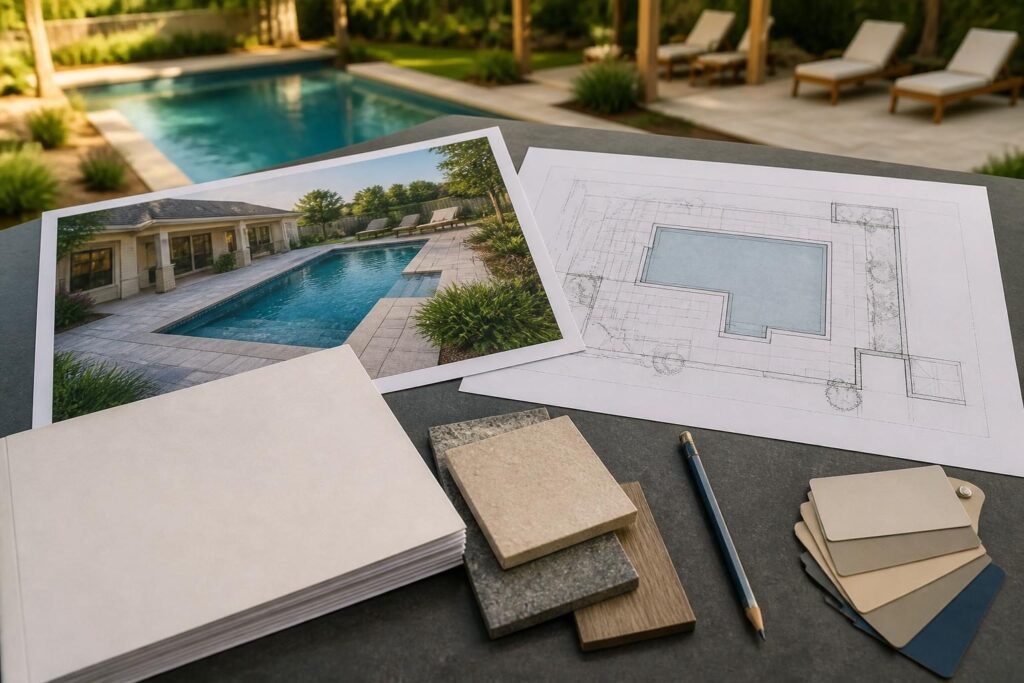
Resolving pool rendering proposal discrepancies before signing means checking whether the picture, sales explanation, and written scope describe the same project. A rendering is a visual illustration of a proposed design. It can help you imagine the backyard, but it cannot answer every construction or pricing question.

A pictured waterfall might be optional. The broad-looking deck might lack written dimensions. A sales discussion might describe equipment that never appears in the proposal. None of these differences automatically proves wrongdoing. Each deserves a clear answer before you approve the project.
The goal is not to decide which document creates legal rights. It is to request one consistent written package that explains what you are buying.
Start with a dated set of pool renderings and proposal documents
Collect the exact materials you reviewed, not just the latest image on a salesperson’s screen. Include the proposal, renderings, dimensioned drawings, equipment list, selections, and relevant emails. Use this document set to track pool rendering proposal discrepancies before signing.
A specification describes the required product, material, or work in writing. An allowance is a budget amount reserved for an item that is not fully selected or defined. Ask the contractor to identify both throughout the package.
- Save each document with its date and revision identifier.
- Record the proposal date and which drawings it references.
- Keep earlier versions in a separate folder marked as superseded.
- Write down sales statements that influenced your decision.
- Ask the contractor to confirm or correct your written summary.
Label your recollection as your recollection until the contractor confirms it. A homeowner’s notes help identify questions, but they are not the same as a mutually confirmed specification.
Ask who can approve scope and price revisions. This prevents an informal answer from being mistaken for an approved project change.
Classify every depicted feature before discussing price
Walk through the rendering feature by feature. Ask the contractor to assign each item a written status:
- Included: Part of the stated price, with its quantity and specification identified.
- Allowance: Covered by a stated budget amount, with remaining selection and pricing questions explained.
- Optional: Available separately, with pricing and approval still needed.
- Owner-provided: Purchased or arranged by you, with installation responsibilities identified.
- Illustrative only: Shown for appearance but not included in the work.
- Unresolved: Awaiting a decision, site information, or professional review.
Do not stop at the pool itself. Review planting, fencing, furniture, lighting, walls, steps, drainage, and restored lawn areas.
An illustrative fence still raises a practical question: who will provide the actual required barrier? A decorative wall might conceal a separate retaining-wall need. Ask whether removing a pictured feature changes safety, drainage, access, or another part of the design.
Use a pool rendering and proposal discrepancy checklist
A useful review of pool rendering proposal discrepancies before signing should end with specific corrections, not general reassurance. Create one tracking row for each mismatch. The following checklist identifies common comparison points, not findings about any particular project.
| Compare | Question to resolve | Written record to request |
|---|---|---|
| Pool outline and size | Do the image, drawing, and proposal describe the same shape and dimensions? | Current dimensioned plan |
| Steps, benches, and ledges | Which are included, and how are their size and water depth defined? | Dimensions and depth references |
| Deck and coping | What area, widths, materials, and pool-edge pieces are included? | Measured layout and material schedule |
| Raised walls and water features | Are the structure, finish, plumbing, and controls included? | Feature details and equipment scope |
| Lights and automation | Which fixtures and remote-control functions are included? | Quantities, models, and connection responsibilities |
| Landscaping and barriers | Which pictured elements are illustrative or supplied separately? | Exclusions and assigned responsibilities |
| Grades and drainage | Does the apparent yard slope reflect evaluated site conditions? | Site-specific grading and drainage information |
| Access and restoration | Who repairs disturbed surfaces and landscaping? | Restoration limits and specifications |
Add columns for document references, the contractor’s response, responsible person, and resolution status. Mark an item resolved only after you receive the promised revision.
Check dimensions without measuring the picture
Perspective can make a deck appear wider or a ledge look larger. Do not estimate dimensions from furniture, shadows, or apparent proportions in a rendering.
Request labeled measurements instead. Ask what each measurement includes: the water area, the outside pool structure, or the surrounding deck. Coping means the cap or edging around the pool perimeter.
- Where does each deck-width measurement begin and end?
- Does the stated pool length include steps or a shallow ledge?
- Are depths measured from the planned waterline?
- What establishes the height of walls, deck surfaces, and nearby doors?
- Which dimensions remain subject to site or professional review?
Elevation means height relative to an identified reference point. Ask for elevation information when the picture shows level transitions or a pool near the house.
After reconciling the sales package, use a preconstruction design decision checklist to track remaining choices. That later review should build on the corrected scope, not replace it.
Translate sales descriptions into verifiable specifications
Words such as premium, oversized, complete, and smart do not tell you exactly what will arrive. Ask what each description means for this proposal.
For equipment, request manufacturer and model information when selected. If selection remains open, ask for defined capabilities and a written approval process. Clarify how any proposed substitution will be documented and priced.
For finishes, request product names, selection references, and included installation details. Rendered colors are not physical samples. Review actual samples where available, and document your chosen material.
For a water feature, ask whether the price includes its supporting equipment and connections. For automation, clarify which functions work through the proposed system and what requires separate equipment or services.
Independently check important product claims against manufacturer information supplied for the selected model. Ask qualified installers about compatibility and installation needs. Verbal assurances alone cannot show whether several components will deliver the promised function together.
Separate design appeal from North Carolina site approval
A rendering does not establish that the pictured layout can be permitted or built on your property. Ask which site conditions the designer has verified and which remain assumptions.
North Carolina requirements can vary by jurisdiction, property conditions, adopted code, utilities, septic systems, flood zones, and project scope. Confirm current permit, setback, barrier, and inspection requirements with the local inspections or planning department.
Use a surveyor for boundary and elevation questions. Ask local environmental health staff about septic and well constraints. Have qualified professionals evaluate drainage, structural needs, and electrical work.
Check contractor licensing independently through the North Carolina Licensing Board’s official search. Confirm that the business information matches the proposed agreement. Ask the board about licensing questions specific to your scope.
These checks do not replace document reconciliation. They help distinguish a clear commitment from a feature that still depends on site evaluation or approval.
Request a coordinated revision, not scattered assurances
Send the discrepancy list in one written request. Ask for corrected proposal pages and drawing references, rather than answers spread across unrelated messages.
The revised package should identify included work, exclusions, allowances, owner responsibilities, and unresolved conditions. Ask the contractor to explain any remaining conflicts in writing. If contract language remains unclear, consult a North Carolina attorney rather than guessing which document controls.
- Check that revised quantities match the revised price.
- Confirm that deleted features disappear from the included scope.
- Identify each attachment by title, date, and revision.
- Request a written change-order process for later scope or price changes.
- Connect payment milestones to defined work and supporting records.
Use a payment documentation checklist to review that last connection. An attractive image is not evidence that a payment milestone has been completed.
Decide what must be resolved before signing
Pause signing when material features, dimensions, responsibility, or pricing remain inconsistent. Pressure to proceed without corrections deserves further questions. So do conflicting explanations or reluctance to document important commitments. These warning signs do not, by themselves, establish misconduct.
Keep the final signed package, written approvals, and later change orders together. During construction, photograph relevant work before it is covered, from safe locations. Retain inspection records, correction records, warranties, and unresolved punch-list items—the remaining work identified for completion.
Addressing pool rendering proposal discrepancies before signing creates a clearer reference for construction and handover. It also gives both sides a practical way to distinguish included work from presentation details.
Consult local inspections staff when approval questions remain. Bring technical conflicts to the appropriate licensed contractor, electrician, engineer, surveyor, or septic professional before accepting an uncertain scope.