
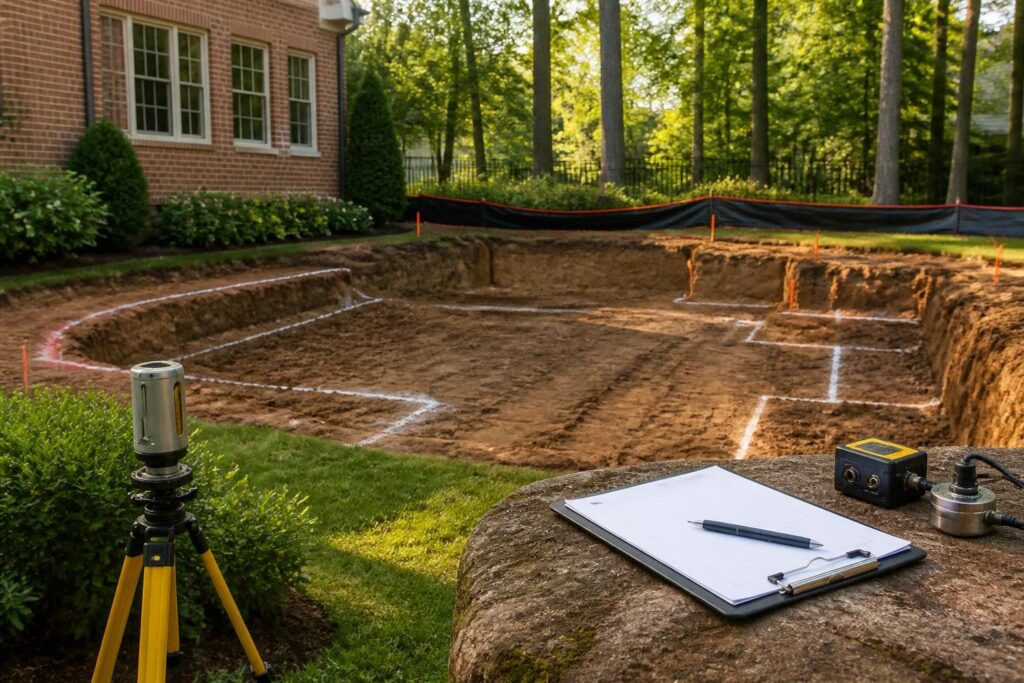
Pool excavation vibration monitoring North Carolina planning helps homeowners prepare for work near homes, walls, walkways, driveways, wells, septic features, and other structures. Excavation equipment can create noise, movement, dust, and changing ground conditions. A clear record does not prevent every problem, but it gives the homeowner and project team a shared reference before work starts.

Vibration monitoring is the process of observing or measuring ground movement during construction. Some projects use instruments that record vibration levels. Others rely on visual checks, photographs, equipment controls, or a combination of methods. The suitable approach depends on the excavation method, soil, distance to nearby structures, site layout, and advice from qualified professionals.
Why vibration questions belong in early pool planning
Excavation risk is not determined by distance alone. A pool may be close to a house, crawl space, retaining wall, masonry feature, paved surface, or buried utility. Soil layers can transmit movement differently. Existing cracks may also have several possible causes unrelated to the pool project.
North Carolina properties vary widely. Clay, fill, rock, groundwater, slopes, narrow access routes, and older structures can change how excavation proceeds. A project near a crawl space deserves particular attention to moisture and movement observations. You can read more about related planning questions in pool construction near crawl space moisture.
Homeowners should not select technical limits or decide that a crack proves damage. Instead, ask the pool contractor whether the site needs a site-specific review by an engineer, surveyor, geotechnical professional, or vibration specialist. That review can help shape pool excavation vibration monitoring North Carolina decisions without asking the homeowner to make technical judgments.
Conditions that may deserve closer review
- The excavation will occur near a house foundation, basement, or crawl space.
- A retaining wall, masonry wall, chimney, patio, or older slab is nearby.
- The lot includes steep grades, fill soil, exposed rock, or groundwater.
- Heavy equipment must operate in a narrow route beside the home.
- Temporary shoring, dewatering, rock removal, or repeated equipment passes are expected.
- Neighbors share a property line or have structures close to the work area.
Shoring means temporary support used to help stabilize an excavation. It is not a homeowner-designed system. Ask who evaluates the need for shoring and which qualified professional handles technical decisions. Our guide to pool excavation shoring questions can help organize that conversation.
Build a pre-excavation condition record
A condition record documents what was visible before equipment arrives. It should cover the pool area, the access route, nearby structures, and features that could be affected by vibration, equipment traffic, dust, water, or settlement.
Take photographs in consistent lighting. Use wide views first, then closer images of existing cracks, joints, stains, leaning features, damaged paving, loose trim, and drainage components. Include a ruler or another simple reference only when it helps show scale. Do not alter a crack or remove material to make it easier to photograph.
Areas to include
- Exterior foundation walls, brick veneer, siding, steps, porches, and chimneys.
- Crawl-space access areas, basement walls, doors, windows, and visible interior finishes.
- Retaining walls, fences, landscape edging, detached structures, and hardscape.
- Driveways, walkways, patios, pavers, curbs, and utility covers.
- Sprinkler heads, irrigation lines where known, drainage inlets, pipes, and downspout outlets.
- Well components, septic markers, cleanouts, tanks, or drainfield indicators where present.
- Neighboring features that are visible from your property or access route.
Record the date, time, weather, camera used, and location of each image. A simple sketch can identify where you took a photograph. Keep original files rather than relying only on social-media uploads or compressed messaging images.
Written notes matter too. Describe whether a door closes normally, whether water is visible, and whether a surface appears loose or displaced. Use neutral observations instead of conclusions. For example, write “a diagonal crack is visible above the window” rather than “the wall is failing.”
Agree on communication before equipment arrives
Good communication is a practical control. It helps the team respond to changing conditions and gives the homeowner a consistent record of decisions. Put the agreed process in the project file, even if the contract already describes general communication.
Questions about the contact process
- Who is the day-to-day excavation contact?
- Who can pause work if an unexpected condition appears?
- How will the homeowner receive the planned excavation dates?
- How much notice will the team provide before rock breaking, heavy compaction, or other high-impact work?
- What channel should be used for urgent observations?
- Who records weather, equipment changes, delays, and site decisions?
- How will the team confirm that it received a concern?
Ask for a daily or phase-based update during excavation. The update might state which area the crew excavated, what equipment it used, whether groundwater or rock appeared, and whether the plan changed. These notes are useful without assigning blame or predicting a final outcome.
Set a simple observation procedure. If you notice a new condition, photograph it from more than one angle, note when you saw it, and contact the designated person promptly. Avoid entering the excavation area or approaching operating equipment.
Ask how the team will control and observe vibration
There is no universal vibration plan for every residential pool. The contractor should explain the planned excavation method and how it may change if soil, rock, groundwater, or access conditions differ from expectations.
Possible controls may include selecting smaller equipment, changing the excavation sequence, limiting unnecessary equipment passes, maintaining safe stand-off distances, using suitable shoring, or changing a rock-removal method. The correct choice requires project-specific judgment. Homeowners should ask for the reasoning, not prescribe a method.
Practical questions for the excavation meeting
- Which nearby structures and surfaces did the team consider in the excavation plan?
- What equipment does the team expect during digging, loading, compaction, and rock removal?
- Could the method change if rock or groundwater appears?
- Will the team measure vibration, observe it visually, or involve a qualified specialist?
- If the team uses instruments, where will it place them and what will they record?
- How will the team document readings, observations, and equipment changes?
- What event would cause the crew to stop and reassess the method?
- How will the homeowner learn about a changed plan before work continues?
Ask whether the project includes a formal monitoring service or only contractor observations. Those descriptions mean different things. Request plain-language details about the scope, record format, responsible person, and limits of the process. This conversation forms an important part of pool excavation vibration monitoring North Carolina planning.
Utility planning also belongs in the conversation. North Carolina 811 provides the state’s official utility-notification resource. Review current notification procedures at North Carolina 811 before excavation. Utility marking does not replace a project-specific review of private lines, irrigation, septic components, or other homeowner-installed systems.
Keep an excavation-day log
A short log can capture facts that photographs miss. Make one entry for each workday or major excavation phase. Record the date, approximate work hours, weather, visible site conditions, equipment types if known, and the location of active work.
This log supports pool excavation vibration monitoring North Carolina documentation by connecting observations with dates, equipment, and changing site conditions. Note whether the crew used a different method than discussed. Record visible dust, standing water, soil movement, exposed utilities, access damage, or changes near structures. Do not estimate vibration levels by touch or sound. If formal readings exist, request copies through the agreed communication process.
Useful records to save
- Preconstruction photographs and location sketches.
- Site plans showing the pool, nearby structures, access route, and excavation limits.
- Written excavation-method notes and any approved project changes.
- Daily updates, emails, text messages, and meeting summaries.
- Monitoring reports or instrument logs, if the project uses them.
- Photos of the same reference areas during and after excavation.
- Notes about weather, groundwater, rock, shoring, pumping, or altered access.
Save files in at least two locations. Use clear names such as “2026-05-14-house-east-wall-before-excavation.jpg.” Keep the originals and a separate index. For related groundwater documentation, see pool construction groundwater dewatering questions.
What to do when you notice a change
Stay calm and focus on timely, factual communication. Photograph the condition without touching it. Note the time, location, weather, nearby activity, and whether the condition appeared in your baseline record.
Send the information through the agreed channel. Ask the project contact to confirm receipt and explain the next review step. Do not direct workers, enter restricted areas, or attempt repairs while excavation is active.
If the condition involves an apparent structural, electrical, utility, drainage, or safety concern, request review by the appropriate qualified professional. A contractor’s observation may not answer an engineering, electrical, environmental-health, or code question.
Verify local requirements and project responsibilities
North Carolina requirements can vary by local jurisdiction, adopted code, property conditions, utilities, septic systems, flood zones, and project scope. Monitoring expectations may also depend on the contract and the advice of qualified professionals.
Ask the local inspections department whether any current permit, inspection, or site-specific process applies to your project. For erosion and sediment questions, review current state guidance from the NC DEQ Erosion and Sediment Control Manual. That guidance does not replace local review or a site-specific design.
Before excavation starts, confirm who handles documentation, temporary protection, restoration, neighbor communication, and technical reviews. Build a Pool in North Carolina encourages homeowners to keep these responsibilities in writing and connect each record to the relevant plan or project phase.
Final homeowner checklist
- Photograph nearby structures, paving, walls, drainage features, and access routes.
- Index each image with a date and location.
- Ask whether a formal vibration assessment is appropriate.
- Discuss excavation methods, equipment changes, rock, groundwater, and shoring.
- Set one contact process for daily updates and urgent observations.
- Ask how monitoring records or readings will be shared.
- Keep a neutral excavation-day log.
- Verify current local permit, inspection, utility, erosion, septic, and well requirements.
- Use qualified specialists for structural, engineering, electrical, drainage, or environmental-health questions.
Consult the local inspections department, licensed pool contractor, electrician, engineer, surveyor, septic professional, or another qualified specialist when site conditions or technical questions exceed general homeowner documentation. This article is educational and does not replace a project-specific evaluation.