
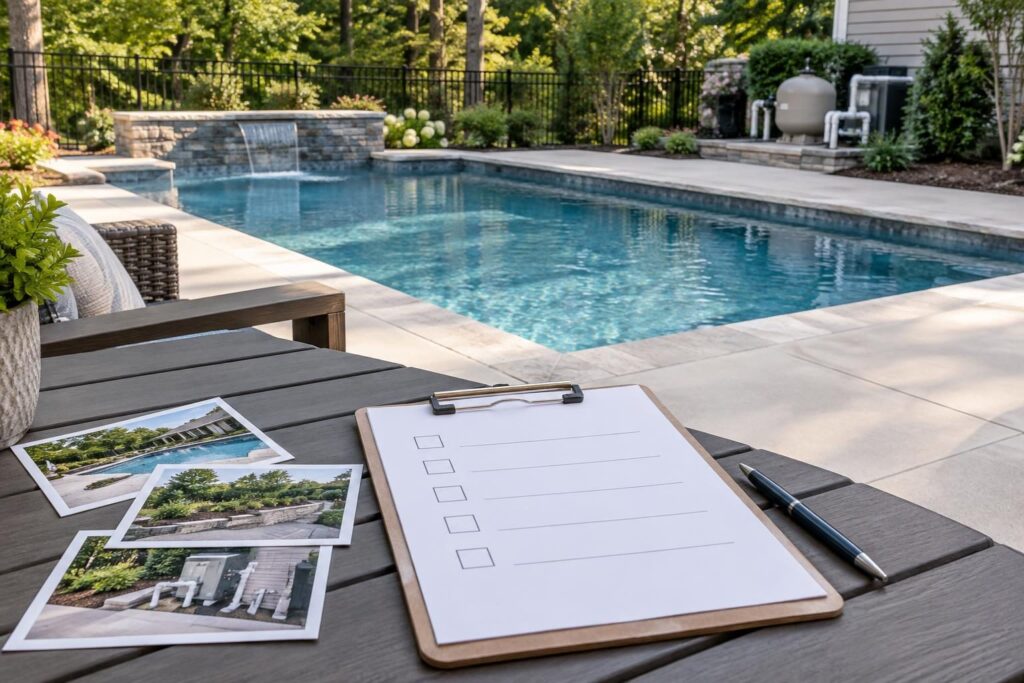
Clear pool punch list item completion criteria turn “finish this” into a task everyone can understand and verify. A punch list records unfinished work and observations that need review near project completion. Each entry should identify the location, expected result, responsible party, and verification method. Keep appearance concerns separate from operational or safety concerns so neither gets lost.
The goal is not to diagnose every problem yourself. It is to replace vague notes with useful questions, agreed actions, and evidence. For North Carolina homeowners, that also means separating contractor completion from required inspections and professional evaluations.
Start with the agreed pool scope, not a new wish list
Gather the signed contract, approved drawings, product selections, written changes, and relevant manufacturer instructions before drafting entries. These records help establish what the contractor promised. A rendering or remembered conversation may not settle a disagreement about the finished result.
Distinguish among unfinished contracted work, an observed concern, a missing document, and a new request. Adding a feature is different from completing an approved feature. If the scope is unclear, mark it “scope clarification needed” rather than assuming either party has accepted responsibility.
- Reference the relevant drawing, specification, selection, or approved change.
- Record the document date or revision so everyone uses the same version.
- Identify missing records that prevent a fair comparison.
- Ask the contractor to confirm the proposed action in writing.
A homeowner’s list does not automatically amend the contract. Confirm any changes to scope, cost, or obligations through the agreed written process.
Give each punch list item four clear fields
Use one entry per issue and assign a unique item number. Avoid combining unrelated work under “finish equipment area.” Different tasks may need different trades, records, and verification.
- Location: Identify the feature and its position using a consistent reference, such as “equipment pad, house-facing side.”
- Expected result: Describe the finished condition using the applicable agreement, approved selection, or professional recommendation.
- Responsible party: Name the coordinating company or person and identify any specialist needed.
- Verification method: State who will check completion, how they will check it, and what evidence you will retain.
Add the observation date, photo references, target date, current status, and verification date. Keep the original observation visible when updates arrive. Agree on pool punch list item completion criteria before scheduling corrective work.
Ask the responsible party to acknowledge their role rather than assigning it by assumption. Ask who will coordinate subcontractors and who will report back. The homeowner should not have to infer responsibility from which worker last visited.
Separate cosmetic observations from functional concerns
A cosmetic observation concerns appearance, such as an apparent color mismatch or visible residue. A functional concern involves how something operates, drains, fits, or performs. Safety concerns deserve a separate flag and prompt professional attention.
Describe what you actually observe. “Dark mark on the patio-facing coping” is more useful than “defective coping.” “Water remains beside the doorway after rain” records a condition without claiming its cause.
Do not assume an appearance issue is harmless. A qualified professional may need to determine whether a visible condition has functional implications. Likewise, attractive finished work does not establish proper operation or compliance.
- Appearance: Compare against the agreed sample, finish description, or documented acceptance standard.
- Function: Identify the operating condition and arrange an appropriate demonstration or assessment.
- Safety or compliance: Seek review from the responsible licensed professional or local authority.
If one feature has both appearance and performance concerns, create linked entries. This keeps a surface touch-up from accidentally closing an unresolved functional issue.
Write completion criteria that can be demonstrated
Useful pool punch list item completion criteria explain what evidence will answer the original concern. “Repair completed” describes an activity. It does not explain whether the work achieved the expected result.
For appearance items, agree on the comparison method before corrective work begins. Consider the approved sample, viewing position, lighting, and surface condition. Do not invent a tolerance after the contractor finishes the work or demand a standard absent from the agreement.
For functional items, ask which operating conditions make the check meaningful. A feature may need a particular equipment setting or suitable weather. Let the appropriate professional define safe testing procedures and any technical acceptance limits.
Useful verification questions include:
- What result should we observe?
- Which document supports that expected result?
- Who is qualified to perform or interpret the check?
- What conditions must exist for verification?
- Which photo, report, demonstration, or record will support closure?
A photograph can document appearance, but it cannot establish every hidden or technical condition. Match the evidence to the concern.
Use specific entries instead of broad repair instructions
The following examples illustrate writing methods, not findings about an actual project or universal acceptance standards.
Example: an appearance observation
Location: Patio-facing coping beside the shallow-end steps; identify it in overview and detail photos.
Observation: Visible residue differs from the surrounding finished surface. No professional has determined its cause yet.
Expected result: Contractor reviews the condition and proposes manufacturer-compatible cleaning or correction consistent with the agreed finish.
Responsible party: Pool contractor coordinates the finish specialist and confirms the approach.
Verification: Compare the completed area with the agreed reference under documented viewing conditions. Retain before-and-after photos and the correction description.
Example: an operational observation
Location: Equipment pad, controller serving the water feature.
Observation: The homeowner could not start the feature using the provided instructions. The cause remains undetermined.
Expected result: Contractor verifies setup and supplies instructions that match the installed controls.
Responsible party: Pool contractor coordinates the appropriate equipment technician.
Verification: Technician demonstrates operation, followed by a homeowner walkthrough using the corrected instructions. Record settings and any unresolved conditions. Do not open electrical enclosures or bypass protective controls.
Track progress without prematurely marking items complete
Use statuses that distinguish activity from verification: “open,” “awaiting review,” “scheduled,” “work reported complete,” and “verified complete.” Add “awaiting suitable test conditions” when necessary. A visit or invoice alone does not establish resolution.
After each discussion, circulate a dated update. Keep prior versions and identify changed entries. Our guide to confirming verbal project decisions in writing explains how to separate agreed actions from proposals.
Photograph relevant work before crews cover it, when safe access permits. Retain written communications, correction descriptions, approvals, and inspection records. Never enter excavations or approach hazardous equipment to obtain evidence.
If conditions prevent verification, leave the item open with a defined follow-up plan. For weather-dependent features, review documenting deferred seasonal testing. Record who will return and how they will resolve the remaining completion question.
Keep inspections and payment decisions distinct
A homeowner punch list is not a substitute for required inspections. An inspection record also does not, by itself, establish that the contractor delivered every contract selection or operating feature.
North Carolina requirements vary by jurisdiction, property conditions, adopted code, utilities, septic systems, flood zones, and project scope. Ask the local inspections department which approvals and correction records apply. The North Carolina Office of State Fire Marshal’s documents and interpretations provide state-level resources, not project-specific approval.
Compare payment requests with the contract’s milestones and documented work. Use our payment documentation checklist to organize that comparison. Do not assume a punch list changes payment obligations or authorizes withholding. Seek legal advice when release language, disputed obligations, or payment rights are unclear.
Vague closure requests or missing records warrant clarification, not an automatic accusation. Ask what remains unresolved and request the supporting documentation.
Close each item with a short, traceable record
Before marking an entry verified, record who checked it, when, under what conditions, and against which expected result. Attach supporting evidence. If the symptom returns, reopen the entry without erasing its history.
Keep pool punch list item completion criteria with the final project file, alongside warranties, startup instructions, approvals, and unresolved-item agreements. Avoid blanket statements that you accept everything when specific items remain unverified.
Consult your local inspections department about required approvals. Use the responsible licensed pool contractor, electrician, engineer, surveyor, septic professional, or other qualified specialist when the concern exceeds ordinary homeowner observation.