
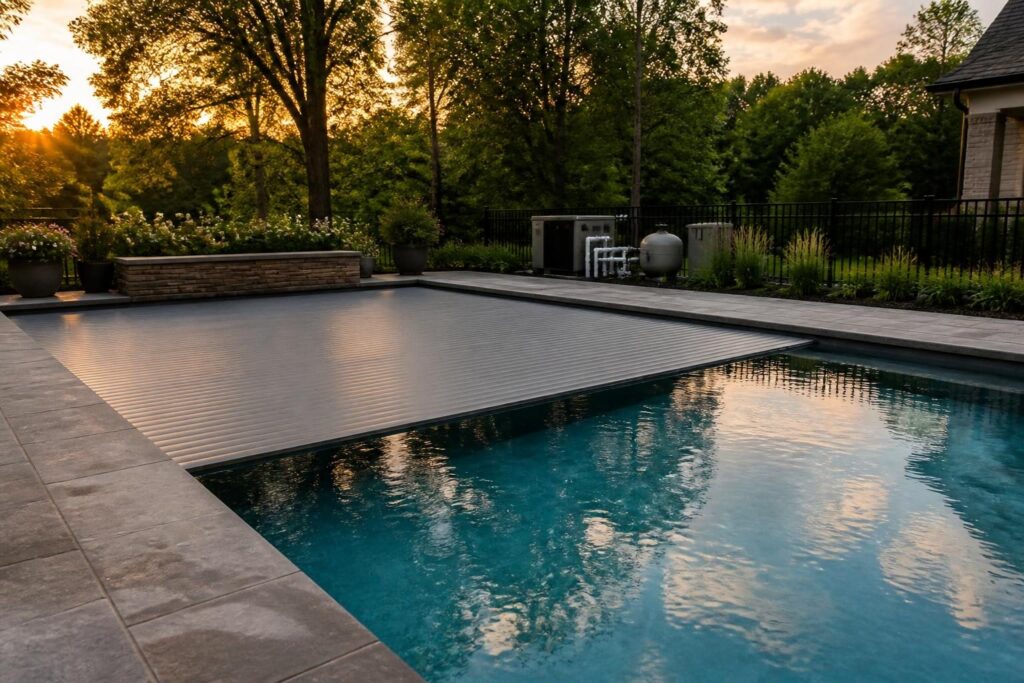
A pool cover energy savings comparison North Carolina homeowners can use should look beyond the cover’s purchase price. The right choice depends on evaporation, water temperature, safety needs, storage, fit, weather, and how consistently your household will use it.
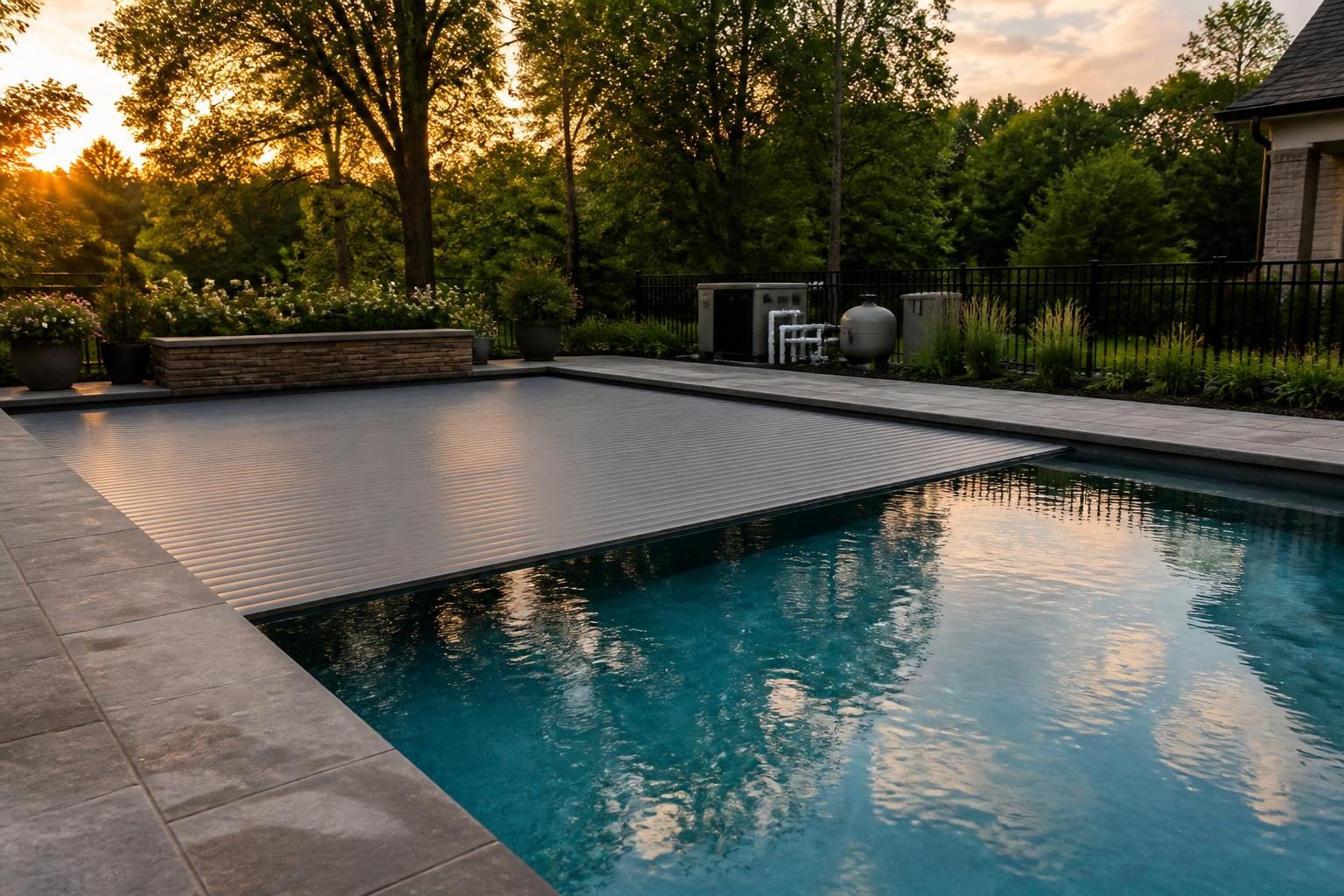
A cover can reduce heat loss and limit debris. It may also reduce some cleaning and water-treatment work. However, results depend on the cover design, installation quality, local conditions, and daily habits. Treat energy claims as planning information, not a guarantee of future savings.
Start with the energy problem a cover should address
Evaporation often creates the main energy concern. When water changes into vapor and leaves the pool, it carries heat with it. Replacing that water can also change the pool’s chemical balance and require additional heating.
A cover creates a physical layer over the water. That layer can slow evaporation when the pool is not in use. It may also reduce wind exposure and help retain heat overnight. The effect varies with air temperature, humidity, wind, water temperature, sunlight, and how much of the water surface remains uncovered.
North Carolina conditions differ by region and season. A coastal property may face different wind and humidity patterns than a home in the Piedmont or mountains. Shade, exposure, pool orientation, and the operating season matter as well.
- Ask whether the proposal discusses evaporation control or only general energy savings.
- Request the assumptions behind any savings estimate.
- Compare the expected use pattern, such as covering the pool nightly or only during travel.
- Consider whether the pool will be heated, cooled, or allowed to follow outdoor temperatures.
For broader heating decisions, see pool heater energy efficiency planning questions. A cover and a heater should work as one operating system, not as unrelated purchases.
Compare common pool cover types
Manual and solar-style covers
Lightweight floating covers often support evaporation control. Some absorb or transmit solar energy, while others focus mainly on limiting water loss. Their performance depends heavily on full surface coverage and regular use.
Manual covers usually need a reel or another handling method. The reel can make use easier, but it needs a suitable storage location. A cover that takes too much effort to remove may stay off the pool more often than planned.
Automatic covers
Automatic covers use a motorized mechanism to open and close the cover. Convenience may support more consistent use, especially when the system operates from a practical location. The system still needs correct installation, service access, and a place for the cover when open.
Pool geometry matters. Steps, benches, raised walls, unusual shapes, water features, and changes in pool width can affect how the cover travels. Ask the designer to explain which areas the cover reaches and which areas remain exposed.
Safety covers
Safety covers focus on load support and access control rather than energy performance alone. Some may help limit evaporation, but homeowners should not assume that every safety cover provides the same thermal benefit as a cover designed primarily for water-surface insulation.
Safety depends on the complete system, including anchors, springs or hardware, fit, installation, and use. Local requirements can vary. Review current requirements with the local inspections department and a qualified installer. The CPSC residential pool barrier guidance offers general safety information, but local code remains controlling.
Evaluate fit, coverage, and pool geometry
Fit affects energy and maintenance. Gaps around the edge expose water to wind and air movement. A poor fit can also allow leaves, pollen, and rainwater to reach the pool.
Ask for a drawing or specification that shows the intended coverage. Review the coping, deck, skimmers, steps, ladders, raised walls, and attached spas. Confirm whether the installer will custom-fit the cover and account for final pool dimensions.
- What happens if the pool shape changes during design?
- Will the cover system work with the planned steps and entry areas?
- Where will the mechanism, reel, or removed cover sit?
- How will runoff stay off the cover?
- What inspection or adjustment will the installer provide after installation?
Pool shape also affects handling. A simple rectangle may prove easier to cover than a free-form pool with curves and projecting features. A designer or installer should explain the tradeoff rather than treating every shape as equivalent.
Include storage and daily handling in the comparison
Energy performance depends on behavior. If a cover takes two people to remove, lacks a dry storage area, or blocks a walkway, your household may use it less often. That practical problem can outweigh a strong product specification.
Plan the storage location before construction. A manual reel may need a firm, level area. An automatic system may require a covered housing, concealed vault, or equipment space. Each option can affect deck layout, drainage, access, and visual appearance.
Keep the cover clean and free of sharp debris. Follow the manufacturer’s handling instructions. Do not drag a cover across rough surfaces unless the product instructions permit it. Store it to avoid unnecessary folding, standing water, heat damage, or contact with chemicals.
Ask who will operate the cover and when. A household that swims several times each day may value fast access. Another household may prefer a cover that stays closed for long periods. The best comparison reflects actual routines.
Separate energy performance from safety performance
A cover can support safer pool access, but it does not replace supervision, barriers, alarms, or household rules. Children and vulnerable swimmers need active protection. A closed cover does not give permission to leave the pool area unattended.
Ask whether the product serves as a safety cover, an evaporation cover, or both. Confirm the conditions for safe use. Some systems may require full closure before the cover can support its intended function.
Review the cover with your broader barrier plan. Doors, gates, fencing, alarms, and access controls may face local requirements. Build a Pool in North Carolina provides additional homeowner planning context in this pool barrier planning guide.
Compare water temperature and maintenance effects
A cover may help the pool hold heat between uses. That can support a more predictable heating plan. It does not create heat, and it can retain more heat than your household wants during hot weather.
Owners may need to uncover the pool, adjust heating controls, or use other cooling strategies. Ask how the proposed cover fits your temperature goals for spring, summer, and fall.
Less debris may reduce skimming and cleaning effort. Lower evaporation may reduce water replacement. Yet rain, pollen, storm debris, swimmer load, and chemical demand still require regular attention.
Cover use can also affect water chemistry. Reduced exposure may change how the pool responds to sunlight and dilution. Follow equipment and chemical manufacturer instructions, and use reliable testing practices. The CDC home pool water-treatment guidance provides general information about testing, chlorine, and pH.
Build a fair comparison for proposals
Commercial comparisons become more useful when each proposal answers the same questions. Avoid comparing one product’s purchase price with another product’s complete installed cost.
| Comparison area | Questions to ask |
|---|---|
| Coverage | Does the cover fit the full water surface, including steps and special features? |
| Operation | How many people are needed, and how long does opening or closing typically take? |
| Energy | What evaporation and temperature assumptions support the performance discussion? |
| Safety | Does the system support safety, evaporation control, or both? |
| Storage | Where does the cover go when the pool is open? |
| Maintenance | What cleaning, inspections, adjustments, and replacement parts will you need? |
| Integration | How does the system work with the heater, pump controls, drainage, and deck? |
Put the answers in the proposal or contract. The North Carolina pool builder contract checklist can help organize questions about scope, responsibilities, exclusions, and changes.
Use an owner-habit test before choosing
Imagine a normal week rather than an ideal week. Would someone close the cover after every swim? Could one person operate it safely? Would the cover remain closed during workdays, overnight, or travel?
- Record when the pool is usually used.
- Note when wind, shade, or direct sun affect the pool.
- Identify who will handle the cover.
- Plan where wet equipment and debris will go.
- Decide how you will check the cover after storms or heavy rain.
- Keep manuals, model information, installation records, and service contacts together.
Review the plan after the first operating season. Note how often the cover was used, whether water temperature matched expectations, and which maintenance tasks changed. Those records can guide service decisions without relying on memory.
Make the decision locally and realistically
The strongest pool cover energy savings comparison North Carolina homeowners can make combines product details with site conditions and household behavior. A lower-cost cover may work well if your household uses it consistently. A more automated system may help when convenience supports regular closure. Neither conclusion applies to every property.
For a useful pool cover energy savings comparison North Carolina, confirm the design, installation method, safety role, storage plan, drainage details, equipment controls, and service expectations. Requirements may vary by jurisdiction, property conditions, adopted code, utilities, flood exposure, and project scope.
Use this pool cover energy savings comparison North Carolina framework when reviewing proposals, but treat product claims as estimates until their assumptions are documented.
Consult the local inspections department for current requirements. Ask a licensed pool contractor about fit and installation, an electrician about powered equipment, and an engineer or surveyor when site conditions affect the design. A septic professional may also help where the cover system, deck, drainage, or pool layout interacts with a septic area.