
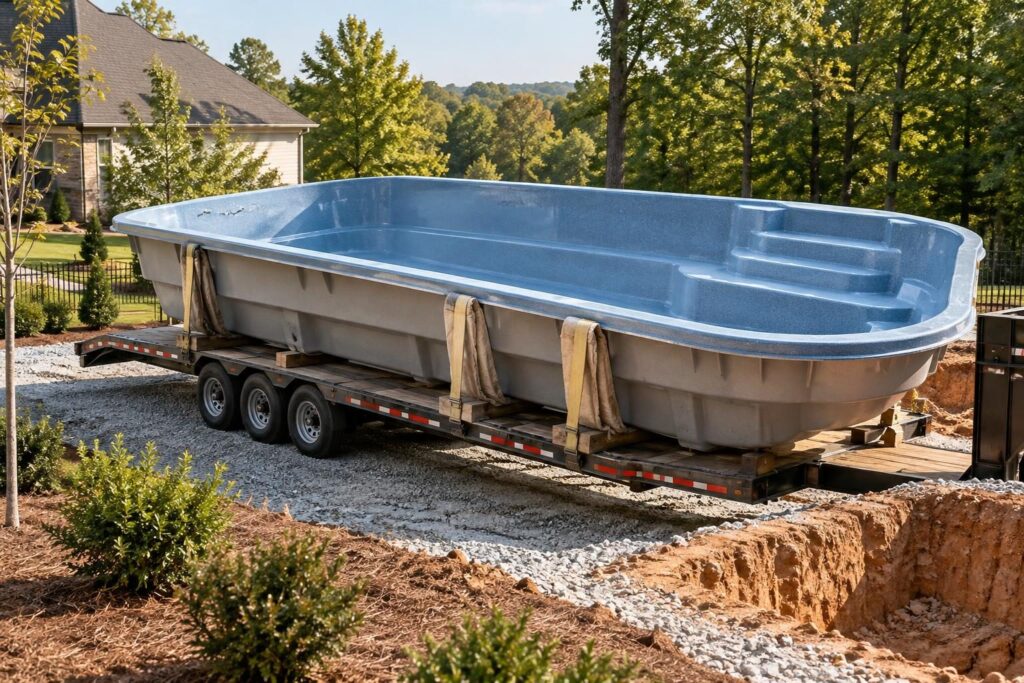
A fiberglass pool delivery condition checklist helps you record what arrived before installation changes what you can see. For North Carolina homeowners, that means matching the shell to the order and documenting accessible surfaces. It also means requesting qualified review when something looks questionable. Your role is observation and recordkeeping—not directing a lift or deciding whether a shell is structurally sound.
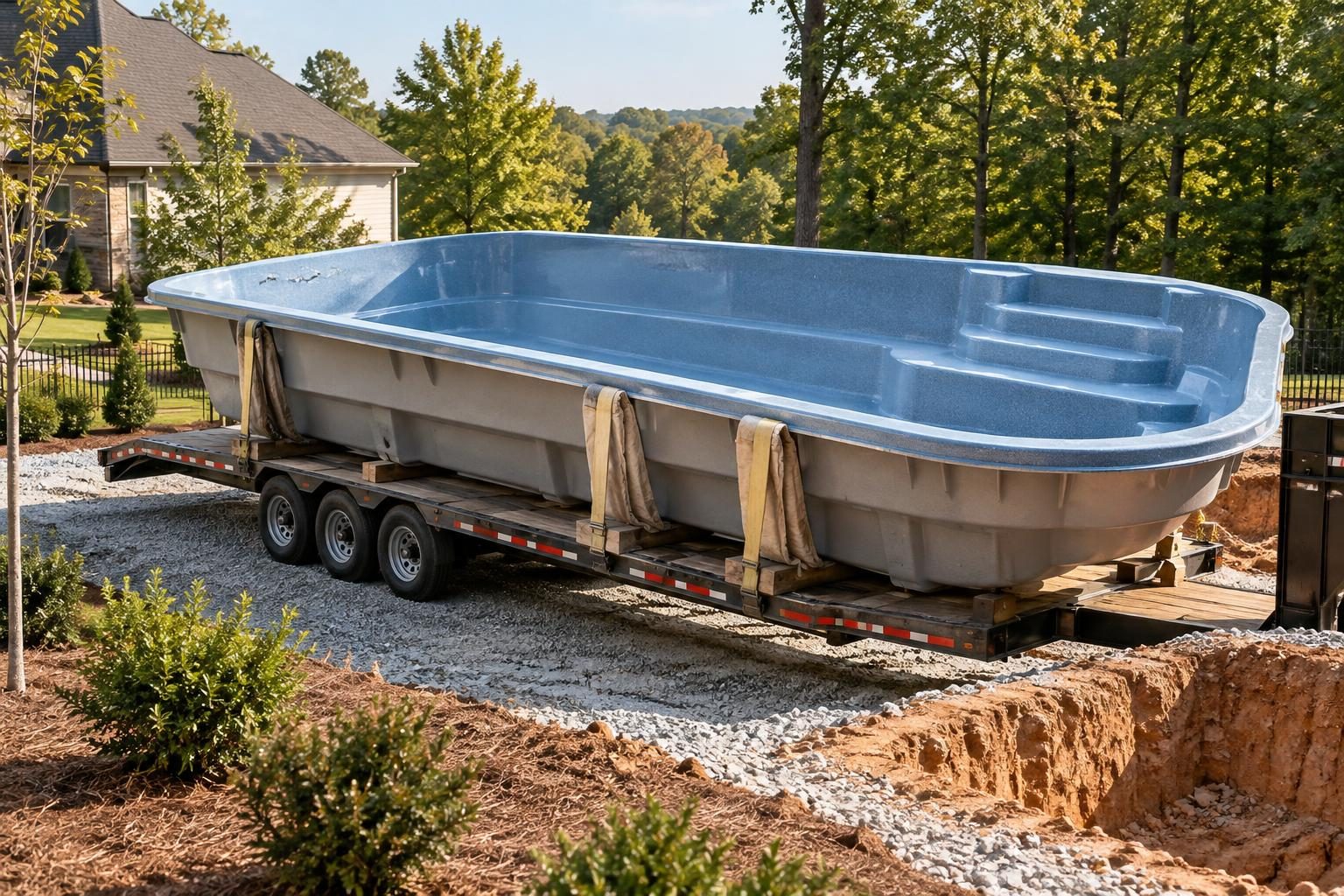
Delivery photos create a useful baseline, but they cannot prove that every surface is undamaged. Keep that distinction clear in notes, signatures, and conversations with the installer.
Arrange the delivery review before the truck arrives
Ask the installer how delivery documentation will fit into the work sequence. Establish a safe observation location and a contact person before equipment starts moving. Share your fiberglass pool delivery condition checklist with that contact before delivery. Do not assume the delivery schedule includes a homeowner walkthrough.
Your written plan should answer these questions:
- Who checks the shell against the purchase order and approved selections?
- Which team member records its condition before unloading, where safely possible?
- Who contacts the manufacturer about visible concerns?
- Which person decides whether placement should wait for review?
- Who documents concealed areas that homeowners cannot safely see?
- How will delivery paperwork and any carrier damage report be handled?
Request the applicable manufacturer handling instructions and damage-reporting process. Confirm who handles temporary storage if placement cannot proceed. Avoid improvising these responsibilities around an active truck or crane.
Keep the approved order with your product selections and material records. The NC Licensing Board’s home-improvement contract guidance also provides a useful starting point for broader contractor and contract due diligence.
Keep observation outside the lifting zone
Ask the site supervisor where you may stand. Stay outside equipment travel paths, restricted work areas, and the shell’s lifting route. Never walk beneath a suspended shell or approach it for a better photograph.
Do not climb onto the trailer, enter the shell, lean over an excavation, or reach beneath shipping supports. Keep children, pets, and visitors away from delivery operations. A camera’s zoom is useful; access restrictions still control.
If you cannot see a surface safely, record it as not observed. Ask the installer to arrange photographs when trained personnel can safely access it. Do not request a photo that requires someone to stand beneath a load.
Discuss concerns through the designated supervisor. Never step into an equipment path to stop work or distract an operator. If a concern arises during a lift, let the crew manage the load safely. Your request should concern review before the next installation step, not an improvised mid-lift inspection.
Match the fiberglass shell to the approved order
Begin the fiberglass pool delivery condition checklist with identification, not surface appearance. A clean-looking shell still needs to match the project documents.
- Record the manufacturer and model shown on the delivery paperwork.
- Request a photograph of any safely accessible serial number or identification label.
- Compare the model with the signed order and approved drawings.
- Check the listed finish selection against your selection record.
- Compare visible steps, benches, and ledges with the approved configuration.
- Save the delivery ticket and related order reference.
Do not climb up to locate a label or measure the shell yourself. Ask the installer where identification appears for that product. If there is no accessible label, request another manufacturer-supported way to connect the shell to your order.
Lighting, protective coverings, and dust can affect finish appearance. Record any apparent mismatch without declaring that the wrong finish arrived. Ask for written confirmation rather than relying only on a verbal description.
Record accessible shell surfaces without diagnosing damage
Photograph what you can see from approved locations. Depending on access, this may include the interior finish, upper rim, steps, benches, and exposed exterior surfaces. The gelcoat is the shell’s smooth interior surface finish.
Look for visible conditions worth asking about:
- Chips, scratches, gouges, or crack-like lines.
- Areas where underlying material appears exposed.
- Unexpected discoloration or patch-like areas.
- Visible damage around openings or projecting edges.
- Areas obscured by wrapping, dirt, shadows, or supports.
Describe appearance rather than cause. Write “thin line visible beside entry step,” not “structural crack from shipping.” A photograph alone may not establish when a condition developed or what it means.
Take an overview and a closer image using zoom when needed. Identify the location by a recognizable feature, such as the entry steps. Do not scratch, tap, sand, clean with solvents, or remove coverings to investigate.
Preserve original image files. Keep annotated copies separately so arrows and labels do not obscure the original evidence.
Document shipping supports without touching them
Shipping supports hold the shell during transport or storage. Their arrangement depends on the product and handling system. Homeowners should not judge support adequacy from appearance alone.
From the designated observation area, record the visible support arrangement and protective materials. Photograph any visibly broken support, displaced padding, or apparent contact mark that raises a question. Include a wider view showing where it sits relative to the shell.
Ask the installer whether the arrangement matches the manufacturer’s handling guidance. Request a written explanation when something appears inconsistent. Do not loosen restraints, move blocks, adjust straps, or try to straighten the shell.
Hidden contact areas belong on the unobserved list. Ask the installer to document them after safe unloading, before they become concealed. An unfamiliar support arrangement is a reason to verify—not proof of damage or improper handling.
Request installer and manufacturer review before placement
Use the fiberglass pool delivery condition checklist to separate routine records from unresolved concerns. A model mismatch, apparent break, exposed underlying material, or unexplained repair-like area warrants prompt installer attention.
Ask for manufacturer review before placement when the concern could affect installation, performance, repairability, or warranty coverage. Include clear photographs, identification records, and a neutral description. If the installer calls something cosmetic, ask what supports that conclusion and whether manufacturer confirmation is appropriate.
Request a written response covering:
- What was reviewed and who reviewed it.
- Whether additional examination is needed before placement.
- Whether repair, replacement, or no correction is recommended.
- Who is authorized to perform any repair.
- How completion will be documented and reviewed.
- Whether the proposed action affects warranty terms.
A verbal assurance or hurried repair is a reason to seek clarification, not proof of wrongdoing. Independently confirm important manufacturer representations through a verified contact. Photographs may not resolve the concern; qualified on-site evaluation may be necessary.
Keep delivery signatures and payment decisions separate
Read delivery forms before signing. Ask whether a signature acknowledges receipt, condition, quantity, or something broader. Do not certify that inaccessible surfaces were inspected.
Where the form permits, record specific visible concerns and observation limits. Keep a copy of the completed document. Follow the applicable reporting process promptly, and verify deadlines in the actual contract and manufacturer documents.
Arrival, unloading, placement, and acceptance may represent different contract events. Compare any invoice with your written payment milestone. The payment documentation checklist can help organize that comparison.
If the payment request and contract do not align, ask for a written explanation. Do not assume delivery automatically triggers payment, or that a concern automatically permits withholding it. Seek legal advice when contractual rights or obligations remain unclear.
Close each concern with a traceable record
Keep the fiberglass pool delivery condition checklist with the order, delivery ticket, photographs, and written communications. Assign each concern a simple identifier. Record its location, date observed, reviewer, recommendation, and current status.
For any correction, retain before-and-after photographs and the repair record. Ask who reviewed the completed work and what remains unresolved. Preserve written approvals before placement or covering work hides the area.
North Carolina requirements can vary by jurisdiction, property conditions, adopted code, utilities, septic systems, flood zones, and project scope. Delivery documentation does not replace required inspections. Consult the local inspections department about current requirements and applicable contractor licensing. Use a licensed pool contractor and the manufacturer for shell questions. Seek a qualified engineer when structural evaluation is needed; homeowner photographs are not a structural assessment.