
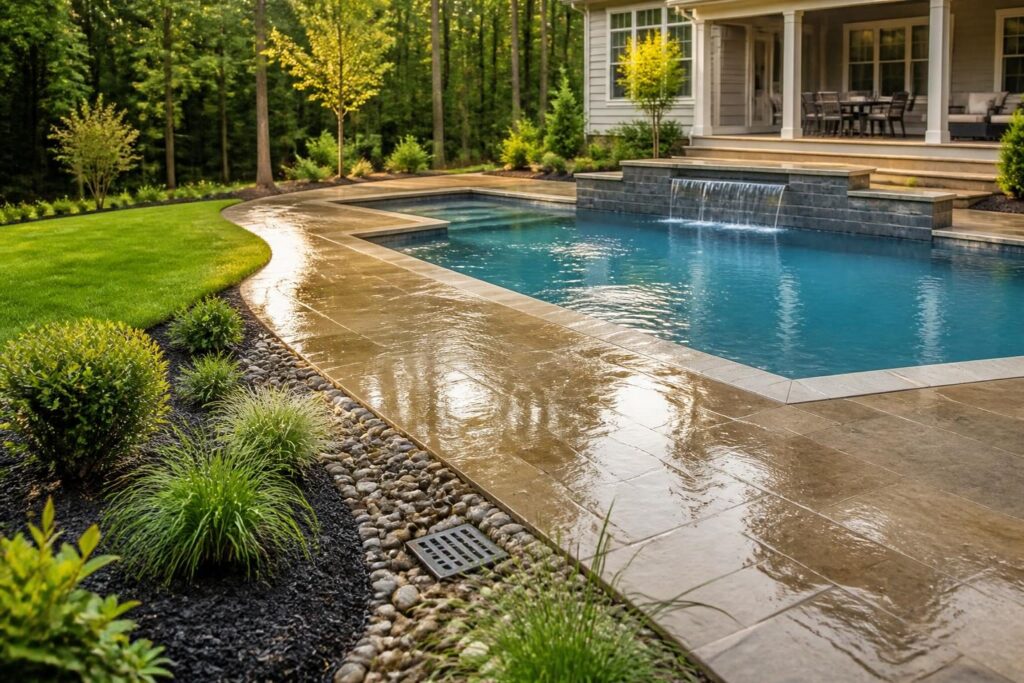
Pool grading after construction North Carolina deserves a careful homeowner review. Once backfilling, soil placement, and landscaping finish, the yard may look complete while drainage patterns continue to develop. A practical review compares the finished work with the approved or current plan, watches how water moves during rain, and preserves clear records.

Grading is the shaping of soil and other surfaces to guide water. Around a pool, it affects the relationship between the pool deck, house, walkways, equipment area, planting beds, neighboring property, and planned drainage features. That is why pool grading after construction North Carolina should focus on evidence rather than appearance alone. Gather useful observations and ask the right qualified professional to interpret them.
Why finished pool grades deserve a separate review
Construction changes the ground in several stages. Excavation removes soil. Backfilling replaces soil around the pool structure. Deck work adds hard surfaces. Landscaping can then add topsoil, mulch, plants, edging, and irrigation. Each layer can change how rainwater travels.
Some settling may occur after soil placement. Heavy rain can expose low spots, wash soil toward a drain, or leave sediment near the pool deck. Irrigation can also create flow that does not appear during a storm. These observations do not prove defective work. They show where more information may help.
North Carolina conditions vary by jurisdiction, lot shape, soil, slope, flood risk, septic design, adopted requirements, and project scope. A plan may also change during construction. Keep the latest approved or agreed drawing, not only an early concept sketch.
Compare the completed yard with the plan
Start with the plan set and project records. Look for grading arrows, spot elevations, contour lines, swales, drains, channels, retaining features, and discharge points. A spot elevation is a stated height at a specific location. A contour line connects locations with the same elevation.
Do not assume every line on a drawing is easy to verify with a tape measure. Some locations require surveying equipment or professional interpretation. Your role is to identify visible differences and preserve the reference documents.
Use a comparison checklist
- Confirm that you are reviewing the latest plan revision.
- Mark the pool edge, deck edge, house walls, doors, walkways, equipment pad, planting beds, and property boundaries.
- Note whether planned swales, drains, channels, walls, steps, or berms appear in the finished yard.
- Compare visible low areas with locations shown on the plan.
- Record features that workers moved, added, removed, or covered with landscaping.
- Ask which finished elevations someone measured and who performed that work.
Request any available as-built information. “As-built” means a record of what workers actually installed, rather than what the original proposal showed. Depending on the project, it may show final elevations, drainage features, utilities, or construction changes.
If the plan uses professional elevation data, avoid changing soil based on a visual guess. A surveyor, engineer, or qualified pool professional can determine whether a visible difference matters and which measurement method fits the site.
For additional context, review the planned drainage outlet and discharge route alongside the completed grading. The outlet location alone does not show whether surrounding grades guide water toward it.
Observe water flow during and after rain
The most useful homeowner observations often happen during ordinary rain. Do not enter flooded areas, stand near exposed electrical equipment, or walk on unstable soil. Watch from a safe location and wait for conditions to improve before inspecting the yard closely.
Observe where water first appears, where it travels, and where it remains. Look at the area between the house and pool, the deck perimeter, steps, gates, planting beds, equipment pad, and lower parts of the lot. Check whether soil or mulch moves toward the pool or a building.
What to record safely
- Date and approximate time of the observation.
- Whether rain was light, steady, or intense.
- Areas where water collected or changed direction.
- Any visible sediment, mulch, soil movement, or exposed roots.
- Whether water approached doors, the foundation, the pool, or equipment.
- How long standing water remained, if you can observe without guessing.
- Photos or video taken from the same safe viewpoints.
Photograph conditions before cleaning or reshaping anything. Include a wide view for context and closer views for soil movement, ponding, or washed-out areas. Place a fixed object in the scene for scale when safe, but do not disturb the ground to create a comparison.
For broader stormwater context, review the NC DEQ Erosion and Sediment Control Manual. It provides state guidance related to erosion and sedimentation during land-disturbing work. It does not replace a property-specific evaluation or local direction.
Inspect the transition from pool work to landscaping
Backfilling and landscaping create several transition zones. These include soil beside the pool shell, the edge below the deck, planting beds beside hard surfaces, and areas near downspouts or irrigation. These transitions can settle or change as workers install plants and homeowners water the soil.
Look for visible separation, depressions, exposed construction material, or soil that sits higher than a door threshold or deck edge. Keep the inspection visual. Do not probe around the pool shell, move structural soil, or excavate near utilities without professional direction.
Mulch can hide low spots and move during storms. Dense groundcover may also make future changes harder to see. Ask how the finished landscape design should work with the grading plan and whether maintenance will preserve the planned flow.
Downspouts and irrigation deserve attention because they can create concentrated water. Confirm that their discharge does not undermine soil, flood the equipment area, or send runoff toward the pool. Have a qualified professional review any proposed change to a discharge route.
Build a useful photo and record system
Good records make later conversations clearer. Create one folder for final plans and another for field observations. Use filenames that include the date, location, and subject. For example, “2026-09-12-east-deck-ponding” is more useful than “IMG_2048.”
Keep original files. Editing a copy for annotations can help, but retain the unedited photo and note what you added. If you use video, record a short explanation of the viewpoint and weather conditions. Avoid filming people or neighboring property when it is unnecessary.
Records worth keeping
- Latest plan revisions and approved drawings.
- Written grading or drainage details supplied for the project.
- As-built drawings, survey notes, or elevation records, if provided.
- Change orders and written decisions affecting soil, drains, walls, or landscaping.
- Backfill, compaction, drainage, and landscaping documentation, if available.
- Rain observation notes, photos, and videos.
- Messages that identify dates, locations, and requested evaluations.
- Inspection records and final approvals that apply to the project.
For permit and inspection paperwork, the article North Carolina Pool Permit Inspection Records explains how homeowners can organize those materials. Keep grading observations separate from official inspection conclusions unless the relevant authority has issued them.
Ask focused questions before requesting changes
When you notice a concern, describe the location and conditions instead of assigning a cause. Clear questions help the project team respond to the same evidence you observed.
- Which plan revision shows the finished grading in this area?
- Did the team document final elevations or drainage features after backfilling?
- What water route should carry flow between the house, pool, and lower yard?
- Could this area settle, and how should you monitor it?
- Which professional should evaluate the condition?
- Could landscaping, irrigation, or downspout discharge affect the observation?
- What temporary protection makes sense while the area receives review?
Keep the discussion tied to records. Ask for a written response that identifies the observation, references the relevant plan or detail, and explains proposed follow-up. If the response requires technical judgment, request the name or role of the qualified professional responsible for that evaluation.
Know when local or technical review is needed
North Carolina stormwater and erosion requirements can depend on the amount and type of land disturbance, location, project scope, and local administration. The NC DEQ Construction Stormwater Program offers general state information. Confirm current requirements with the local inspections department or other applicable authority.
Contact a qualified specialist when water repeatedly approaches the home, undermines soil, affects a retaining feature, reaches electrical equipment, exposes utilities, or crosses a property boundary. Depending on the issue, that may include a licensed pool contractor, engineer, surveyor, landscape professional, drainage specialist, septic professional, or electrician.
Pool grading after construction North Carolina works best as an evidence-gathering process. Compare the latest plan, observe water safely, photograph changing conditions, and preserve the project record. Build a Pool in North Carolina can help homeowners frame those questions, but local authorities and qualified professionals must address property-specific requirements and technical conclusions.
For pool grading after construction North Carolina, consult the local inspections department when requirements or approvals are unclear. Use a licensed pool contractor, electrician, engineer, surveyor, septic professional, or other qualified specialist when site conditions require technical review.